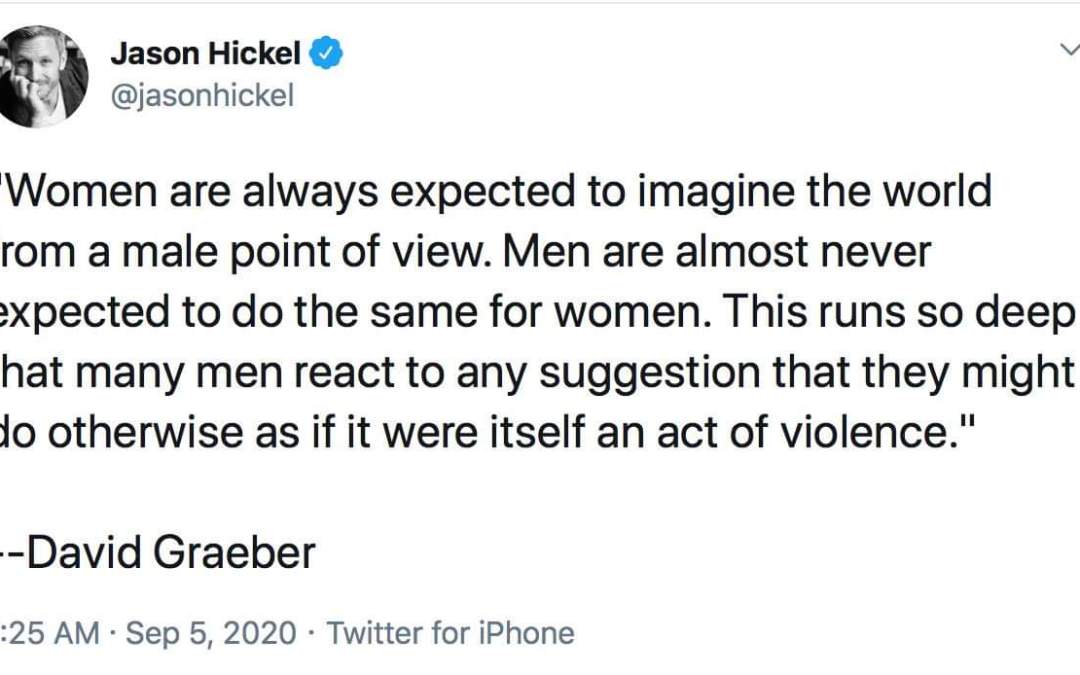
*On social media I follow a comedian who goes by the name (title?) of God, in part because I love the idea of my atheist ass being a follower of a (another) fake god. Plus, she’s funny (could be a man, could be a woman, I choose woman as my false deity). Not hahahahaha funny but ironic and sarcastic and, at times, provocative funny. A while back, she posted a question to her 3.2 million followers: Men, what do you think would be the worst thing about being a woman? And, I prepared for the worst, or at least a lot of superficial nonsense and snark (bras!), but hey, whaddayaknow, I was very pleasantly surprised by how great the answers were, as in very great, very aware, and very smart as well as respectful. Yay.
Here are a few of the best, because we give credit where credit is due, and because the internet is so often such a cesspool YET… it is also place where formerly marginalized communities and humans come together to create awareness, to communicate and support one another, to organize, and to show us all, via these platforms and the activism that can and does result, the possibility of a better present and future. Yay. Sometimes the internet doesn’t suck.
Caleb: A society that systemically caters to men. Being mansplained to. Feeling unsafe. Wondering about every guy’s intentions, no matter the situation. Being held to higher standards and targeted for failures in ways men never would. Having so little true representation in government, film, corporate leadership, etc. I could go on for a while, but these are the ones that jumped out to me first. And as aware as a lot of us are of these things, I think we also realize we still have plenty of blind spots and we don’t live with it every day. It’s really easy to have that awareness, but still enjoy life in a world where these are not our problems.
Nathaniel: Let’s see everyone is saying period, however I would not want to experience child birth.I would least like the fact that I might not get to grow up completely before becoming pregnant against my will then being denied a choice on whether or not I kept the child then being forced to go through child birth. Then being judged by the same people who denied me my choice. That is what I would like the least.
Mick: Periods and men.
Matt: Being expected to bear children.
Mario: Being alone in the dark. Getting often times paid less than my male coworkers. Being catcalled on a daily basis. Having much more pressure to look good. Not being taken seriously because of being reduced to my looks or simply out of misogyny
Jeremy: I know most of my top picks have already been called out so I’ll go with the next one on the list: having the concerns you have about your health being dismissed
Justin: Being a second class citizen.
Kyle: Constant fear that both strangers and intimate partners could hurt/kill me.
Erik: Less pay for doing the same work, being treated like a second class citizen, having some @hole try to explain things I already know, being told to smile.
Multiple men but especial credit to Nick for getting it: Having to choose the bear. This hit me in the feels like it was meant to. I get it
Scott: The weird stuff my body would do honestly. Periods seem like a 40 year monthly subscription to the worst magazine ever.
Joe: The Supreme Court of the United States
JD: No pockets. (this may seem silly, but the pain of no pockets – or girlie pockets that can’t even warm your hands, FFS, let alone hold a wrench, is REAL)
Luke: Living in 2024 and still being treated as an object instead of an equal human being, like we see all over constantly still.
Blake: Childbirth.
Richard: I can’t imagine how much periods must suck. Also, high heels. How do you not break an ankle or something in those. I mean yeah, they look great but jfc.
Philip: Misogyny, violence, periods
R. Philip: Watching people we love be supportive of leadership that would see us destroyed in every possible way.
Matt M.: I’m going to guess dealing with us men. God bless em for putting us with us, I couldn’t do it
Kevin: Being a second class human being under the law because of someone else’s religious beliefs.
Kyle K.: Probly the overall disrespect, constant danger, man-splaining/spreading, and general inequality. Or periods.
Lukas M.: Being attracted to my only natural predator. Having to answer questions about my wardrobe when undergoing post-rape care. Constantly being underestimated. Being expected to do most of the housework/child raising WHILE working full-time. Not being able to exist without men constantly evaluating my “fuckability.”
Stoakley: Fearing men physically. I’m 6’2″ 400lbs I’m not a fighter but it’s been 35 or 40 years since I’ve felt physically afraid of anyone. Having my opinions or knowledge dismissed out of hand. Being patronized.
Baruch: After living and working with women and hearing quite a lot of things they have said, it is probably a tie between men who see them as objects for their use rather than people, and the lack of decent pockets.
Andy: Being told, by men, what I can, and cannot, do with my body.
Mike B.: The lack of bodily autonomy. Not having full agency over my body would be a constant burden. The state controlling my reproductive system, the threat and reality of never feeling fully safe from violence, having my health concerns not taken seriously, a range of insults and indignities, small, large, and existential.
Brian P.: Not being taken seriously by half the population, politicians trying to regulate their bodies, literally to the point of death, guys being predatory, violent, and guys witnessing that behavior and doing nothing, double standards…
Tom H.: I am unable to rank these as they are all bad. Dealing with the patriarchy and the pay gap. Worrying about being attacked and raped. Worrying about victim blaming and forced birth following a rape. Having men try to control my body and reproductive health. Having to deal with puberty, menstrual cycle, and severe cramping and other health-related issues. Dealing with men staring at me, catcalling, and seeing me as an object to possess rather than a fellow human.
Richard M.: Periods, menopause, dealing with men, dealing with other women, always having to be on the lookout for hidden ulterior motives, always being expected to do things like housework, listening to other people talk (being expected to “be there” for others, a LOT), being expected to babysit, being expected to care about fitting in…
Thanks, guys – now, do better, support women, and call out your gender brothers on their shitty behavior, votes, attacks on women, expectations, cat-calling, mansplaining, micro-aggressions, unconscious biases, and anything else that contributes to harms to women and girls.
Never heard of her. Nope. Not a clue. But then – a recent show in New York (at the Neue Gallery until 9/9/24, so there’s still time, y’all, if’n you’re close – and inspired – enough), a dive into wiki, and a long rabbit hole run down a number of the paintings she produced in her short life and voila – what a incredible artist, gone much too soon. Born in Germany in 1876, Becker died in 1907 at only 31, which makes her output and impact even more impressive, even more so despite the Nazi’s destroying, repressing, or hiding many of her ‘degenerate’ works decades after her death.
How and why did Paula Becker die so young? After giving birth, and being told by her doctor to stay in bed in order to ‘rest and recover’ – women being so delicate and all. Think about this, for literal eons women had to give birth while continuing to move and forage and work in fields or wherever and yet, in the Victorian into the 20th century/modern era, because our collective gender was deemed fragile, women were told by medical professionals, not one of whom would ever give birth, to lie down and stay down. Gack. Eve, byCat Bohannon informs all of this, if you’re interested in the literal biological and cultural history of women, birthing and evolution. This rest in bed prescription, common at the time, most likely killed Becker as the embolism that traveled from her leg to her lungs and heart might have been prevented by the simple act of getting up and walking around post-partum. Sigh.
Becker, known as Modersohn-Becker after her marriage, was the first known woman painter to paint nude self-portraits, and the first woman to have a museum devoted exclusively to her art, the Paula Modersohn-Becker Museum, founded 1927, in Bremen. Additionally, she is considered to be the first woman artist to depict herself both pregnant and – gasp! – nude and pregnant, which portraits are among the reasons those pesky Nazis considered her and her works degenerate. The primary reason they did, however, was that the Nazis were ignorant, sexist pigs in addition to most of them being conservative misogynistic Catholics.
Her work is revolutionary; Becker was an impressionist, and if you’re interested in taking a look at her paintings, you will be reminded of the work of Cezanne, Mattisse, Pissarro and Manet, artists who did not die in childbirth, and whose work – also impressionistic – is much better known than that of Becker’s, perhaps in part because they lived a lot longer, and in places where the Nazi ideology was a visitor, ‘only’.
The pro-forced birth crowd like to decry abortion because ‘how many doctors have been aborted, docs might have found the cure for cancer!!” Yup, Sure. I know like I know like I know that it is much more likely that actual living women whose opportunities were denied or limited, whose lives were cut short by childbirth, by domestic violence, by a thousand cuts of other kinds were actual losses we can no longer stand. When 50% of a population anywhere at any time is being held back or erased by gender ideology or violence, we all lose.
Paula Becker was a friend of the poet Rainier Maria Rilke, who both wrote and dedicated his poem Requiem for a Friend in her memory on the first anniversary of her death. Her portrait of Rilke is posted below; I love it. Here are two excerpts from that very long poem, although some say it is a letter, and not poetry at all – but, can’t it be both? I think it can, and is:
“I have my dead and I have let them do and was amazed to see them so contented, so at home in being dead, so cheerful, so unlike their reputation. Only you return; brush past me, loiter, try to knock against something, so that the sound reveals your presence. Oh don’t take from me what I am slowly learning. I’m sure you have gone astray if you are moved to homesickness for anything in this dimension. We transform these Things; they aren’t real, they are only the reflections upon the polished surface of our being.”
“If you are still here, if in this darknessthere is still a place where your sensitive spiritresonates on the shallow waves of a voice, isolated in the night,vibrating in the high room’s current:then hear me: help me. See, we can slip back sounknowingly, out of our forward stride,into something we didn’t intend: findthat we’re trapped there as if in dreamand we die there, without waking.No one is far from it. Anyone who has firedtheir blood through work that endures,may find that they can no longer sustain itand that it falls according to its weight, worthless.For somewhere there is an ancient enmitybetween life and the great work.Help me, so that I might see it and know it.Come no more. If you can bear it so, bedead among the dead. The dead are occupied.But help me like this, so you are not scattered,as the furthest things sometimes help me: within.” – translator, A.S. Kline
*Esther Greenwood, is, of course, the main character of Sylvia Plath’s The Bell Jar. I confess, I avoided this slim novel forever – until just last month, because it was, I knew, about an intelligent, troubled young woman, written by an author who took her own life in 1963. I had read her poems, I had read quite a lot about her, but this autobiographical or semi-autobiographical novel? No. And then, recently, there it was in a little free library, and why not? Why not now? Esther – late in the novel, experiences sex for the first time, and thus, I share it here as a part of The First Time Project. The book is, by the way, dated, yet still very fresh, poignant, powerful, immediate, and moving.
..I murmured, “You know, Irwin, I think I ought to tell you, I’m a virgin.”
Irwin laughed and flung me down on the bed.
A few minutes later an exclamation of surprise revealed that Irwin hadn’t really believed me. I thought how lucky it was I had stared practicing birth control during the way, because in my winey state that night I would never have bothered to perform the delicate and necessary operation. I lay, rapt and naked, on Irwin’s rough blanket, waiting for the miraculous change to make itself felt.
But all I felt was sharp, starlingly bad pain.
“It hurts,” I said, “Is it supposed to hurt?”
Irwin didn’t say anything. Then he said, “Sometimes it hurts.”
After a little while Irwin got up and went into the bathroom, and I heard the rushing of shower water. I wasn’t sure if Irwin had done what he planned to do, or if my virginity had obstructed him in some way. I wanted to ask him if I was still a virgin, but I felt too unsettled. A warm liquid was seeping out between my legs. Tentatively, I reached down and touched it.
When I held my hand up to the light streaming in from the bathroom, my fingertips looked black.
“Irwin,” I said nervously, “bring me a towel.”
Irwin strolled back, a bathtowel knotted around his waist, and tossed me a second, smaller towel. I pushed the towel between my legs and pulled it away almost immediately. It was half black with blood.
“I’m bleeding!” I announced, sitting up with a start.
“Oh, that often happens,” Irwin reassured me. “You’ll be all right.”
Then the stories of blood-stained bridal sheets and capsules of red ink bestowed on already deflowered brides floated back to me. I wondered how much I would bleed, and lay down, nursing the towel. It occurred to me that the blood was my answer. I couldn’t possibly be a virgin any more. I smiled into the dark. I felt part of a great tradition.
Surreptitiously, I applied a fresh section of white towel to my wound, thinking that as soon as the bleeding stopped, I would take the late trolley back to the asylum. I wanted to brood over my new condition in perfect peace. But the towel came away black and dripping.
“I … think I better go home,” I said faintly.
“Surely not so soon.”
“Yes, I think I better.”
I asked if I could borrow Irwin’s towel and packed it between my thighs as a bandage. Then I pulled on my sweaty clothes. Irwin offered to drive me home, but I didn’t see how I could let him drive me to the asylum, so I dug in my pocketbook for Joan’s address. Irwin knew the street and went out to start the car. I was too worried to tell him I was still bleeding. I kept hoping every minute that it would stop.
But as Irwin drove me through the barren, snow-banked streets I felt the warm seepage let itself through the dam of the towel and my skirt and on to the car seat.
As we slowed, cruising by house after lit house, I thought how fortunate it was I had not discarded my virginity while living at college or at home, where such concealment would have been impossible.
Joan opened the door with an expression of glad surprise. Irwin kissed my hand and told Joan to take good care of me.
I shut the door and leaned back against it, feeling the blood drain from my face in one spectacular flush.
“Why, Esther,” Joan said, “what on earth’s the matter?”
I wondered when Joan would notice the blood trickling down my legs and oozing, stickily, into each black patent leather shoe. I thought I could be dying from a bullet wound and Joan would still stare through me with her blank eyes, expecting me to ask for a cup of coffee and a sandwich.
“Is that nurse here?”
“No, she’s on night duty at Caplan….”
“Good.” I made a little bitter grin as another soak of blood let itself through the drenched padding and started the tedious journey into my shoes. “I mean … bad.”
“You look funny,” Joan said.
“You better get a doctor.”
“Why?”
“Quick.”
“But…”
Still she hadn’t noticed anything.
I bent down, with a brief grunt, and slipped off one of my winter-cracked black Bloomingdale shoes. I held the shoe up, before Joan’s enlarged, pebbly eyes, tilted it, and watched her take in the stream of blood that cascaded on to the beige rug.
“My God! What is it?”
“I’m hæmorrhaging.”
Joan half-led, half-dragged me to the sofa and made me lie down. Then she propped some pillows under my blood-stained feet. Then she stood back and demanded, “Who was that man?”
For one crazy minute I thought Joan would refuse to call a doctor until I confessed the whole story of my evening with Irwin and that after my confession she would still refuse, as a sort of punishment. But then I realized that she honestly took my explanation at face value, that my going to bed with Irwin was utterly incomprehensible to her, and his appearance a mere prick to her pleasure at my arrival.
“Oh somebody,” I said, with a flabby gesture of dismissal. Another pulse of blood released itself and I contracted my stomach muscles in alarm. “Get a towel.”
Joan went out and came back almost immediately with a pile of towels and sheets. Like a prompt nurse, she peeled back my blood-wet clothes, drew a quick breath as she arrived at the original royal red towel, and applied a fresh bandage. I lay, trying to slow the beating of my heart, as every beat pushed forth another gush of blood.
I remembered a worrisome course in the Victorian novel where woman after woman died, palely and nobly, in torrents of blood, after a difficult childbirth. Perhaps Irwin had injured me in some awful, obscure way, and all the while I lay there on Joan’s sofa I was really dying.
Joan pulled up an Indian hassock and began to dial down the long list of Cambridge doctors. The first number didn’t answer. Joan began to explain my case to the second number, which did answer, but then broke off and said “I see” and hung up.
“What’s the trouble?”
“He’ll only come for regular customers or emergencies. It’s Sunday.”
I tried to lift my arm and look at my watch, but my hand was a rock at my side and wouldn’t budge. Sunday—the doctor’s paradise! Doctors at country clubs, doctors at the seaside, doctors with mistresses, doctors with wives, doctors in church, doctors in yachts, doctors everywhere resolutely being people, not doctors.
“For God’s sake,” I said, “tell them I’m an emergency.”
The third number didn’t answer and, at the fourth, the party hung up the minute Joan mentioned it was about a period. Joan began to cry.
“Look, Joan,” I said painstakingly, “call up the local hospital. Tell them it’s an emergency. They’ll have to take me.”
Joan brightened and dialled a fifth number. The Emergency Service promised her a staff doctor would attend to me if I could come in to the ward. Then Joan called a taxi.
Joan insisted on riding with me. I clasped my fresh padding of towels with a sort of desperation as the cabby, impressed by the address Joan gave him, cut corner after corner in the dawn-pale streets and drew up with a great squeal of tyres at the Emergency Ward entrance.
I left Joan to pay the driver and hurried into the empty, glaringly lit room. A nurse bustled out from behind a white screen. In a few swift words, I managed to tell her the truth about my predicament before Joan came in the door, blinking and wide-eyed as a myopic owl.
The Emergency Ward doctor strolled out then, and I climbed, with the nurse’s help, on to the examining table. The nurse whispered to the doctor, and the doctor nodded and began unpacking the bloody towelling. I felt his fingers start to probe, and Joan stood, rigid as a soldier, at my side, holding my hand, for my sake or hers I couldn’t tell.
“Ouch!” I winced at a particularly bad jab.
The doctor whistled.
“You’re one in a million.”
“What do you mean?”
“I mean it’s one in a million it happens to like this.”
The doctor spoke in a low, curt voice to the nurse, and she hurried to a side table and brought back some rolls of gauze and silver instruments. “I can see,” the doctor bent down, “exactly where the trouble is coming from.”
“But can you fix it?”
The doctor laughed. “Oh, I can fix it, all right.”
*ever heard of SUN Bucks? Neither had I – until last week, although I knew there was a summer food program created by the Biden Admin., I hadn’t heard the term SUN Bucks. FYI, SUN Bucks is another Federal program under SNAP benefits, which are Food Stamps, funded through the Department of Agriculture (agriculture = food production = food distribution = food consumption.) Project 2025 moves SNAP from the Dept. of Ag. to the Dept. of Health and Human Services, and for good reason: Dept. of Agriculture money rarely gets cut; we heavily subsidize Ag in this country but kids and families, not so much, yet attaching it to Ag means the program survives ‘pro-family’ GOP depredations. A second You-Know-Who administration wants to drastically cut what is already a minuscule program, and – additionally – serve only ‘traditional families’ as in one working man and one procreating women GACK.
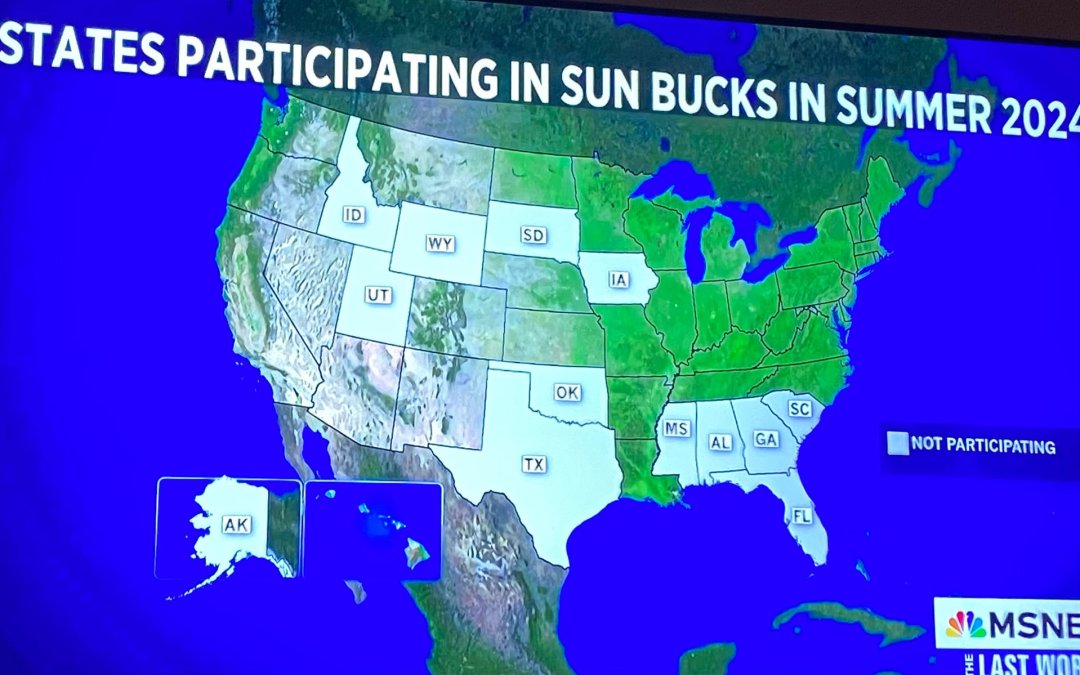
SUN Bucks were created by the Biden administration to help kids and families get groceries – get fed, in other words – during the summer months, which are coming to an end, and which – OF COURSE – overwhelmingly GOP led states opted out of participating in. In other words, the GOP talks a great line about protecting our kids from nonsensical fake harms like exposure to drag queens and Maya Angelou while doing fck all about feeding them. The following excerpts are from the SUN Bucks website as well as the Center for Budget and Policy Priorities (CBPP), which is a “nonpartisan research and policy institute that advances federal and state policies to help build a nation where everyone — regardless of income, race, ethnicity, sexual orientation, gender identity, ZIP code, immigration status, or disability status — has the resources they need to thrive and share in the nation’s prosperity.” Sounds good to me.
Links to both the SUN Bucks program and CBPP are included, but I’ve done the reading for you; you’re getting the highlights, only, with my thanks for being here, and for voting for and donating to candidates that actually GAF about kids and families. And by the way, SUN bucks ain’t a lot – in fact it’s an embarrassingly small amount of money. Why would ANY state reject the program? Good question.
Summer Grocery Benefit for Kids
SUN Bucks is a new grocery benefit available across most of the U.S. Families with eligible school-aged children can get $120 per child to buy groceries during the summer. SUN Bucks may have a different name depending on your location.
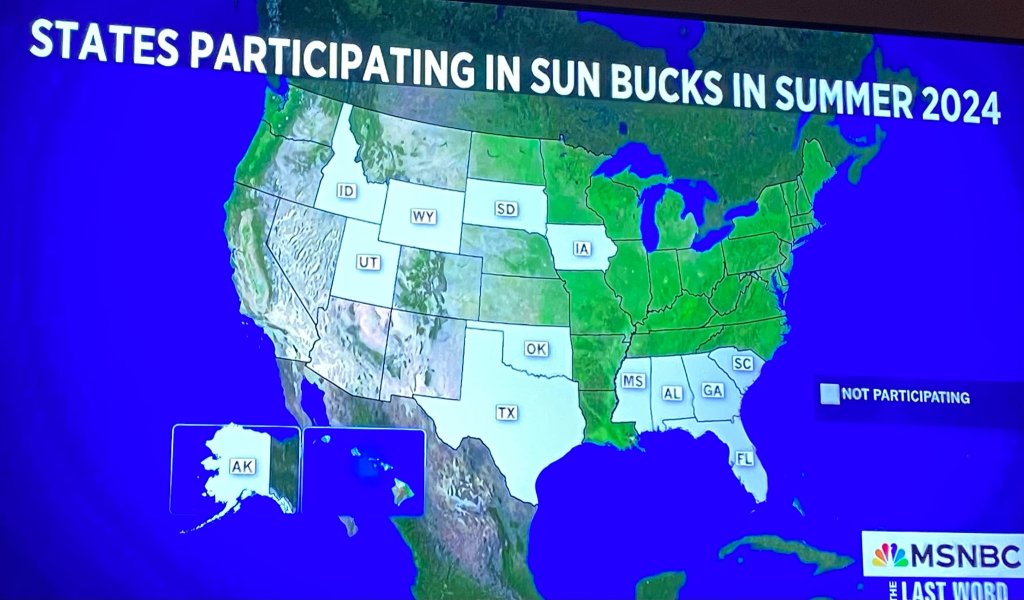
Summer EBT (SUN Bucks) will not be available in the following states: Alabama, Alaska, Florida, Georgia, Idaho, Iowa, Oklahoma, Mississippi, South Carolina, South Dakota, Texas, Utah and Wyoming. Those states may choose to participate in future years.
Expiration of Pandemic Relief Led to Record Increases in Poverty and Child Poverty in 202 Overall poverty and child poverty rose in 2022 by the largest amounts on record in data back to 1967, a sharp retreat from the historic progress made during the COVID-19 pandemic:
In 2021, bolstered by federal pandemic relief, economic security programs drove the poverty rate down to a record low of 8.0 percent. The expiration of that aid drove poverty back up in 2022, to 12.4 percent. The number of people living in poverty fell by 14.5 million between 2019 and 2021 and rose back up by 14.5 million in 2022.
The American Rescue Plan’s Child Tax Credit expansion and stimulus payments, in conjunction with other relief measures, spurred the largest one-year drop in child poverty on record in 2021. In 2022, the expiration of that aid led to a historic increase in child poverty. (See Figure 1.) As a result, 5 million more children lived in poverty in 2022 compared to 2021.
The significant backsliding on child poverty that occurred after Congress allowed the Child Tax Credit expansion to expire underscores the fact that the number of children living in poverty is a policy choice. Recently there have been encouraging signs of bipartisan interest in a modest expansion. On January 31, 2024, in a strong bipartisan vote, the House passed a tax bill that included a Child Tax Credit expansion that, while far smaller than the Rescue Plan expansion, would help about 16 million children and lift a half million or more children above the poverty line in 2025. Unfortunately, the legislation has been stuck in the Senate.
In the late 1960s, assistance programs were fewer and weaker and a substantial number of families with children were taxed into poverty, making child poverty modestly higher than it would have been without accounting for taxes and government benefits. In 2020 and 2021, in contrast, taxes and government benefits — bolstered by pandemic relief legislation — cut child poverty by 59 percent and 76 percent, respectively, both all-time highs in data back to 1967. In 2022, due to the expiration of pandemic relief, taxes and government benefits cut child poverty by a smaller though still sizeable 41 percent, dropping the child poverty rate from 20.9 percent to 12.4 percent.
Recent studies of nutrition assistance and the EITC, for example, have found evidence that children whose families receive assistance earn more as young adults. Other studies have linked income assistance programs with healthier birthweights, lower stress for mothers (measured by reduced stress hormone levels in the women’s bloodstream), better nutrition in childhood, higher scores on reading and math tests and other measures of school performance, more high school completion, higher rates of college entry, and better health in adulthood.
The American Rescue Plan’s Child Tax Credit expansion, in effect only in 2021, not only reduced poverty for all children, but also helped narrow racial and ethnic inequities in child poverty. In 2021, the poverty rates for Black, Latino, and AIAN children exceeded those for white children by 6, 6, and 5 percentage points, respectively — the narrowest such differences on record. Prior to the pandemic, the poverty rates for both Black and Latino children were always at least 13 percentage points above the rate for white children.
After Congress allowed the Child Tax Credit expansion to expire, the credit reverted to a smaller and less equitable design that denies full participation to families with low or no earnings. As a result, in 2022 an estimated 46 percent of Black children, 39 percent of AIAN children, 37 percent of Latino children, 17 percent of white children, and 15 percent of Asian children received less than the full credit or no credit at all because their family incomes were too low.
The U.S. can afford these kinds of investments — indeed, other similarly wealthy nations invest larger shares of their economies in family benefits such as child payments and allowances, parental leave benefits, and child care support. But this will require the right fiscal policy choices, including raising revenues from high-income people and corporations so we have the resources we need to make important investments that improve economic security and broaden opportunity. The 2025 tax debate over the fate of the 2017 tax cuts provides an opportunity to shift from policies that hollow out our revenue base to policies that raise revenues for important national priorities
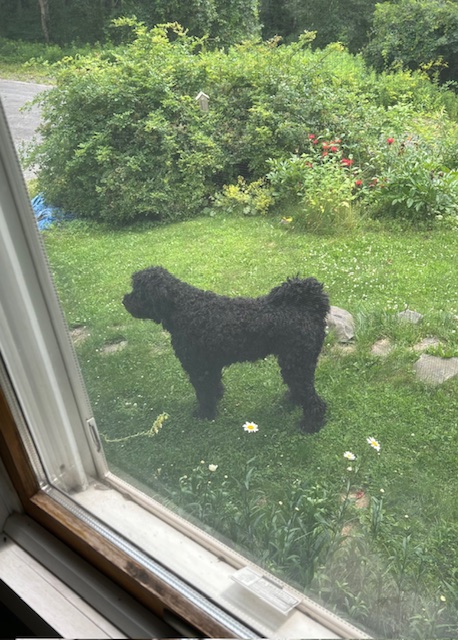
This is famous rabbit hunter Diego Lou Mueller. He is watching, waiting, looking, posted for a run at whatever bunny appears from the brush, if one dares... It’s been a banner year for bunnies, because mild and sunny with bursts of rain good for growing things, like whatever greens they and their many progeny eat. The other day this big beast got away from me, because – well, because it’s been over a year since he’s either face-planted me or brought me to my knees, and I just couldn’t do it – so I let go. He dove into the high grass up the road from my house, and – like all of his legs were pogo sticks – bounced up and down and up and down like an animated bunny or kangaroo; I laughed so hard, watching. It really was that funny. He’s a mopsy-flopsy fellow, and this ridiculous pursuit (he did not catch a thing) was just too perfect. Eventually, after wearing himself out in the extreme heat, he came back; such a good boy, such a love. Diego, the great curly haired rabbit chaser, but don’t tell him; he thinks he’s a killer, the big booby.