Jan 31, 2025
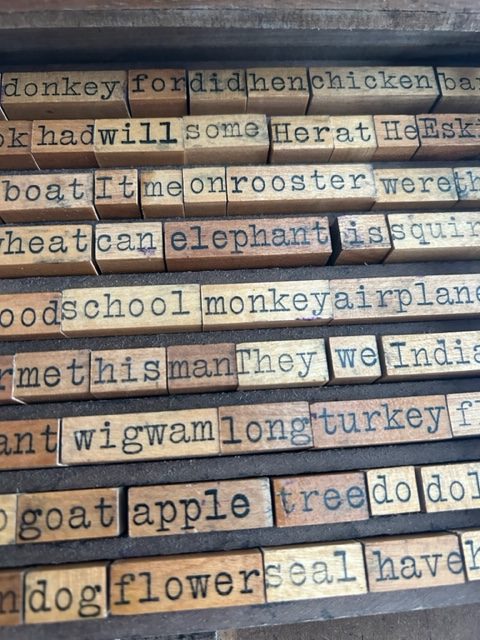
A few terms and trivia I learned in 2024, and share here with you because why not? 2024 is done and dusted for the most part, except historically, and my taxes which I will file shortly (always early!). My hope with this blog is always to clear out my teeming brain, as well as to maybe let others in on the trivial and not so trivial stuff I read, think, and write.
For example, when discussing potential donors to a fund I am creating with a close friend, a name came up about which I know some historical trivia. I woke more than once during the following week, thinking with regret how I’d missed an opportunity to share this tidbit, because I am a nerd, and can’t help myself. The potential donor’s last name is Gerry; Eldbridge Gerry – an ancestor – was VP under James Madison, and his name and political career is the genesis of the term, and long-term problem, of gerrymandering. Oh! I feel such relief! I let them know and now I have shared this tidbit with y’all. Phew!! Insert eye-roll and deep sigh right here ___________.
Christmas Adam. This one I really want to forget because it is beyond the valley of the stupid. For your information, Christmas Adam is the day before Christmas Eve because a really idiotic subset if man-ist freaks insists that because in the Bible Adam came before Eve, Christmas Adam should come before Christmas Eve, I kid you not. Of course what these freaks don’t and cannot understand is that, sadly, for women everywhere, Adam almost always comes before Eve, or Sue, or Mary, or Joan or any other female engaging in sex with selfish, stupid, spoilt straight men, if – and that’s a big if – Eve comes at all. And it’s evening, you assholes, not Eve. JHFC.
Menty B. = Mental Breakdown. Does shortening a term that denotes pain or vulnerability make for good outcomes? Only time – and hard stats – will tell.
Rizz. Short for charisma. Lord help me I wish I had never heard this one, either, and thought, what was that he/she just said??!, but I did. And now I know.
Touch Grass. Get off-line and go outside. This one I get behind 100%. 200%. Get off line and touch some g.d. grass. As I write and post this… on line.
Ate and left no crumbs. This means you did something so well no one can top it, you did the best outta all comers. It does not mean that you’re a scarfer of food and a thrifty one at that (thrifty? clean? whatever).
Bed Rot refers to someone who is spending too much time in bed scrolling and napping and whatever. Sounds like a Menty B to me, but what do I know?
I’m starting to feel like I’m trapped in an episode of Gossip Girl, which I actually did watch back in the day, a show which in no way reflected real life or any real life with which I was at all familiar.
If you feel a need to get up to speed on current slang, have at it, altho by the time you read this, things might’ve changed? Personally, I like the Urban Dictionary, but not always because combine people (mainly men), and the internet, and what do you get? A hot mess, and a nasty obscene one, at that. Still here’s a decent slang source: https://gabb.com/blog/teen-slang/

Jan 30, 2025
*I’m sharing this because it’s been too long since I’ve read Alice in Wonderland, and because it feels right, true, and authentic, this snippet of conversation between two fictional characters. And, there’s the significant presence of the white rabbit in The Matrix films, which I love – but a white rabbit is seen throughout many different cultures. The Chinese tradition is that a white rabbit signifies longevity; in Celtic mythology, the sight of a white rabbit meant good luck, especially when beginning a new endeavor. The Druids believed that white rabbits were spirit guides predicting success or, conversely, warning of complications and challenges ahead. In Christianity, white rabbits are connected to Easter – symbolizing renewal and hope, and in some Native American cultures, rabbits – whatever the color – represent fear, that frozen in place immobility that has bedeviled me when driving (do I go around?, do I just go straight?!) in rural America. Self-love – trusting yourself and knowing that you can handle ‘it’ (a.k.a. life, and whatever it throws at you) – as well as just plain old fashioned appreciation for yourself warts and all is essential. YES.
Do you love Me? Alice asked.
No, I don’t love you! replied the White Rabbit.
Alice frowned and clasped her hands together as she did whenever she felt hurt.
See? replied the White Rabbit.
Now you’re going to start asking yourself what makes you so imperfect and what did you do wrong so that I can’t love you at least a little.
You know, that’s why I can’t love you.
You will not always be loved Alice, there will be days when others will be tired and bored with life, will have their heads in the clouds, and will hurt you.
Because people are like that, they somehow always end up hurting each other’s feelings, whether through carelessness, misunderstanding, or conflicts with themselves.
If you don’t love yourself, at least a little, if you don’t create an armor of self-love and happiness around your heart, the feeble annoyances caused by others will become lethal and will destroy you.
The first time I saw you I made a pact with myself: “I will avoid loving you until you learn to love yourself.”
– Lewis Carroll

Jan 29, 2025
Like any number of the people I once knew and no longer do, he continues to haunt me, even though I don’t remember his name. I am not good with names, I never have been. But I remember his energy, his kindness, his sadness, his embrace of and even the way in which he ran toward his fate, and I wonder – did he? Did he die young, as his father and uncles and grandfather and great uncles had? Or did he live beyond expectation, beating the odds?
He was an actor, originally hailing from Boston, and was from a large Irish family that was, due to the early deaths of so many of the men, heavy with females. This included his mom, who fretted about her son way off in NYC. He felt familiar to me, his background, and he was an actor, as was I at the time we met. His kindness, too, perhaps reminded me of my dad, another weak, sad man burdened by family and fate. He was also, like my dad, married to a bright, driven woman standing just over five-foot tall; she did not like our being friends, but was also – or so it seemed to me – using him, his money, his connections (was there a maternal uncle, or two, in the NYFD or PD?) to promote her own desire to succeed in the Big Apple and the business of show. She had pushed him into moving to New York; they had a window of opportunity, of life, and they were stepping through it.
He was not ambitious, not in an overt, hungry way; he just wanted to do good work. But she – the wife – wasn’t wrong to dislike me, as I did love him, in a way. We were working on audition material together, or was he directing me in a piece? I don’t remember. I just remember long, slow conversations and the frustration I felt in his running toward what he believed to be his fate. Why do that? Why decide you’re going to die young, live into those lousy odds? Defy them dude! I must’ve been very annoying.
So, yes, what I didn’t love, or like about him, was his defeatism. He was a smoker, you see, at least a pack a day, and the thing that was killing off the men in his family was sudden, deadly heart attacks, compounded by congenital heart problems. Was his heart enlarged, or does that simply sound and feel right because his kindness was overly large, including everyone, it seemed, except perhaps himself. His father was dead before the age of forty, before this man whose name escapes me was out of elementary school; his uncles also died before attaining forty years of age, his grandfather and his brothers, too. All these men he never met, spoken of in reverent tones, as tragic noble heroes dying young, in stories he heard time and again as a child – how wonderful and special they all were! Why would he not want to live up to, or down to that? The noble sainthood club of absent men!
When we became friends this kind, decent, sad man was in his mid-thirties, and expected death daily, if not hourly. And, regardless of all this, he kept doing life, moving forward, making friends – and, he kept smoking, which I have to say drove me mad. He told me all about this, the deaths, the heart issues, his acceptance of his fate, on a mild sunny day on a street in the mid-forties, west side. Hell’s Kitchen. We were outside because he needed a break to have a smokey treat. I wanted to shake him. Ridiculous. This is ridiculous. Your dad isn’t some fucking hero, he’s a long-gone dead man, a myth, not someone to emulate, but to mourn. They – he and the wife – had decided not to have children.
We lost touch. We both moved on. He might have returned to Boston. He might have died suddenly and I never heard about it because in the days before social media and cell phones, how would I have been notified regarding a random man’s death in NYC, a man I knew well but briefly during a period of my life in which I moved twice in one long, interesting year, making changes in location, in spirit, in substance. His wife would not have kept my number, would not have followed up. He was sweet. He was lost, as we all are, and dying, as we all are, only his death was, if not in substance, in vision much closer than most. We are all dying. I say this at least once a week, because it’s true. We are all dying. Nobody gets out of here alive. I wonder what ever happened to that kind, sad man? I hope he lived.

Jan 28, 2025
Tradwife life isn’t as good as it looks on TikTok – just ask former tradwives
**from NPR, during the recent Christmas Season – a season when the the height of insanity and inanity is met by tradwives working their tight buns off, proving to their families and culture (Evangelical, Mormon, Catholic, you name it) just how great they can be at everything Christmas/happy family… gender roles are bullshit, peeps, we know it, and oh are they hard to resist! What I find particularly galling – even in the following article from supposedly ‘woke’ NPR – is what goes unmentioned, unexamined, including the reality that if women need men to protect them it’s from MEN in this society – altho I have never, personally, subscribed to that please protect me/must have a boyfriend/husband concept. Women need protection from the culture that tells them to be nice, compliant, friendly – among other silencing tactics used by the dominant culture, tactics that turn girls and women into easy victims for male predators. AND – many women are of course going to go along with this shit, because it’s fucking hard to buck expectations and pressure from family, religion, culture and our peers doing what their family, culture, and religion wants them to do as well. Also maddening – that men are largely being let off the hook yet again in this discussion, as if they’re not benefitting from women fighting over who does woman-ing right. JHFC. Still, an interesting read. I did not link the actual ex-tradwife videos in the following, but have linked the original NPR piece at the end, in case you’re interested.
Also, poor women, women without college degrees, women stuck in abusive marriages with small children and no money of their own, don’t have ‘a choice’, as presented here.
Jennie Gage still remembers an assignment she was given in kindergarten: What did she want to be when she grew up? She wrote that she wanted to be president.
“I brought it home, and instead of my mom being proud, she cried,” Gage said. “She said, ‘Jennie, you’re not gonna be the president when you grow up. You’re going to be a mommy, like me. Heavenly Father made you to be a mommy.'”
Gage grew up in the Mormon church. She got married while she was a student at Brigham Young University-Idaho. She said her husband discouraged her from finishing her degree; instead, they started a business together. When church leaders found out, she said they asked her to step down from the business and to focus on her family. So Gage agreed, and she raised her five children.
“I did all of the housekeeping, all of the decorating, all of the furnishing, all of the cooking, the shopping, taking care of kids, getting them to all their different sports and practices and school and homework,” she said.
Gage said her relationship was also abusive. She left the church and then left her husband. At the time, she was living in her car and feeling isolated, so she started posting on social media about what she was going through. Then, she saw tradwives trending on TikTok.
“The first time I ever saw Ballerina Farm, I didn’t realize she was Mormon. I didn’t realize she was rich,” said Gage. “She just came up in my algorithm, and I had a visceral response. I was furious.”
Ballerina Farm, the account run by content creator Hannah Neeleman, boasts nearly 10 million followers. In her videos, Neeleman posts about raising her eight children on a farm with her husband, Daniel Neeleman, whose father founded JetBlue and several other commercial airlines. Hannah Neeleman is widely considered to be one of the faces of the tradwife movement, which embraces a return to traditional gender roles. (Neeleman, in a controversial profile by The Times, said she is not sure she “necessarily identifies” with the label.)
So Gage posted her own video in response, saying: “I’m an ex-tradwife. I work three minimum wage jobs just to pay my rent.” She said it’s part of the financial reality of being a single mom without a college degree. Her TikTok video, which has now racked up over 1 million views, is one example of a growing phenomenon: ex-tradwives who try to de-influence the lifestyle by sharing why it didn’t work for them.
Tradwives … and girlbosses
Since 2020, tradwives have become wildly popular on social media. Creators like Neeleman, Nara Smith and Estee Williams post videos of their day-to-day routines, often cooking elaborate meals or doing chores in beautiful outfits.
Several experts say tradwives and their renewed focus on family values are the direct aftermath of decades of “lean in” feminism, which eventually lead to a do-it-all mentality. Cinzia Solari, a sociologist at the University of Massachusetts Boston and co-author of the book The Gender Order of Neoliberalism, says the result of that mindset is a deep disillusionment with gender disparity in the workplace, paired with a growing sense of burnout from trying to do it all. “It doesn’t turn out to be sustainable,” she said. “Folks are exhausted.”
So what we’re left with, she said, are two identities that appear to be on polar ends of a spectrum: “girlbosses” who prioritize their careers over marriage and kids, and tradwives who do the opposite. But Smitha Radhakrishnan, a sociologist at Wellesley College and Solari’s co-author, said they’re actually not so different. “Tradwives and girlbosses end up in the same quadrant,” she said. “They are actually both trying to cut their work in half.”
Although tradwives are making an appeal for a return to gender roles from the 1950s – or in Ballerina Farm’s case, a return to the Laura Ingalls Wilder/homesteader pioneering era – Radhakrishnan and Solari say a key aspect of the lifestyle is the element of choice. Women are choosing to opt out of the professional world and prioritize domestic life, and for many tradwife creators, that choice carries an element of empowerment. Radhakrishnan said this is especially true for Black women who’ve been historically forced to work in the United States.
Jacqueline Beatty, who teaches history at York College of Pennsylvania and wrote about tradwives for TIME Magazine, said the rise of tradwives also coalesces with renewed interest in the role of men as protectors. She points to commentsmade by President-elect Donald Trump on the campaign trail, in which he vowed to protect women “whether they like it or not.” She said these attitudes, reflected by tradlife roles for both men and women, are reminiscent of 18th-century legal customs that placed married women under the protection and authority of their husbands. It left women unable to own property or have any legal independence from men, and set a precedent of social and political inequality.
“It’s a way to also keep their agitation for political rights at bay,” said Beatty. “You have this very special and even more important role of being a wife and mother. The vote compared to that is negligible.”
‘I wasn’t oppressed’
Sharon Johnson, another ex-tradwife with a following of more than 600,000 on TikTok, said that’s part of the reason she originally didn’t identify with the trad label. “I didn’t think that I fit into that narrative at all,” she said. “That wasn’t my life. I wasn’t oppressed. I chose this life.”
But Johnson said that all started to change when she and her husband left the Mormon church three years ago. Not long after, her husband got laid off from his job — and she said it broke their family dynamic wide open. He started taking on more responsibility at home and with their six kids, while she started monetizing her social media and co-hosting a podcast to make ends meet.
“Both of us stopped having this pressure of these roles we had to play,” she said. “We are learning to have more healthy relationships with not only each other, but with our kids.”
She acknowledged that it’s not an easy transition to make; she said it’s taken a lot of therapy and teamwork to rebuild their life together. Johnson still has many friends and family members who are tradwives — and the biggest trad creators have not openly addressed the ex-trad phenomenon. But Johnson said she’s found a lot of healing and catharsis in a growing community of women on social media who are looking for a new kind of middle ground.
“I am a completely different person than I was three years ago, and our marriage is completely different, everything for the better,” she said. “I feel like I am a person, and a wife and a mother second.”
https://www.npr.org/2024/12/17/nx-s1-5206673/tradwives-have-taken-over-tiktok-now-ex-tradwives-want-their-moment?utm_source=facebook.com&utm_term=nprnews&utm_campaign=npr&utm_medium=social&fbclid=IwY2xjawHU7BBleHRuA2FlbQIxMQABHabI8b90Olwg9FA2eYqQVP0zyu8zgRH7TJ1oVuRpLogrbfm5c69pPHRS7w_aem_bMPDLQRztO0wmQywEz1vWA
Jan 27, 2025
My dad loved card games, and was an excellent card player; he played solitaire at work, eventually on a computer, for ages, passing the time. Canasta was big at one point, among the relatives during family reunions, bridge too. Two of my mom’s siblings were grand-master bridge players, until one dropped out (Aunt Polly) because the other (Uncle Norbert) was flagrantly screwing around on his wife (Aunt Sally) amidst the lady bridge players. There came a time when she could no longer stomach the stress of hearing gossip about her younger brother, and more. She saw what he was doing; it was ruining her pleasure in the game, and in traveling to various tournaments. They had different last names, and didn’t look at all alike; no one knew they were related.
My dad and mom played pinochle with my grandparents often on a Sunday night during my childhood; these were after dinner games that were the only time I ever heard my mom curse at my dad, albeit curses that were pretty tame, ‘Dammit, Richard’ – that sort of thing. My dad always laughed, but in the midst of the game he was quite competitive; he liked to win. My grandmother, who was already going deaf by then, did what she did during our steak and potato dinners and, I suspect, in her daily, married life: she smiled and carried on, ignoring the drama, especially my grandfather’s criticism of her ability to play, or to remember old neighbors and friends. My mother despised my grandfather; listening to her avoid being openly hostile toward him during these games, and dinners, was a powerful lesson in pussy-footing bullshit and passive-aggression.
We played, their kids, lots of games of War and Gin, and eventually pinochle and canasta, too, although canasta fell out of favor early on (special scoring paper? too complicated?). My paternal grandmother taught me several versions of solitaire I still occasionally play. We learned and for a year at least were obsessed with a simple card game called ‘Spoons’, taught to us by my parents’ best friends, Bob and Carc. This was a type of musical chairs’ game, only sitting down and with spoons to grab placed in the middle of the table instead of chairs arranged for sitting. You had to get one of the spoons to survive each round, and how you got there – got to the moment the music/card playing stopped – had to do with someone achieving a pair? A straight? That part I don’t remember, but I do recall how my dad’s very long arms gave him a huge advantage grabbing those spoons. I also vaguely recall younger kids crying because they couldn’t reach, and that wasn’t fair! Ah, childhood!
Whoever survived and got the most spoons won, as each other player was eliminated. A good lesson for life, circa 2025?
Years later, after I got rid of my dad’s computer, which he was only turning on to play solitaire, he returned to using actual cards, spread out on the kitchen table. My mom was in the nursing home by then, and he had been having me open and print out his emails two or three times a week – all of it either spam or jokes from other old folks – a task which I was no longer willing to do, especially as he didn’t want to spend money to buy more ink for his printer. When my mom died, and then he died three years later, clearing out their house, I found sets of pinochle and regular playing cards in multiple drawers, some encased in fancy boxes or plastic, gorgeously decorated, ready for use. Does anyone play cards anymore? Other than competitive poker? Do kids even play card games these days? Slap jack? War? 52-card pick-up?
When I was fourteen, a terrible, horrible year, my mother and I started playing two-handed pinochle; I don’t know why although I suspect it was an attempt by her to teach me a lesson. I remember I kept beating her and it was unpleasant, but she was distracted, not least by her desire to defeat me soundly enough to take me down a peg or two. The only way that was going to happen was if I let her win (like my dad, I am good at card games), and I was never gonna do that, mostly because she was no dummy – she would know, and that would make her even angrier.
I do remember the last game, though, in the dining room, facing one another across that big wood table that for once was not smothered in green linen, a table cloth she prized as yet another of her siblings had brought it back as a gift for her from Ireland, a.k.a. the ‘mother country’ several generations earlier. I beat her again, and she threw her cards and all others she could grab on the ground, telling me that it was my job to pick them up. Okay, mom. Learning to stay calm, stoic, in the face of her horseshit was a skill that, by then, I had mastered. Only a couple more years and I would be out, and free of her. Or so I thought. Ah, childhood!
“Death ends a life, but it does not end a relationship, which struggles on in the mind of the living toward some end or resolution, which it never finds.” – Robert Anderson
