*except of course I have heard of her – she is May Sarton, whose slim novel Joanna and Ulysses is a permanent member of my favorite books’ bookshelf. It’s powerful, painful, wonderful and informative, telling the story of a part of 20th c. history which which I was, personally, unaware. I love learning sh*t. The following is an excerpt from Sarton’s journal of the year she turned 60, and it fits my current situation perfectly (I’m in recovery from ambulatory surgery), after which excerpt I have linked her wiki page. She was, along with being a novelist, a poet and memoirist/journal writer. It is so essential to living, I believe, to take days off – to vacate, to stop doing and producing and scrolling and all that jazz. To be still even if meditation isn’t on our personal dance card of how to spend part of an hour, or a day. Enjoy, and yes, check out J & U, it’s that good; tender hearts, beware, however – Ulysses is a donkey, and – well… I will say no more. <3
[18th January 1971]
“A strange empty day. I did not feel well, lay around, looked at daffodils against the white walls, and twice thought I must be having hallucinations because of their extraordinary scent that goes from room to room. I always forget how important the empty days are, how important it may be sometimes not to expect to produce anything, even a few lines in a journal. I am still pursued by a neurosis about work inherited from my father. A day where one has not pushed oneself to the limit seems a damaged damaging day, a sinful day. Not so! The most valuable thing we can do for the psyche, occasionally, is to let it rest, wander, live in the changing light of a room, not try to be or do anything whatever. Tonight I do feel in a state of grace, limbered up, less strained. Before supper I was able to begin to sort out poems of the last two years … there is quite a bunch. For my sixtieth birthday I intend to publish sixty new poems and, as I see it now, it will be a book of chiefly love poems. Sixty at Sixty, I call it, for fun.”
“No one is more arrogant toward women, more aggressive or scornful, than the man who is anxious about his virility.” – Simone de Beauvoir, The Second Sex
Brian who? I’ll never tell. Yet, I have been wondering about this for some time – what the actual fuck happened to him to make him such a schmuck, and so, I did a search for Brian’s natal astrological chart. Read on, noting well that the following is a very generalized take on his temperament from a strictly astrological point of view, but I have italicized those points that feel especially right to me. And the truth is, I don’t really know the guy, I only tried to work with him for four long years in local government, which was made pure hell by him because – oh who knows? Other than that experience – trying to work with him, I have an outsider’s view of his personality and temperament for the prior 50+ years, as he was a classmate of my brother’s, and we live in the same small town-lette. Yes, I was away for much of that time, my twenties and thirties and early forties, because getting out of Dodge was imperative for my survival and growth, whereas staying in Dodge was his best and possibly only option, given his lack of ambition? Insert shrug emojis _______ here.
Back to his astro overview where, again, I have italicized what seems spot on. Rising Sign (a person’s mask) is in 25 Degrees Virgo: You tend to be very shy and not very self-assertive. You are supercritical about how you appear to others. Even though you may think you are uninteresting and dull, you are actually quite soft-spoken, orderly, neat and very likable. You are a perfectionist with high standards, and at times you can be quite tactless in pointing out the faults of others. Very practical, efficient and purposeful, your appearance and bearing reflect your need to appear graceful, sensible and reserved. You have a crisp, no-nonsense approach to dealing with others. Never lazy or self-indulgent, you tend to be dedicated to the work ethic (this not lazy thing is so untrue it’s not funny, although if he can possibly make money at it – fantasy baseball for instance – he can be quite diligent. how many times did I call him to discuss town business only to be put off by ‘hey, I’m working on my fantasy baseball team, can we do this another time’? many times). He is a LAZYBOY.
Sun (a person’s essence) in Cancer: You tend to be quite generous, giving, loving and caring, but only when your own needs for emotional support, love and security have been met.If they are not met, you tend to withdraw into yourself and become very insecure and selfish. Your home and family (especially your mother or the person who played that role for you early on) represent security for you and thus assume a larger-than-life importance. Very sentimental, you have vivid and long-enduring memories of the past. No matter how well adjusted you are, you will always need a secret quiet place of your own in order to feel at peace. Feeding others can give you great pleasure, and you would enjoy being part of a large family.
Moon is (your emotional life, childhood and relationship to your parents, especially your mother) in 14 Degrees Capricorn: You are serious and shy and very uncomfortable in those situations where spontaneous and exuberant emotional reactions seem called for. An achiever, you prefer doing practical, worthwhile things that produce tangible results. You need role models to respect, love and emulate. You tend to feel that you’re a failure unless you get an important and highly respected position in life. Don’t be so hard on yourself! For you, practical needs always win out over emotional considerations. Remember that you too have the right to comfort, security and love. Dutiful and patient, when you make an emotional commitment, you sign on for the long haul — your love is long-enduring (no comment other than that he has been married twice and remains obsessed in a very odd way with his first wife, from whom he has been divorced for…almost 40 years). Mercury is (the way you communicate and relate to others/the outside world) in 23 Degrees Cancer: Your emotions tend to rule your thought processes. You have difficulty seeing life objectively. You have an excellent memory, especially about things to which you have formed an emotional bond (or, I would add, a grudge of any kind). You prefer ideas and thoughts that are known and familiar, and therefore tend to dislike fads or radical ideas (he’s an intellectual wet noodle). The beliefs and traditions of your family and culture are very important to you. Your thinking becomes quite unclear when you are emotionally shaken — try not to make major decisions when you are upset. Let things calm down first. Venus is (love life, appearance, temperament) in 05 Degrees Gemini (Gemini, the twins, a two-faced sonofabitch, makes so much sense!): You are friendly, warm, open and tolerant toward others. You love variety in relationships, indeed you may even prefer to maintain more than one relationship at a time! Very witty and humorous, you have the ability to amuse and please others (I didn’t experience this side of him, but …giving credit where it’s due, I gather he can be funny and fun).This makes you quite popular. You love to play the field and thus find it difficult to settle down and make any deep emotional commitments. Your innate charm and vivacity makes you welcome most everywhere you go. (I could highlight a lot more of that but the duality of Brian, his front facing niceness, combined with his backstabbing hideousness makes this a tough call). Mars is (the way you get what you want, energy levels) in 17 Degrees Aries: You are very independent and self-assertive, and you have lots of physical energy. You are not satisfied unless you can be the first to do something. As such, you are more comfortable in leadership positions than you are as an underling. When you are challenged by anyone for anything, you delight in the competitive process and will fight long and hard for your beliefs. You are bold and courageous and often act without thinking (LOL, no). At times, in your zeal to get ahead, you are tactless and offensive — learn that cooperation with others can often bring you nearer to your goals quicker because of the support you will get (Brian is a passive aggressive prick, but he is ambitious to a point – fantasy baseball means a lot to him, as does appearing to be a nice guy, which he most definitely is not).
Okay enough with the astrological stuff. The truth is, I search for anything on him, for some way to frame him, because I just don’t know him well at all – yet his animus toward me was so intense, and remains so all these years later, I have to wonder what the hell it is?! On a monthly basis for four years this guy along with one or two others (the third stooge missed all but the occasional meeting, attending maybe 11% of them annually) tried to humiliate me publicly in open town meetings, and – although I really try hard not to hate anyone, as its counterproductive and a waste of time and energy, I really do look forward to pissing on Brian’s grave.
I know his first wife, and have known her since we were in diapers, and one of his demands during my first term in office was that I unfriend her on Fakebook if I ever wanted him to trust me, or work with me, instead of continually attempting to humiliate me in public meetings. This ask came after yet another instance in which he and the other two stooges voted to put a person they didn’t know on a municipal board rather than vote to place me on it because – as they said on the record – they didn’t like me. When he made the unfriending request, I actually laughed in disbelief, after which I told him to fuck all the way off.
I use the quote from Simone de Beauvoir at the top of this post because that virility question may be at the core of his problems with me, and with women in general. I learned from his ex that during the many years they were together, throughout high school and college, and several years of marriage, she never fell pregnant, despite not using birth control. Maybe he’s sterile? Do I care? No, I don’t. Before I knew this, I also found out that his second wife cheated on him, which is unfortunate, but as I also said to him on that phone call, none of this, known or unknown – no relationship with his current or ex-wife or anything else (was my brother mean to him in grade school?!) – had anything to do with or should have affected our ability to work with one another, performing jobs we were both elected to do.
Never heard of her. Born in 1852 in Kingston, Tennessee, Jennie Jackson was a well-know, well-regarded singer and voice teacher as well as being one of the original Fisk Jubilee Singers, an African American acapella ensemble of 19th century note. Her last name of Jackson was also very well-known and well-regarded (still is, by some) in the 19th century, originating from her grandfather having been enslaved in 7th American President Andrew Jackson’s household. Jennie’s parents were also enslaved, but Jennie Jackson was raised in freedom from an early age after her mother, who worked as a laundress, was freed.
Jackson and her mother (not sure about her father’s whereabouts because … slavery) lived in Nashville, Tennessee during and after the American Civil War. She enrolled at the Fisk Free Colored School as one of its first students after it opened in 1866, and toured as an original member of the Fisk Jubilee Singers from 1871 to 1877, including concerts in Great Britain and Europe, primarily performing spiritual and religious music. Their tours raised funds for the Fisk University campus, and the group’s audiences included Queen Victoria, Ulysses S. Grant, Henry Ward Beecher, Mark Twain, and William Lloyd Garrison (Never heard of ‘em!? Oh, okay, a journalist, abolitionist and social reformer, got it).
Jackson left the acapella group in 1877 when she fell ill with digestive issues. In 1891, she formed her own sextet, the Jennie Jackson Concert Company, as well as teaching voice throughout these years. Jackson married Rev. Andrew J. DeHart in 1884 and lived in the Walnut Hills neighborhood of Cincinnati, Ohio. She was widowed in 1909 and died on May 4, 1910, aged 58 in Ohio. In 1978, Jackson and the other original members of the Fisk Jubilee Singers were granted posthumous honorary Doctor of Music degrees from Fisk University. Fisk University, it is worth noting, is the oldest institution of higher education in Nashville, and was the first HBCU to gain accreditation by the Southern Association of Schools and Colleges (is that a good thing? Hmmm…I’m sure it is).
So, now you know. Every month is African American History Month, because African American History is American History. Y’all.
When I bought my first home, a co-op, after a decade plus of renting generally cramped, over-priced apartments in a college town, in London studying abroad, on an island in the Atlantic Ocean, as well as in New York City, I was thrilled. Security, permanence, equity ~ an elevator! A laundry room! Oh happy day! However, it also required I move myself and my stuff for the third time in under two years. Please lawd, no!! Or if yes, can we at least not move all of it, again?! Everything that I owned had to be examined in the light of ‘you’re packing this again, carrying this up or down stairs again, including into that blessed elevator, carting it to the next place of residence, again, really?! Really?!’
This amalgam of stuff new and old, my stuff, included an ancient trunk that had belonged to my Great-Aunt Martha, a large trunk full of journals and letters, all of the journals used and all of the letters I had received to that point since childhood. Every. Single. One. There were a lot. No. Not again. I decided I’d had enough with the saving ephemera thing; it stops here and now. Having to move yourself and your accumulated crapola on multiple occasions in a short amount of time is a magic equal to any advice from Marie Kondo, as I can attest. I let go of most, not all, of the letters and the journals. I unloaded. I lightened up.
That this process of unloading and moving into an actual owned piece of real estate happened after cajoling, forcing, threatening, and dragging my sorry ass family of origin into family therapy was no coincidence, but rather a happy, semi-intentional series of falling dominoes, a cornucopia of major and minor (so many levels!) breakthroughs, a crack in the wall, a rising from the dead or near dead, a tornado-sized blast of relief, a declaration of value: mine. Along with a rise in self-valuation, it seemed, came a reckoning with things saved commemorating others value to me, and my own past selves in both letter and journal form. What, if anything, would I save?
My siblings and I were raised in a time of letter writing, by parents whose handwriting was pretty much illegible, but who, nevertheless, believed in the power of personal notes, thank yous, Christmas cards that included a brief handwritten update on family, and, eventually, typed missives chock full of my father’s misspelled words and corny advice, and various admonitions re: safety and good behavior from my mother. We were raised in a time before email, a time when letters arriving at the post office for me, me?!, meant that I existed, I mattered; those letters were a big deal, or so it seemed to this little punkin’.
Among the letters I had preserved? Several bunches from a pen pal, a teenaged counselor I met at Girl Scout camp; she was kind to me, but I don’t recall her name. She wrote to me for at least two years, and was starting at Keuka College the fall after we met. I was half her age, but because she was intent on teaching grade school, I believe she was motivated to stay in touch by an interest in little kids? Maybe? What I do remember was that her spelling was pretty bad, like my dad’s, although her childishly loopy handwriting was legible; her grammar wasn’t great, either. I think, too, that she felt sorry for me as I was one of, if not the only kid at camp without a friend or group of friends present, attending with me. Those two-week periods away from home, surrounded by peer Girl Scouts all under fourteen years of age from towns in central New York I had never heard of, let alone visited (they’d never heard of my home town, either), were long, and if not lonely, they were at the least very solitary. I loved being in the woods, though; still do.
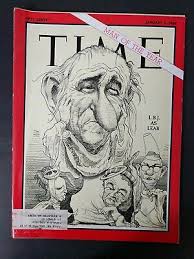
Out of all the bunches and bunches of letters contained in that big old trunk, I kept very few, including several from my brother (two to three lines at best, yet quite revealing and dear, for all their brevity), and a couple of the best from my dad and mom. I kept a response letter from LBJ’s White House; I’d written the President in my grade school years, complaining about the disrespect shown him by a caricature version of his face on a Time Magazine cover. They’d made his nose and ears too big; it wasn’t nice. A different world. Many of those who had written me I simply could not remember, at all, which made me sad. I had started the clearance looking at every letter then realized I’d never in a million years get through them all; it was time to just let go. I filled several garbage bags with them, dragging them out to the curb in the middle of 45th street between 9th and 10th avenues where they would be picked up by midtown’s sanitation crew. G’bye, y’all.
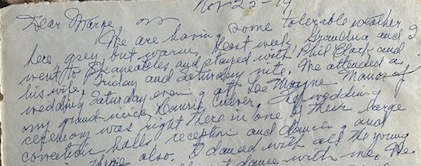
I kept two letters from my grandparents, one of which included a quote my grandfather transcribed in his best Edwardian script, several lines from Shakespeare’s Two Gentlemen of Verona, a play I had seen but didn’t know very well; it’s an early work, possibly his first play, and it shows, but the quote intrigued me, delighted me, studying acting in London at the time. It was so unlike him to wax poetic, even if I knew, deep down, that he had it in him, that under his crusty caustic armor there lived a romantic, a poetry spouting charmer. The thin blue airmail envelopes had arrived at the base location for theatre students abroad, and were welcome during a very transformative, powerful time for me, the longest period in my life to that point away from my family of origin. I received more letters weekly than most of my peers, it was remarked upon numerous times, because the pick up location was public, and the amount of letters I got really was remarkable. My family, trying their best to keep me in the herd, is what I thought then, even if I would not say it aloud. Not yet. Not then.
One of my deepest concerns before leaving was that my grandmother might die when I was that far away, across a big ocean, in the land before cell phones and easy communication across various platforms. I was named after her, my dad’s mother, and she was a consistent loving presence in my life, a truly kind and decent human, filled with humor and intelligence. She had been suffering with shingles, had lost a great deal of weight, and was, at the time, an increasingly frail eighty-five years old. I visited Scotland in part to send her postcards of her family’s ancestral homeland, which she’d never been able to visit; in London, I found and bought a kilt in the family pattern, her family, the Davidsons. I own it still.
I traveled to Ireland, north and south, before heading back to London and a Freddy Laker flight (sardines, I feel you) into JFK. I’d had a dream while staying in a youth hostel in Dublin, a premonition of death and loss, my grandfather, which made no sense as he was fine, yet the anxiety this vision struck into my heart had me cut my travel short to get home as soon as possible.
I called, long distance, sinking a mess of British sterling into a pay phone on a noisy city street, all to ask, ‘Is everyone okay? How’re grandma and grandpa?’ ‘Everyone is fine. When are you coming home?’ I didn’t say, about the dream, and the anticipation of loss and of death. ‘Okay. Tomorrow, I’m coming home tomorrow.’ And there they were, my grands, in the self-proclaimed Knoll House on Cemetery Road, hale and hearty – or at least as hale and hearty as one is at eighty-plus years old in the sticky heat of an unseasonably humid day in early May. My grandfather had been outside chopping wood in ninety-degree weather. I dropped in on my way home to the farm, promising another visit right away, a long visit, full of stories and sights seen.
The next day my mother dragged me around showing me off, or so I felt, her newly coined, ‘studied abroad’ daughter. Her hairdresser’s place on Southside Rd., her favorite lunch spot, a friend on Main St., an old lady from her church, and another on a back road, where I sat mostly in silence unless questioned directly. My mother was an Olympic level talker; I was there for presentation purposes only. It was dreadful, in part because I was exhausted, jet-lagged, still feeling the humming anxiety of that dream. Still, she was being nice to me, which was different, interesting and new.
I’d been away long enough to get a dollop of perspective, after an explosion of clarity that past Christmas – as if seeing my family for the first time – when I’d surprised everyone by returning home mid-year abroad. I no longer saw her as I had, as an inevitable, implacable force, a tsunami of anger and resentment; she was just a small round woman full of frustration and desire, more to be pitied than feared. Implacable, but – not inevitable. I would, ultimately, escape her; the process had begun years before; time was on my side even if my natural and temperamental impatience made days spent in her home feel like lifetimes. Let her have her fun; I’ll see the old folks tomorrow, as I told them when I called later that day to apologize for not showing up.
The following morning I went by their house on the knoll, where I found my grandfather in his favorite red velvet wing chair, bent over and in pain; he’d been up vomiting much of the night, but other than agreeing to go lie down, he refused to go to the ER. I called my dad, who left the store to come take a look at the old man, the invincible one, the terror of his own childhood. He called an ambulance, and – three hours or so later – the old man was dead, a series of heart attacks over several days, they said, culminating in this last one, which killed him. He’d had no blood pressure, none at all, when the EMT took it, or tried to, but he was talking up a storm, even offering to do a headstand at the hospital, if the doctor thought that might help get his blood moving.
I spent the next two weeks living my my grandmother, cooking bacon (he’d forbidden her any), buying donuts (ditto) and mourning a difficult, complicated man we had both loved. I have those letters still.
Vouchsafe me for my meed but one fair look; A smaller boon than this I cannot beg, And less than this I am sure you cannot give.
The folks up the road are having a garage sale, and Diego is all over it. Every single time someone drives up the road, he charges to the door, I let him out, and he expresses his outrage at their trespass, which isn’t – of course – trespass at all. Then, we repeat the same thing when they leave, as – inevitably – leave they must. This is the third day of intense activity above my house, and yes, I am a little over it (gross understatement). If it weren’t as humid as it is, or raining, as it has been for much of the last three days, it wouldn’t be such a drag; Diego could then just stay outside, doing his King of the Hill act with my blessing. Sigh.
Deep breaths, and – soon, soon it will all be over.
They’ve also been getting dumpsters delivered on a regular basis throughout the weekend and today. Diego can hear that truck from about 2 miles away, the little dear. Small annoyance, I know, but omg, will you please just shut up, already, dog?
In the U.K. they have car boot sales, where people load up the trunks of their cars, congregating in parking lots or around village squares where they unload their junk for pounds and pence. I like that idea, but more than that, I love the term ‘boot’ for the trunk of a car. I know boot as footwear, of course, but I also knew a woman my freshman year of college who called barfing booting – which was an interesting regionalism I’d previously never heard. I’ve never been able to use boot in that way, because when I am nauseous, the charms of saying ‘I’m about to boot’ disappear, but in sharing it with you, I finally get to use it, kinda, sorta. Boot. Heeheehee.
The garage sale and Diego’s enthusiasms have worn me right out. It’s time for bed.