*Last week, the Alabama Supreme Court did it again – they rejected the petitions and signatures required to get an abortion ballot measure in front of Alabamians in November because of course they did. Okay it was a 4-3 vote, better than the slam dunk on IVF (frozen embryos are babies, thus destroying them = murder!!) earlier this year but – really? Really?!! 10k+ more signatures than needed were submitted, but nope, the paperwork was flawed. This is how conservative Republicans use their positions of power to block the democratic process – which should, always, favor the voters – approving the signatures gathered because they are the court’s constituents too; it’s enraging. The following is from PBS with reporting on the ground by the Associated Press; PBS is where I go daily for info, news, and a clear-eyed presentation of current events. And, grrrrrrrr…..
LITTLE ROCK, Ark. (AP) — The Arkansas Supreme Court upheld the state’s rejection of signature petitions for an abortion rights ballot initiative on Thursday, keeping the proposal from going before voters in November.
The ruling dashed the hopes of organizers, who submitted the petitions, of getting the constitutional amendment measure on the ballot in the predominantly Republican state, where many top leaders tout their opposition to abortion.
Election officials said Arkansans for Limited Government, the group behind the measure, did not properly submit documentation regarding the signature gatherers it hired. The group disputed that assertion and argued it should have been given more time to provide any additional documents needed.
“We find that the Secretary correctly refused to count the signatures collected by paid canvassers because the sponsor failed to file the paid canvasser training certification,” the court said in a 4-3 ruling.
Following the U.S. Supreme Court’s 2022 decision removing the nationwide right to abortion, there has been a push to have voters decide the matter state by state.
Arkansas currently bans abortion at any time during a pregnancy, unless the woman’s life is endangered due to a medical emergency.
The proposed amendment would have prohibited laws banning abortion in the first 20 weeks of gestation and allowed the procedure later on in cases of rape, incest, threats to the woman’s health or life, or if the fetus would be unlikely to survive birth. It would not have created a constitutional right to abortion.
The ballot proposal lacked support from national abortion rights groups such as Planned Parenthood because it would still have allowed abortion to be banned after 20 weeks, which is earlier than other states where it remains legal.
Had they all been verified, the more than 101,000 signatures, submitted on the state’s July 5 deadline, would have been enough to qualify for the ballot. The threshold was 90,704 signatures from registered voters, and from a minimum of 50 counties.
In a earlier filing with the court, election officials said that 87,675 of the signatures submitted were collected by volunteers with the campaign. Election officials said it could not determine whether 912 of the signatures came from volunteer or paid canvassers.
Arkansans for Limited Government and election officials disagreed over whether the petitions complied with a 2013 state law requiring campaigns to submit statements identifying each paid canvasser by name and confirming that rules for gathering signatures were explained to them.
Supporters of the measure said they followed the law with their documentation, including affidavits identifying each paid gatherer. They have also argued the abortion petitions are being handled differently than other initiative campaigns this year, pointing to similar filings by two other groups.
State records show that the abortion campaign did submit, on June 27, a signed affidavit including a list of paid canvassers and a statement saying the petition rules had been explained to them. Moreover, the July 5 submission included affidavits from each paid worker acknowledging that the group provided them with all the rules and regulations required by law.
The state argued in court that this documentation did not comply because it was not signed by someone with the canvassing company rather than the initiative campaign itself. The state said the statement also needed to be submitted alongside the petitions.
*As I made my way around my house the other day, looking for excremental contributions from Diego, I spotted this lil guy, which delighted me (so much nicer than – y’know – doggie droppings), hanging out on a hosta leaf (how odd, this program is telling me that hosta is spelled incorrectly, are you telling me no gardening bloggers use this sucker – doubtful…). The night had been rainy, the humidity was back, and I had to envy this lil guy, and his very simple life under the big sky, which to him must be even bigger than it is to me. Ribbet. Or do I mean, Belch? The world is so beautiful.
I just finished reading It’s Not Hysteria by Dr. Karen Tang, a specialist in public health, gynecology and minimally invasive gynecological surgery located in Pennsylvania. It’s pretty great, and the following facts come from this very accessible, readable book on the subject of women, their health, and how our system needs to change. There’s so much more of value than what is below, so think about checking it out, or buying it. Knowledge is power, especially when it comes to women and girls and OUR BODIES.
Speaking of which, let’s start with the following fascinating fact: the NIH allocates more money ($37 million) toward smallpox research, a disease that has been eradicated from the U.S. since the late 1940s, than it sets aside for endometriosis research ($27 million); endometriosis affects at least 10% of women (N.B.: 10% of half the population, y’all), or that is sets aside for fibroid research ($15 million) which affects one in ten women in their lifetimes, including negative impacts on fertility.
I will link the funding info for the NIH at the end of this, and hope my blood pressure lowers, because looking at the numbers on funding for prostate cancer research ($278 million) – higher than ovarian, cervical, vaginal, and uterine cancers individually by a multiple of A LOT(almost more than all of those combined) – is absolutely maddening. Uterine cancer – $37 million – is the most common form of gynecologic cancer in the U.S. Ten percent of women who have post-menopausal bleeding will develop uterine cancer, with the other ninety percent experiencing p.m. bleeding due to benign causes (fibroids, polyps, or common menopausal changes). Breast cancer research is well-funded ($738 million), higher than prostate numbers, but again – the entire research funding for the cancers affecting women listed above combined, excluding breast cancer, is only $88 million higher than funding for prostate cancer. Deep breaths.
You know what does get well funded? Higher than even prostate cancer research? Perinatal and newborn health. Host body health? Not so much.
Fibroids, in case you don’t have ‘em or didn’t know, are benign tumors of the uterus that affect up to 80% of black women and 70% of white women. Hysterectomies guarantee that fibroids are gone but are not the only option for treatment. More than 400K hysterectomies occur every year in the U.S.; hysterectomies are the most common surgical procedure in the U.S., are also among the most expensive, and are harder on maternal bodies, taking longer to recover from – with more complications – than vaginal births, particularly in underserved or poor populations.
One average, it takes seven years to be diagnosed with endometriosis from onset of pain and related issues, which is simply a reflection of continued biases with regard to women’s reporting on systems, pain, and illness within our medical system.
One in four women in the U.S. will have an abortion in her lifetime. Most countries that ban abortion have a higher rate of abortion than those who do not criminalize it. Vasectomies are much less invasive and have fewer surgical risks than surgical sterilization procedures for women. Ninety percent of abortions are done within the first trimester, with only one percent occurring after twenty-one weeks. One in five pregnancies will end in a miscarriage, although that is an under-reporting, as many women don’t realize they’re pregnant, and have miscarried, and thus do not report. Up to seventy percent of fertilized eggs may result in a miscarriage. Up to eighty percent of first-trimester miscarriages pass naturally without treatment, but the process may take several weeks. The vast majority of people who experience miscarriage will go on to carry to term, and deliver normally.
Under 200 million people world-wide experience infertility. About a third of cases of infertility are due to a medical issue involving the male partner. IVF offers the highest pregnancy rates of any fertility treatment. More than eight million babies have been born through IVF worldwide.
How much money (all figures I use here are from NIH re: 2022) is invested in infertility research? $189 million. Teen pregnancy gets $17 million. Is that money, I wonder, asked to discourage it, recognizing it as the scourge it is? And how much of that funding is aimed at helping teenaged boys and older men who impregnate female children keep their dicks in their pants? Hmmm….
*my August progressive column for a local regional paper – thanks for reading, & being here!
Americans – you need to take a break. We all need to take a break, travel, get away, unplug, cease doing, scrolling, or texting! In France, almost everyone takes a month off, vacating for – primarily – the entirety of August. Doesn’t that sound fabulous? Of course, the French also have universal healthcare and solid parental leave policies, like much of the planet, with the notable exception of the U.S. Why can’t we have nice things? Don’t get me started. I’m on vacation.
Also, please don’t bring up the shooting in PA, the weirdness of the GOP convention or the energizing change at the top of the Dem ticket. More on that next month, when I am done vacating. But – can this year get any more – weird? Intense? Discombobulating? Ignore that question: I’m vacating (trying to…).
We vacate in this country for, on average, 11 days per year, which is the least recorded amount of vacation days taken by citizens among developed nations. Even the highly disciplined Japanese do better than we Yanks do, and by quite a lot. People, this non-vacating thing is a problem. It’s no wonder we’re cranky!
Week nights and ends in the internet age, when our bosses, clients, or co-workers might be in touch via email, text, or even social media, often finds us working after hours while officially ‘off the clock’, making truly unplugging an even more precious and elusive commodity, one that is absolutely necessary for a happy, healthy life. Vacationing is defined (by me) as getting out and away from the daily locale and grind, accompanied by immediate family or close friends only; no work allowed. None, nyet, nada. None.
My dad worked seven days a week for much of his professional life, which made sense as he was a depression era baby whose concerns about money never entirely faded. But what’s our excuse, current generations? Get off the computer/ phone/social media and go explore! Y’only live once. Unplug, Neo, go see the world, or – at least – see the USA. I don’t know if you’ve heard, but it’s actually pretty great.
On my vacations I read. Away for a week? I take a bag of books, expecting to leave at least two en route in airports, on train or bus seats, but I have also left finished novels many other places: here, read this, unknown friend. Unless the book was so awful I couldn’t stand it, then I do everyone a favor and toss it. Reading is fundamental, meditative, an escape, a life-long joy. Reading on vacation, while completely ignoring that monstrously addictive mini-computer by my side or, better yet, having left mini-dictator back in my room? Bliss.
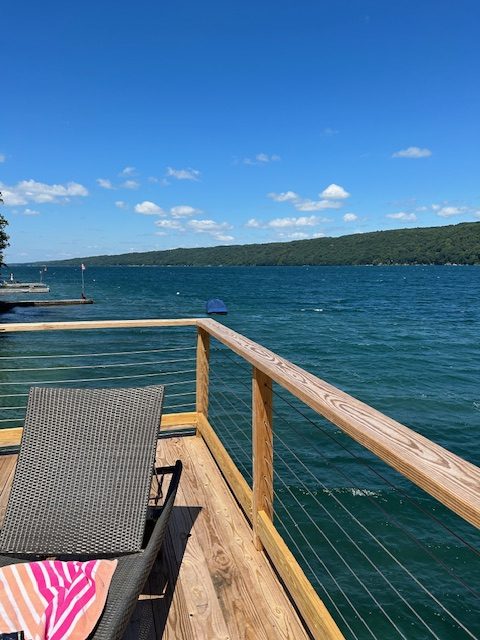
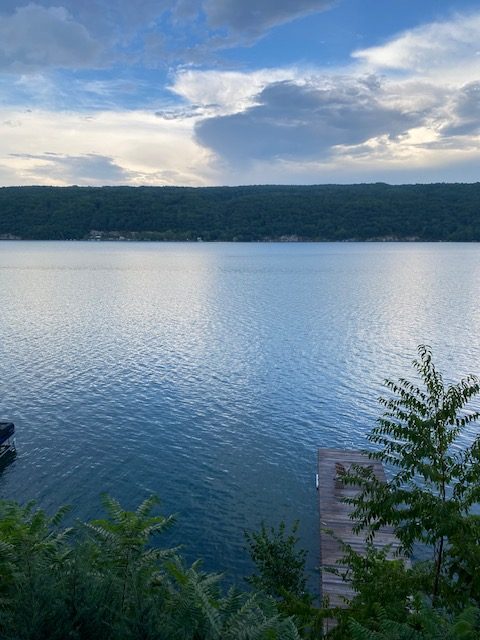
My preference is a lake vacation, because the beach is great for only about 15 minutes if I am completely covered, and slathered with sun block. Lake water is also, after the clean, clear water of Catskill Mt. creeks, my most favorite element. And please, I’m on vacation, don’t make me hike in the mountains, although I will walk with you on a cool morning, most summer days. I did that once, hike on a vacation, a trip that began with a float plane ride into remote British Columbia, walking the Mackenzie Trail back to civilization over the course of two weeks. Gorgeous scenery, but, no thanks, one and done. Carrying 60 pounds on my back, eating dried meats and fruits while being eaten by various bugs, attempting to sleep on the ground: not my idea of a relaxing break. Swimming in a lake, reading (in the shade) while sipping a gin and tonic, the scent of fresh food being cooked by someone other than myself on a grill wafting my way? Yes, please!
Many American leave vacation days unused, often going more than a year between breaks. The challenges of taking time off amidst busy lives, planning trips while meeting social or familial obligations are a couple of the reasons we don’t vacate. The good news is younger Americans are better at taking time off than older generations; they’re also more likely to travel abroad. After World War II, approximately 70% of all Americans had lived in a city or area other than their hometowns for a significant amount of time; mobilization to fight that war required travel on a massive scale. The post-war years were also a time when our society moved ahead by leaps and bounds, improving opportunity for all, increasing union participation, and – ultimately – codifying civil and women’s rights. Nowadays, only about 30% of Americans have lived or traveled more than 40 miles away from their origins for an extended period; I believe this lack of exposure to the beautiful, diverse and wider world is reflected in our current cranky lives and politics.
America: give yourselves and each-other a break. Vacate!