*a poetic fragment from Mary Oliver, who is, let’s face it, the bomb. Taken from Swan: Poems and Prose Poems. Thank you for being here, and for following along, reading along, being a READER, period…
Ordinarily, I go to the woods alone, with not a single friend, for they are all smilers and talkers and therefore unsuitable.
I don’t really want to be witnessed talking to the catbirds or hugging the old black oak tree. I have my way of praying, as you no doubt have yours.
Besides, when I am alone I can become invisible. I can sit on the top of a dune as motionless as an uprise of weeds, until the foxes run by unconcerned. I can hear the almost unhearable sound of the roses singing.
If you have ever gone to the woods with me, I must love you very much.
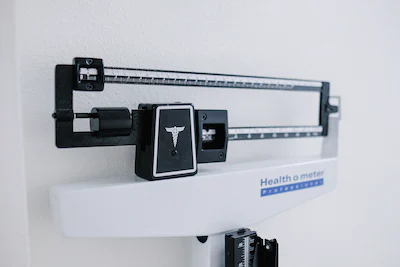
*I too love going into the woods alone, a habit I developed during a challenging childhood when – luckily – I was surrounded by 300+ acres of mostly woods and sloped fields into which my enemy would not venture, as she was terrified of untamed nature, and eschewed exercise of any kind, almost as if it’d kill her. We had one of those shaking belt machines instead, which was actually kind of fun. Did it help her lose weight? Fuck no! And, forgive me but this photo – which Mary Oliver would never in a million years pair with her poems – is just too perfect to resist adding here. Mary, forgive me!! Youze guys too, por favor!
Yes, Tony Benn – not Tony Bennet, although they’re both white guys born in the early part of the 20th century; Benn – a politician – in London in 1925, and Bennett – the crooner – in NYC in 1926. Benn (and spellcheck keeps making Benn into been, so if you see that, I simply missed it while typing away!) was born into a life of privilege, but throughout his long career in British politics, he was uniformly liberal, anti-war and unapologetically progressive. I have linked a terrific speech he gave against the Iraq War that applies just as much today and is so moving, I dare you to try to resist it, and Tony Benn.
Why should we GAF about knowing who Benn was? Because he was not only a strong voice for decency and fairness, he was and remains a role model for persistence in the face of difficulty, disappointment, loss, and despair. He was often described as having grown more immature (read: liberal) with age, the opposite of a popular aphorism I won’t repeat because I believe it’s untrue.
Here’s the thing, for me anyway, we are riding together, yes, together, along a dangerous curve in a continuing, cyclical road; it sucks, what’s going on, and the level of current uncertainty – a lot – is debilitating. And, we control our response, we – as individuals and as a collective ‘we the people’. Despair is not an option. FFS. Do something. For me it’s blogging, writing my progressive column, volunteering for various voter registration orgs, and staying up on the news without burning myself out on outrage in an outrageous age. And, doing something also means taking a break from the news, watching seriously idiotic comedy or whatever works for you, and getting off line, away from screens, and going outside!
Outrage, like everything else, is as old as humans, and everything old is new again. I will not let this moment, defeat me, and – as an optimist – I know like I know like I know that all will be well and all will be very well. In fact, this moment looks like an opportunity. We shall see.
All of the following quotes below are from Benn.
“It’s the same each time with progress. First they ignore you, then they say you’re mad, then dangerous, then there’s a pause and then you can’t find anyone who disagrees with you.”
“I don’t think people realise how the establishment became established. It simply stole the land and property off the poor, surrounded themselves with weak minded sycophants for protection, gave themselves titles and have been wielding power ever since.”
“I think there are two ways in which people are controlled. First of all frighten people and secondly, demoralize them.”
“The people in debt become hopeless, and the hopeless people don’t vote… an educated, healthy and confident nation is harder to govern.”.
“In the course of my life I have developed five little democratic questions. If one meets a powerful person–Adolf Hitler, Joe Stalin or Bill Gates–ask them five questions: “What power have you got? Where did you get it from? In whose interests do you exercise it? To whom are you accountable? And how can we get rid of you?” If you cannot get rid of the people who govern you, you do not live in a democratic system.”
“But if there is hope, it lies in ordinary working people. When you put it in words it sounds reasonable: it is when you look at the human beings passing you on the pavement that it becomes an act of faith.”
“I have divided politicians into two categories: the Signposts and the Weathercocks. The Signpost says: ‘This is the way we should go.’ And you don’t have to follow them but if you come back in ten years time the Signpost is still there. The Weathercock hasn’t got an opinion until they’ve looked at the polls, talked to the focus groups, discussed it with the spin doctors. And I’ve no time for Weathercocks, I’m a Signpost man. And in fairness, although I disagreed with everything she did, Mrs Thatcher was a Signpost. She said what she meant. Meant what she said. Did what she said she’d do if you voted for her. So everybody who voted for her shared responsibility for what happened. And I think that we do need a few more Signposts and few fewer Weathercocks.”
“We are not just here to manage capitalism but to change society and to define its finer values.”
From the video, in case you ain’t got the time to watch: “I was born about a quarter of a mile from where we are sitting now and I was here in London during the Blitz. And every night I went down into the shelter. 500 people killed, my brother was killed, my friends were killed. And when the Charter of the UN was read to me, I was a pilot coming home in a troop ship: ‘We the peoples of the United Nations determined to save succeeding generations from the scourge of war, which twice in our lifetime has brought untold sorrow to mankind.’ That was the pledge my generation gave to the younger generation and you tore it up. And it’s a war crime that’s been committed in Iraq, because there is no moral difference between a stealth bomber and a suicide bomber. Both kill innocent people for political reasons.”
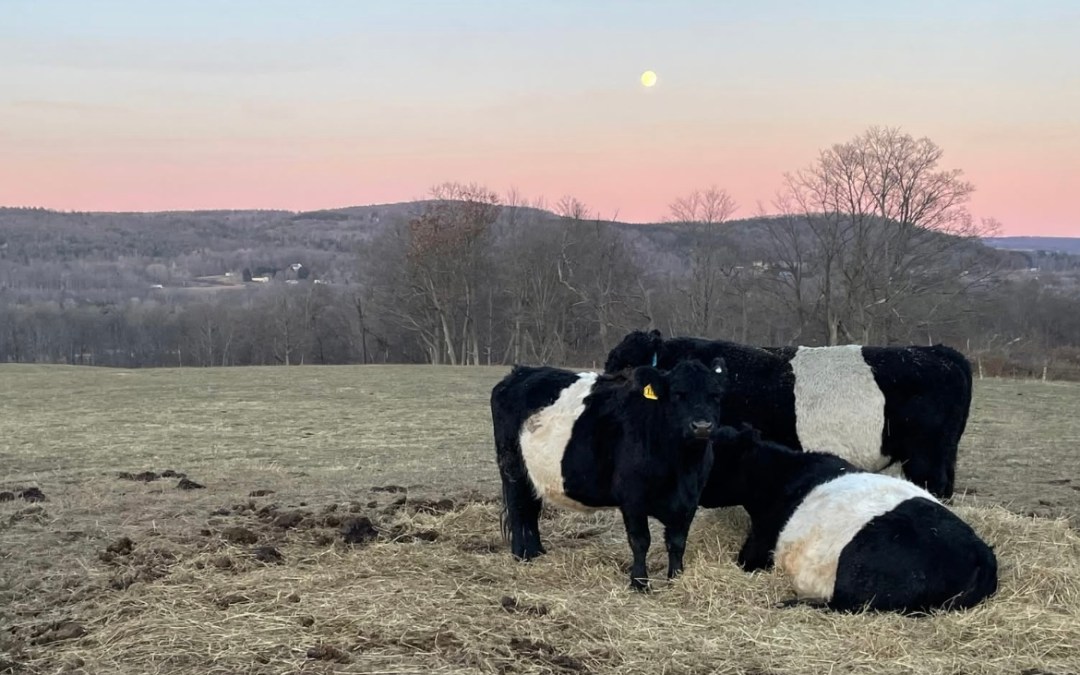
Ever heard of ’em? Seen ’em? Well, I think they’re gorgeous, yet – the first time I saw them in a field, on my right as I drove to my new job in an even more rural part of the Catskills, I did not know what the hell I was seeing. What WAS that? Was that – huh? Was that a white horse, a pony – standing next to a – huh? Was that a sheet or blanket on a cow? It looked like a part of an animal was missing? Impossible. Was it a big white sheep and a…? This does not compute.
I soon found out what I had seen were Belties, a breed of cow that feature bands of black and white on their coats. Coats? Hides? Skin? Whatever. I took a slow drive home that night, having asked around, and still – amazing – it looked as if a part of the cows was missing, or something? It required – and still does, when looking at the photo below of a group of them – a rewiring of a part of my brain that says: this is different, this is not what a cow is, this does not compute, how does this fit in my brain’s gallery of visual flags. Bing bing bing – rewire.
Belties are not their official name; that is Belted Galloway, denoting a Scottish breed of cow that can come in black and white, or brown and white bands, but I feel sure you will agree that the black and white are tres’ cool. I love them. For some reason, these cows remind me of bees. I love bees, too. The world is so beautiful.
*From NPR and Sarah Boden: “Doctors Urged to Treat Pain for IUD Insertion and Other Procedures”
Y’Think?
*TBH that headline “Doctors Urged…” made me see red. Having had numerous below the waist exams and treatments – including a cervical biopsy in my 20s (‘This shouldn’t hurt a bit!, I was assured…GAAAAHHHHHHHHHHHHHHHHHH BrOtHeR FcKiNg WTF!!!!), I almost didn’t read it, but then I wouldn’t be able to pass it along to you, so, get over yourself, Mojree, and I did. This shit matters. Women and girls are suffering needlessly.
Maybe just start with the same default assumption that we have for men, and male procedures of all kinds but particularly those below the waist: medical procedures involving human – or any animals’ – private parts are gonna hurt (except – hm – animals have been getting better pain care, come to think of it). Pain relief for ALL such procedures should be standard unless declined by the patient. There are still a number items in this reporting that made my eyes roll back in my head SO HARD it hurts but, it is good news, mostly, generally, finally.
IT’S 2025 AND WE’RE JUST NOW GETTING THIS? Deep breaths. The article:
Countless patients have suffered through in-office gynecological procedures like IUD insertions or cervical biopsies, with nothing more than ibuprofen and white knuckles.
Pain is complex and individual. One patient might feel little to no discomfort and for another it can be excruciating. But some clinicians don’t offer pain management because they believe it’s unnecessary.
In its new recommendations for cervical and uterine procedures, released last week, the American College of Obstetricians and Gynecologists says there is “an urgent need” for this to change.
ACOG directs clinicians to have an “upfront and thorough” conversation so patients know pain might occur and are offered options to manage that pain, such as a paracervical block.
The block is done by injecting a local anesthetic, often lidocaine, on top of and near the cervix. Lidocaine cream and spray are additional options for patients who want to avoid needles, though there is less research on their efficacy, said Dr. Danielle Tsevat, an OB/GYN at the University of North Carolina at Chapel Hill
Tsevat, who researches gynecological pain, noted that some physicians use a combination of these methods by applying a topical to numb the area first before going in with a syringe.
The guidelines include a comprehensive review of studies that analyze the efficacy of various pain management methods.
Sedation and anti-anxiety medication are briefly mentioned in the recommendations, which note these options might be beneficial for certain patients, including adolescents or survivors of sexual trauma.
“What I always tell patients is that I bring medical experience. But they bring the expertise in their life. And we partner together to help find the best option for them,” said ACOG fellow Dr. Jayme Trevino.
Norms change as women speak out
The new guidelines seek to prevent problems like the ones experienced by Melissa Stewart, a Memphis-based attorney whose doctor didn’t warn them that IUD insertion might hurt, as NPR has reported. For Stewart, the insertion felt like being stabbed. This kind of experience can lead to patient distrust and even make the pain worse, according to research cited in the recommendations.
ACOG’s guidelines come just nine months after the Centers for Disease Control and Prevention updated its guidanceon IUD insertions, which also emphasize shared decision-making.
But while the CDC only acknowledged that local anesthetic can make an IUD insertion hurt less, ACOG explicitly states that clinicians should offer it along with other options.
It’s a subtle but meaningful difference and welcomed improvement, said Dr. Karen Meckstroth, who practices at the Obstetrics, Midwifery and Gynecology Clinic at San Francisco General.
For much of her career, Meckstroth has provided local anesthetic for in-office procedures, and now trains resident physicians to do the same.
“I can’t think of any other procedures where there’s a significant chance of severe pain where we don’t recommend at least local anesthetic when we know that it can help,” Meckstroth said.
But this norm is changing. Meckstroth told NPR that she knows OBGYNs who have started incorporating a paracervical block into their practice for in-office procedures after being resistant to it.
This coincides with the wave of social media advocacy over the last several years, with people discussing bad experiences at OBGYN clinics. Some patients have even filmed their own faces during IUD insertions (!!!!!!) and then posted those videos to TikTok (!!!).
While the CDC focused on pain management for contraception, ACOG’s guidance addresses the variety of in-office uterine and cervical procedures that involve the placement of an instrument into the cervix or uterus, such as an endometrial biopsy, which is often done to determine the cause of irregular bleeding after menopause.
Though some of these procedures are more common among older patients who might be less inclined to post on TikTok, Tsevat said they deserve the same attention, “because it’s the same probable level of pain.”
Acknowledging inequalities in the history of treating pain
The timing of ACOG’s release is significant and symbolic, said historian Dieter Cooper Owens, a UCONN professor. Cooper Owens has written about the birth of modern gynecology, including how 19th century physicians experimented on enslaved women who were not able to consent or object.
“In the wake of so much governmental legislation that has removed women’s voices, bodily autonomy, and agency concerning their bodies, these medical recommendations were especially needed,” Cooper Owens told NPR via email.
Both the CDC and ACOG’s guidelines note that racism and other structural inequities can affect the quality of patient care, including which patients receive treatment for pain management.
“Historically, Black patients have received less analgesics than White patients, and women have received less attention to their pain than men undergoing similar procedures.” ACOG states.
Cooper Owens said it’s good that these guidelines, which emphasize transparency and choice, acknowledge this history.
Or, why I don’t weigh myself. I don’t. I don’t own a scale. I also don’t look, or want to be told what I weigh at my annual physical. I know when I am chubby, or not so much. I know when I am fit. I know when my clothes feel comfy and are nicely, appropriately loose, or not so much. And I don’t want to be told, or look, or own a scale not simply because I am indifferent to the ‘BMI’, which is so much bullshit, as bodies vary much more than that and many other indices allow, but mostly because throughout my long life I have seen women suffer, I have suffered, due to the grotesque, stupid, all-encompassing, culturally insane obsession with WEIGHT.
“A cultural fixation on female thinness is not an obsession about female beauty but an obsession about female obedience.”- Naomi Wolf
Don’t tell anyone, BUT DIETS DON’T WORK, weighing yourself – especially daily, obsessing over your weight in any way, also doesn’t work, and might just make you crazy or crazier than society and family already make you/us in our female bodies, bodies that come in a variety of shapes and sizes because NATURE loves and requires variety. Miracle drugs – the current rage – destroy muscle tissue, and – because ‘Merica – have not be tested for long term effects in humans but, y’know, we’ll do anything and I mean anything rather than regularly exercise while making a serous effort to eat better.
“In two decades I’ve lost a total of 789 pounds. I should be hanging from a charm bracelet.” Erma Bombeck
Things I have done, and that my mother, and my sister, and friends and women I have known have done to lose weight, or to remain skinny – and possibly still do, right now, in order to maintain an ‘ideal weight’ or to lose those pesky last ten, twenty, thirty, fill in the blank ______ pounds:
Weigh Down With God: my mother, praying at the local Catholic Church on a weekly basis to lose weight in her 70s, and yet again, it did not work but the solidarity in community was a positive. Yes? Yes.
Passive exercise: my mom actually went into business in her 60s with an entire set of passive exercise equipment developed by a father for a son with Parkinson’s or Lou Gehrig’s disease. It was a phase, and while she was vaguely successful – her tanning booth was especially popular – phases don’t last, she didn’t really want to run a business, and passive exercise isn’t, possibly, the best way to work up a sweat. They were interesting, though, I’ll give you that. I think I may have actually fallen asleep on one when I was passively exercising, trying ’em out. Good times. And kudos to that dad, an engineer, as I recall, doing what he could for his son.
Fast. My mother did a week-long fast at the Omega Institute in the Hudson Valley with my aunt Sally – her sister-in-law – and Sally’s daughter-in-law. I visited them all one afternoon. The atmosphere was – odd, loaded, disturbing. My relatives were very, very hungry. Everyone there was, except me. Aunt Sally’s d-i-l was morbidly obese, and remains so thirty-plus years later. It was something to do, an attempt, a hail-Mary pass; it was also something to do in concert with a beloved sister-in-law, but it didn’t help my mother in her truly endless-seeming quest to be what she wasn’t, and couldn’t be: slim, and, preferably, taller.
We have the bodies we are given, and working with them, not against them (punishing our bodies with fasting and compulsive exercise etc., etc.) is not working with them, for their/our benefit.
I too have fasted, however, although I did it primarily to prepare for a vision quest I did in my 30s, where I’d be out on a hill in Montana for 4 days, all in one spot, without food, to attain spiritual enlightenment. But, TBH, the whole skinny thing was pretty great too. It was interesting, how well I felt, giving my body a break from food once a week for six months to prep for the trip, and the experience. But fasting is hard on the body, especially on the heart. We need fuel. Our bodies require it.
Did I attain spiritual enlightenment? Hm. But I also didn’t, ever….
Develop an eating disorder, anorexia and bulimia: my sister suffered with both of these diseases, which often come in a package, from the time she was around 12 or 13 until she was 28 or so, including during 2 pregnancies, but for all of my adult life I have known women who binge and purge, or have starved themselves into skeletal form. These women break my heart.
I have seen them in acting and dance classes, and at auditions; I have smelled the aftermath of their binges in dorm halls and other public and private spaces; I have noticed them at diners and restaurants, felt their heightened anxiety, shame, and desire around food; I have done shows and readings with these women; I roomed with two of them during separate years in college; they are everywhere, and they are suffering. My sister prepared me for this lifetime of knowing, and noticing. Should I thank her?
Exercise compulsively: my sister and, at times, many of my friends and even myself, altho it’s a bit of a stretch to say I did it compulsively. I do so love to move, y’see. My sister, in her years-long anorexic phase, used to thump her thighs for hours at a time against the floor in her bedroom down the hall from mine, or – more often – out on our covered porch. It was a regular, near constant drum beat of my childhood, that thump thump thump, while I was (usually) reading a book in my room. All the other bedrooms, except my parents’, were on other sides of the house, and my parents didn’t hang out in their room – my dad was at work, my mom in the kitchen or den – so my ears were the primary ones picking up the sound of her thudding compulsion.
Take laxatives: who knows, really and truly, about this one, although I’m aware that my sister did this for years; I believe she still does, at size zero, take them daily, along with, I suspect, many other women I have known in my long life. I even knew a woman, an actress, who – y’know what? It’s too gross. Let’s just say she was both bulimic and obsessed with not pooping, having a goal of ‘evacuating her bowels’ just once per week. She was dating a friend of mine, and he shared with me some of her truly bizarre habits. She and I were acquaintances, only; my friend, her live-in boyfriend, and I did several shows together, and he clearly needed to talk. Her skin looked gray to me, and it was clear on many levels that she was in pain.
We cannot save people; we can only love them. Eventually, they broke up. I have no idea where she is now.
Uppers. Smoking. Supplements loaded with caffeine. Hypnotherapy. Spas. Bariatric Surgery. Saunas. High colonics. Extreme diets. Nutri-System. Weight Watchers. The list is endless.
This year, largely because I lost the plot of health and wellness in 2024 amidst a cancer scare (I’m fine, surgery last July, and post-surgical prognosis excellent), I am focusing on my beautiful, lovely, so good to me body. Loving the homes we live in, our lovely, working, workable bodies, is essential. More exercise, more often outside because I love it so, so much, less (a lot less) sugar, more variety in what I eat (our actual small-d diet: what we eat) and gratitude for my basic, DNA and genes and the luck of the draw overall healthy AF body. Not perfect, but healthy. And thank goodness for that.
Yes, it helps if you love moving, as I do, a lot, but I believe all of our bodies love to move, given the chance to do so, without shame, regardless of idiotic, cruel public or private ‘beauty standards’.
Hey. It’s working. Moving more, cooking more and with more variety, less sugar (but not none, that’s insane, y’all!), and slowing down, making sure I get my rest. My clothes are already more comfy. Ain’t that grand? Yes, it is – but believe me, I ain’t obsessing over it.
“Body acceptance means, as much as possible, approving of and loving your body, despite its “imperfections”, real or perceived. That means accepting that your body is fatter than some others, or thinner than some others, that your eyes are a little crooked, that you have a disability that makes walking difficult, that you have health concerns that you have to deal with — but that all of that doesn’t mean that you need to be ashamed of your body or try to change it. Body acceptance allows for the fact that there is a diversity of bodies in the world, and that there’s no wrong way to have one.” – Golda Poretsky