May her memory be a blessing. Gavin Newsom has a choice, now, with regard to who he appoints to her seat in the Senate, and, in my opinion, a strategic choice would be to ask Barbara Boxer to fill in, allowing the voters to decide on their choice in 2024; the Democratic primary is in March of 2024, not too far away, after all. Barbara Lee, Katie Porter, and Adam Schiff are all running and while I love them each and every one, Katie Porter is my choice, and were I a resident of California, which I am not, I’d happily vote for her. Barbara Lee is an extraordinary public servant and congresswoman, who also happens to be seventy-seven years old, which means she’ll be seventy-eight next year and eighty-four when her first term ends. No, no, no, no, no, no, no – not when we have other very good, one might even say great, choices, younger choices.
But, first, instead of immediately showing myself to be a crappy human (which I freely admit I can be) devoted merely to politics and more politics, let’s me pay my respects and honor Diane Feinstein. What an icon. Among the drivers of gay rights and gun control in the Senate and before that as Mayor of San Francisco, Feinstein was a trailblazer start to finish. From her Wikipedia page:
After losing a race for governor in 1990, Feinstein was elected to the U.S. Senate in a 1992 special election. In November 1992, she became California’s first female U.S. senator; shortly after, she became the state’s senior senator after Alan Cranston retired in January 1993. Feinstein was reelected five times. In the 2012 election, she received 7.86 million votes, the most popular votes received by any U.S. Senate candidate in history.
Feinstein authored the 1994 Federal Assault Weapons Ban. She was the first woman to have chaired the Senate Rules Committee and the Senate Intelligence Committee and the first woman to have presided over a U.S. presidential inauguration. Feinstein chaired the Senate Intelligence Committee from 2009 to 2015and was the ranking member of the Senate Judiciary Committee from 2017 to 2021. Aged 90, she was the oldest sitting U.S. senator and member of Congress. She was also the longest-serving U.S. senator from California, the longest-tenured female senator in history, and the senior Democratic member of the Senate. In February 2023, Feinstein announced she would not seek reelection in 2024. During her final years in office, as she grew older and her health declined, there were concerns about her mental acuity and fitness to serve.
Feinstein died on September 28, 2023, at the age of 90. She is the 302nd senator to have died while serving in office, and the first to do so since John McCain in 2018.
Count all those firsts. An icon. Again, may her memory be a blessing. Rest in power.
*Oops! The patients of female surgeons have better outcomes than those who have male surgeons. I’ve spent the last half-hour reading numerous articles regarding this (unsurprising) finding, as well as taking little dips into the cesspool known as ‘the comments section’ after the articles. Typically, men are angry about this, calling B.S. and saying well, then, women docs can take all of the emergency calls. Sigh. Men are so fragile.
Just do better, brother fuckers. Just. Do. It.
I well remember the ridiculous agita around Howard Dean, a potential Dem presidential candidate back in the day, having a wife who was a practicing physician, as if that meant she wouldn’t be able to serve as First Lady, instead of the more sensible ‘hey, she’ll be a working First Lady and ain’t that grand?!‘ Women are highly competent in al kinds of jobs, not least of which is because we often have had to struggle to get there, doing everything required backwards and in heels. This is especially true for women of color.
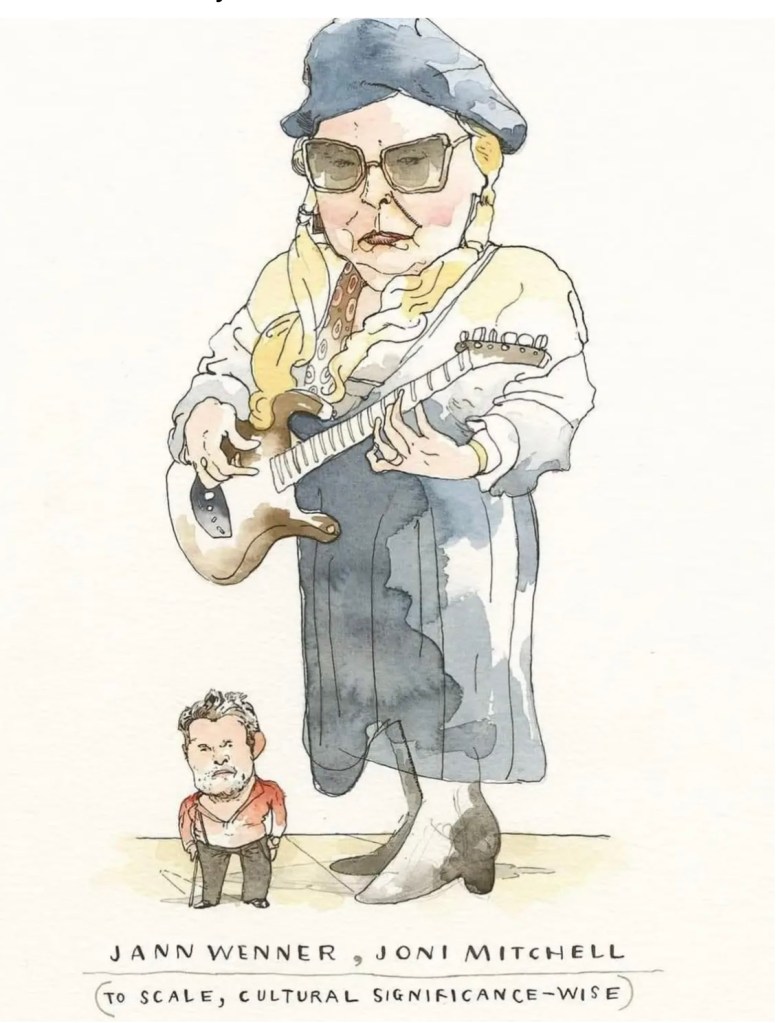
*Because celebrating Joni Mitchell is always in order, especially after the Jann Wenner nonsense. Sheesh. That guy. Joni Mitchell is, like Walt Whitman, one of my very favorite poet-philosophers, and this song has always been among my many favorites of hers, because the lyrics and music are perfection, total delight, total genius, total Joni. In a recent documentary on the life of fellow-Canadian singer-songwriter Gordon Lightfoot, there was, at one point early in in his life as a musician, a room filled with rock and roll and folk talent, each of whom were highlighted in captions – except the woman in the room, Joni Mitchell, a woman who, moreover, would go on to greater success on the national and international stage than any man including Lightfoot. It was astonishing to me, and – sadly – typical.Of course, Mitchell left Canada to settle in the U.S., which may be why Lightfoot is the more celebrated by Canadian documentarians, yet perhaps she left Canada because she was treated like the candy in the room, and because of the circumstance surrounding her early pregnancy, and abandonment by the baby’s father. Women’s lives are very often much more complex than men’s; our decisions too. (((JONI)))
…Just before our love got lost you said “I am as constant as a northern star” And I said, “Constantly in the darkness Where’s that at? If you want me I’ll be in the bar”
… On the back of a cartoon coaster In the blue TV screen light I drew a map of Canada Oh, Canada With your face sketched on it twice
… Oh, you’re in my blood like holy wine You taste so bitter and so sweet Oh, I could drink a case of you, darling And I would still be on my feet Oh, I would still be on my feet
… Oh, I am a lonely painter I live in a box of paints I’m frightened by the devil And I’m drawn to those ones that ain’t afraid
… I remember that time you told me You said, “Love is touching souls” Surely you touched mine ‘Cause part of you pours out of me In these lines from time to time
… Oh, you’re in my blood like holy wine You taste so bitter and so sweet Oh, I could drink a case of you, darling Still I’d be on my feet I would still be on my feet
… I met a woman She had a mouth like yours She knew your life She knew your devils and your deeds And she said, “Go to him, stay with him if you can But be prepared to bleed”
… Oh, but you are in my blood You’re my holy wine You’re so bitter Bitter and so sweet Oh, I could drink a case of you, darling Still I’d be on my feet I would still be on my feet
*And the bear is a changing world, wherein (predominantly white) men cannot get away with the same old shit they’ve been getting away with for a millennia. Yay. (stage directions stolen from A Winter’s Tale, one of Shakespeare’s ‘problem’ plays, which designation and play I absolutely love) The following commentary is stolen from Rebecca Solnit’s FB page…
Really nice to see Jann Wenner be ushered offstage after his horrendous remarks. But this week is full of men whose crimes went unchecked for too long, and American culture would’ve been richer had Rolling Stone not narrowed down music to a certain kind of boring white guy for 50+ years.
Rock and roll was an invention made by narrowing the field to what people like Wenner liked or just what Wenner the arbiter liked: white guys with electric guitars, not women, not Black people, not music that was more folk, funk, experimental, etc. (He slagged Joni Mitchell specifically and without defending him I’ll say whatever she does is maybe not rock and roll, because it reaches in other directions; it’s broader and deeper than his favorite flavor.)
Maybe rock and roll died a while ago–the deadliness of stadium rock was what my beloved punk rock was rebelling against, in part, in the 1970s. There was the smug self-righteousness of middle-class white people who identified with rock and roll hating on disco (urban nonwhite and gay people) and country (poor rural people) back in that era–defending their narrowness in other words.
Wenner could have just said his book was about the artists he liked best and taste is subjective and he was stuck in the sixties, but he had to pretend he was hewing to some objective standard of quality by trashing women and Black musicians as insufficiently “articulate,” as if the strung-out Jerry Garcia was somehow verbally adept in ways that the National Book Award winner and poet Patti Smith is not. Men like him think that they’re arbiters of truth and their judgment is objectivity, and that’s an ongoing problem (that I’ve written about a lot because they also often assert that facts, when profferred by women are subjective opinions while believing their opinions and tastes are facts).
But mainly, let the door hit you on the way out, Jann. Adding a screenshot from this new feature in Vanity Fair: Sticky Fingers author Joe Hagan says Wenner built the rock magazine “for and about white men.”
And this quote: “You know, just for public relations’ sake,” Wenner added, “maybe I should have gone and found one Black and one woman artist to include here that didn’t measure up to that same historical standard, just to avert this kind of criticism. Which, I get it. I had a chance to do that. Maybe I’m old-fashioned and I don’t give a [expletive] or whatever.”
*I LOVE BARRY BLITT, the New Yorker Cartoonist whose image is below… LOVE. tee hee heeeeeeeee….
My mother had seven brothers and four sisters. Her brothers were Ed, Fred, Bob, Larry, Norm, Bill, Jim, and her sisters were Polly, Mary, Fran and Betty. They were Irish and German Catholics, born and raised in a small town called Waterville, in upstate New York, not far outside of Utica. Their dad, Michael, was a baker, and their mother Pauline was kept very busy birthing and taking care of their children (her oldest was born in 1911, her youngest in 1934), especially after her husband – my maternal grandfather – died in 1938. Pauline died in 1949, at the age of sixty-two, when my mother was twenty-one.
My mother’s family was both functional and dysfunctional in many ways, like most families; many aspects of their dysfunction were cultural, ingrained, traditional, resistant to change, entirely of the times in which they – and their parents – were born. For example, my mother, surely one of the most brilliant women I have ever known, believed that boys were more important and inherently superior to girls because boys could become priests, professors, doctors, and lawyers, while, no matter how intelligent, girls got married and had someone else’s children; girls did not carry on the family name. Girls might become nurses or teachers, prior to becoming other men’s wives, and teaching – her chosen profession – was a noble one, but women’s work of all kinds, of any kind, was less than. My mother (who never shut up) also believed that girls should be compliant, amenable, and, preferably, silent – all of which fell under one of her oft-used, favorite rubrics: lady-like. Ladies were well-behaved, ladies were not interested in athletics except as spectators of the more genteel sports (boxing and football are not genteel), ladies were not openly ambitious in any sphere, ladies did not ‘want’ to date or spend time with males outside of marriage or the brief, well-chaperoned period prior to that happy state, ladies kept their legs crossed at the ankles, ladies did not discuss sex or mention ‘the body’ or ‘body parts and functions’, and a whole host of other nit-picking bullshit I had no patience with, being born wholly un-ladylike myself.
With seven brothers, there came seven (plus) sisters-in-law, because even her perfect by virtue of boy-ness Catholic brothers ran into the conundrum of discontent, abandonment, death, and divorce. Of her seven brothers, my mother’s favorite was Bob; Bob married favorite sister-in-law, Eleanor Jewell, who was the perfect wife, the perfect mother, the perfect woman, my mother often said. Eleanor was certifiably lady-like, college educated (U. Mass Amherst), Irish, and Catholic, fertile (seven children including three boys to carry on the name), the perfect help-meet for her husband’s busy career, well-spoken, never intemperate, always smiling, even though my uncle was often away for long stretches doing who knows what with the CIA and, later, in his busy role as a professor of history at Indiana U. Eleanor even did all the driving, so favorite brother and very important man-person Bob could catch up on his sleep, or his reading.
Eleanor knew how to fold a fitted sheet correctly, a sign of her perfection in the domestic sphere. Mom, really? Really? Yes, said mom, being able to fold a fitted sheet correctly is a sign of womanly perfection. Additionally, Eleanor never talked about herself, and her children were, all seven of ‘em, all the time, well-behaved and intelligent. Her daughters, a decade and more my seniors in age, were ladies because they were Eleanor’s girls, and no matter how raucous their visits to us might be, roaring with laughter at the dinner table, playing cards while flirting with my dad, we were to note, please, that their legs were crossed at the ankles at all times when seated, their hair carefully coiffed. Note too how well-behaved they are at mass, kerchiefs of lace carefully pinned in place! All of perfect Eleanor’s children would marry and pro-create, even whip smart and bean-pole tall cousin Susan, who almost left it too late. Her husband was practically an icon in our home, to my mother at least: Saint Tony, saving poor Susan from the indignities of single-hood, barrenness, failure as a human being and as a Catholic, as a woman!
Aunt Eleanor was also noteworthy in our house due to her being the only sister-in-law my mother unreservedly loved and admired. To be honest, my mother didn’t really like or approve of any of the others, although she was very fond of Sally, my uncle Norm’s wife, but that was complicated by Norm’s numerous infidelities, which – let’s face it – given mom’s mind-set (hint: patriarchal) had to have been Sally’s fault. Sally was short and stout, and she smoked those dreadful cigarillos; even if she had given Norm three boys, it was clear that Sally needed to try harder. Norm was a successful attorney, and banker, a Harvard grad, but more than anything, lest we forgot or didn’t know, Norm was good to their mother, our grandmother. When my older sister told our mother that Uncle Norm tried to get her into bed with him during a solo visit to Boston, my mom’s response was, ‘but he was so good to my mother!’, as if both things – incestuous sleeze and mommy’s boy – can’t possibly be true, when they very often are. He stuck his tongue down my throat once when I was an undergrad; I thought I was going to vomit but I sure AF didn’t tell my mother. Why would I? I knew what the party line was: obedience to family and church is everything, upsetting the given order is forbidden. Individuality, individual needs, are nothing, especially the needs of those born with a uterus.
If Bob was my mom’s favorite, her least favored brother was Ed, with Uncle Bill running a close second. Ed was the oldest brother, had been precociously intelligent as a child, married in the 1930s, had three sons, but then his wife left him, left them all. The problem was, he didn’t take this in a manner my mom and her collective sister-think believed he should (Dorothy/mom, Polly, and Betty). He raised his sons alone but then he filed for and was granted a divorce. And he re-married, and then – doubling down on his errant ways – he re-divorced, and then re-married again in 1971, his final wife, my Aunt Jeanne. Divorce is a No-No. Being abandoned was a terrible thing, and a pity, but one had to suck it up, stay married to the abandoning partner for life and that’s that. Why? Because Catholicism says so. Ed was divorced; Ed had brought the ‘D’ word into the Byrnes family’s life, and that was an unforgivable transgression. His sisters Betty, Polly and Dorothy that is. What Mary or Fran thought about it all didn’t matter. Mary was problematic herself, they both were, Fran and Mary, and they always had been. But at least Fran’s husband was a dear, if simply for taking her on, said the sisters. Uncle Phil. Italian, flamboyantly Catholic, but perfectly acceptable.
Brother Bill had also let the family down, wedding an older woman – Aunt Jane – who somehow trapped him into marriage said my mom, stifling his potential with her low-class aspirations, all of which, it turned out, was complete bullshit. Okay, she was nine months older than Uncle Bill, but their eldest child was born thirteen months after they were hitched, and Bill’s aspirations were all essential to who Uncle Bill was at his core: a man of heart. For Uncle Bill, Jane and family came first, community second, work a distant third. He adored Jane, and his kids, and was a loving, warm, generous – if distant (thanks mom) – presence throughout my life.
But the competition to be the least favored sister-in-law was actually quite fierce, Jane and Agnes (Uncle Jim’s wife, who abandoned him, and their three kids, twice!), Jetta (Jim’s second wife, who is excluded from even a mention in the family address book), Julia and Rosemary (Ed’s number one and two wives, both mentioned in the book), but then there was ‘that woman’, my aunt Chris. She married Uncle Fred in 1943 and remained his wife until her death in 1994, and she was both German and Catholic, which you’d think would be a huge plus, but there’d been a ‘jollier’ Irish American girlfriend in Utica or Waterville before Chris came along that the three sisters had all preferred. So? Obviously that didn’t work, for either party, right? Chris and Fred met while counsellors at a summer camp; Chris was tall and athletic, they both loved tennis, and she had the kind of hair I have envied my whole life, thick and fabulous, with just enough curl to make it interesting, prone to blond streaks after a day spent playing tennis in the sun.
The truth is I don’t know a lot about my aunt Chris. And I regret that. And I don’t know very much about her because my loyalty as a child, and beyond, was to my mother, to the sisters she gossiped and agreed with, Polly and Betty, and to the idea they instilled in me that Chris was not very nice, that Chris was cold and a bad wife to Fred (barren!), but not just because she didn’t ‘give him’ children. There was something else, and looking back, it seemed that, to the sister-hive, she didn’t have down what Uncle Bill’s wife Aunt Jane personified: insecurity, guilt, responsibility, shame. Jane kept her head down around the sisters, but Aunt Chris did not, and so along with her failure to ‘bear fruit’, Chris defied their accepted norms, which defiance they would not forgive. Yet even as a child I saw that Chris and Fred were happy together, that Uncle Fred adored her, that they both had great clothes, nice cars, a gorgeous house in Ridgewood, N.J., a place in Florida, a close yet expansive circle of friends: a great life. Keep her head down? Please.
Chris and Fred wanted children, I think, but it hadn’t happened; I don’t know why or whose ‘fault’ it was, but the sister-hive blamed Chris. Aunt Chris and Uncle Fred wanted me to come to them for a week, maybe more, meet their friends, to be introduced around at the club and elsewhere, to play tennis, taking a lesson or two, or more. I loved tennis, and was very good at it, which prompted the invite, but I refused (it’s your choice, said my mom. really, really, I thought, really?!). I knew my mother didn’t want me to go, and, longing for her approval, I passed on getting the kind of attention I needed from two adults who didn’t have another kid in their lives, or none that I knew of. My Uncle Fred and Aunt Chris were also my brother Fred’s godparents; it was made clear to me by my mom that any invitation from them was actually supposed to go to my brother, not to me, and that in accepting I would be usurping his place – but it’s your choice, Moj. My godparents were Aunt Anne and Uncle Larry in Buffalo, a couple with seven kids of their own to raise who sent me prayer cards for my birthday every year, and were as far from my kind of folks as it was possible to be. That sister-in-law (Aunt Anne) was acceptable, a devout Catholic, but disappointingly she wasn’t a gossip, and furthermore, given that Larry died young (at 59, from diabetic complications), wasn’t it fair to say that Anne was at least in large part to blame?
Aunt Chris was kind, and smart; she knew that her husband’s sisters didn’t approve of her, but she never behaved other than like a ship passing in the night, a luxury liner, the Queen Christina I, moving on, above and outside the fray of family gossip and sexist, bullshit stupidity. I wish I’d know her better; I wish I’d said yes, and yes, take me away, please – get me out of here – but I didn’t. Least favored sister-in-law with least favorite child might’ve been a powerful combo, if I’d known better – but I didn’t.