*how perfect that this post, with this message, appears on the day after You-Know-Who (Orange Menace, Con-man Dump, Convicted Felon #45, Major Insulter of Women. Yes, of All Women) was found guilty in an NYC courtroom. Several of my friends worked in YKW’s hotels in Manhattan during the 80s, and it was well-known that if you were a white or light-skinned Latino girl, blond especially, and YKW was roaming the halls of his various properties, watch out, beware, and do not clean rooms or walk through the halls of those same properties alone, ever. The 80s were an ugly time in the city, and he was one of the ugliest humans of that ugly age. Yesterday’s decision by a jury of 12 Americans proves that the justice system works. Let’s hope the American electoral system also decides to work, expunging him from the public sphere once and for all, as in for all time. Insert dancing emojis here____________________________
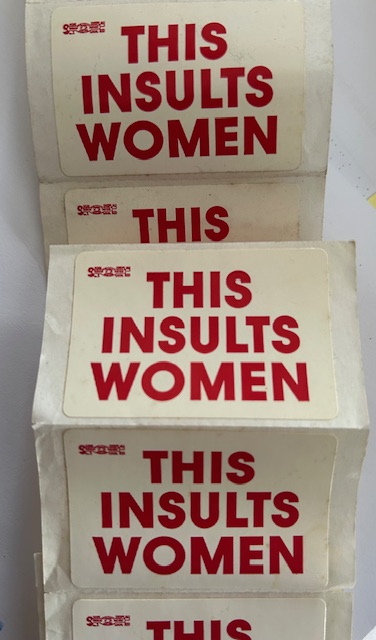
I bought these puppies, an entire roll of them (1000?), in the mid-eighties. I used them on subway advertising, mostly, which I believe was, on my part, a minor felony? A misdemeanor? But I didn’t use them all, as these leftovers attest, and I was careful, very much so because I didn’t like the idea of being arrested, going to jail, or paying fines, especially as I didn’t have a lot of money to throw around. I had enough, however, to buy these, obviously. Values, y’all. We find the money for those things we value, prioritize, need. I prioritize feminism, and activism.
As for the ads that really bothered me enough to lay a sticker on ‘em, there were so many to choose from, but the one I really hated were from one NYC ‘Breast Augmentation Clinic’, which posited women and girls as feeling – and being – less desirable because their boobs were small. The shame, the shame! Lonely, undesirable women and girls, solve everything by purchasing bigger boobs from us! You will be porn-star hot, which is the goal of every woman everywhere!
The language of the ads was, literally, along the lines of ‘we know you feel and look like shit because you’re flat-chested.’ No. Just no. The photo accompanying the ads were of a blond, long-haired women who was contemplating her chest, head down, grainy and out of focus, because no one wants to look at that, that pancake chest a’yours, right!?! FEH.
Another set of ads I targeted concerned ‘abortion counseling services’, a.k.a. conservative religious organizations selling their anti-abortion agenda as helping women make ‘the right choice’. These non-medically licensed places harm women and girls, are chock-full of mis- and dis-information and are, in too many states, supported by local taxpayer dollars, which is so fucking infuriating I cannot even, I just cannot.
Bus ads, the big glass or plastic panels at the stops – those were good for application of these stickers as well, and safer to apply. If you are inclined toward activism, even of the sticker and run kind…
Deep breaths. Patience is a virtue, one I am working on all the time. #SmashThePatriarchyNOW
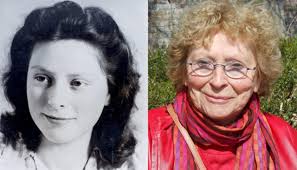
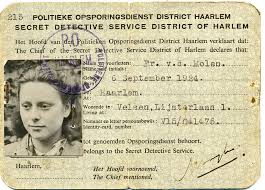
Never heard of him. Her. Freddie is – or rather was, a her. Freddie short for? I can’t find that it was short for anything but one assumes Frederica – a not uncommon name in Northern Europe in the 1920s, when Freddie was born. She grew up in poverty and, when still a child, seduced Nazi soldiers in occupied Holland, luring them to the woods where she killed them. My point being that as much as I think I would do such a thing – holy fuck – Freddie actually did it.
Her family hid a Jewish couple in their home, and Freddie became a resistance fighter in the Netherlands in her teens, handing out anti-Nazi pamphlets, using dynamite to disable bridges and railroad tracks and yes, seducing soldiers to their deaths as well as, in one noteworthy incident, shooting one from her moving bike. Again – something I like to imagine myself doing and – probably not. In addition to the above, Freddie and her sister helped Jewish children escape Dutch concentration camps, and, ultimately, the country.
Here’s the thing: why no film or TV show about Freddie, FFS? I’m pretty sick TBH, of films about the Nazis and their hateful, heinous behavior, which in my opinion distract somewhat from the heinousness of current people/s and events, events we don’t want to look at and consider because then we’d have to take some responsibility for not getting on the bike or doing something, anything (calling a Senator or Congressperson, for example) to help change the present day shitshow of heinousness. Costume dramas, reality TV, professional sports: a lovely way to distract ourselves while shit happens elsewhere, bad, terrible shit we participate in passively from our comfy homes – but wait I lost my thread!
A show about a teenaged girl and her equally adolescent sister, Freddie and Truus! Now that I could get behind, while waiting for my congressman (a one-termer, fingers x’ed) via one of his representatives, to pick up. Again.
Okay so to set the scene, we are living at the farm, and I am eight, maybe nine years-old. It is spring, I think, and we are, as a family, cleaning up an area around and near the garage and gas pump, a metal hand-cranked thing left-over from the actual farm-farming days; I love and miss this antique pump to this day, no matter how inconvenient it was, because in my opinion it was very, very cool! But I digress. There were branches lying about, weeds too, and we were all doing our thing to make the patch around the pump, near our dirt road driveway’s end, nice again. Maybe there had been a wind storm or something. But, we were all outside, together, participating in an activity of rural life (or whatever), notable for all of those aspects alone. But wait, there’s more.
At that tender age, what I knew, had learned, or been told about the female body – my own body – was almost nothing. Nothing. I remember being chastised one Easter for looking at the girdle ads in a Monkey Wards catalogue with my brother and younger sister (‘Giggling, laughing, at those photos, while Jesus is dying for your sins on the cross!!‘, my mother said), but other than that, and the covers of girlie magazines in my dad’s store, which were positioned way above my head, I knew nothing. Nada. Nyet.
I did know I was supposed to be a virgin until I married. I knew that there were good girls and bad girls, good women (married) and bad (unmarried, fast, or loose – whatever those terms actually meant), and I knew I better be a good girl except – well, that horse had already left the barn, right? Except it wasn’t a horse, it was the giant elephant in the room, the bruise on my little girl mind and soul, one I would ignore for decades because – survival comes first, y’all, and while denial might not just be a river in Egypt, disassociation is very real, and very, very powerful.
All to say that at eight or nine, what I didn’t know about my own body was a lot. And ignorance was not and never is bliss, in my view, but it can be damnably hilarious at times. But. And. However – children aren’t stupid, I certainly wasn’t, but what I also was – and all children are, was deeply imaginative, and hints of this and that and what bad stuff could happen (and in fact had happened) in the land of supposedly blissful ignorance, those hints and inferences were imagined into even larger boogie-men. And, in this instance, what I didn’t know anything about that made for future hilarity but late 1960’s terror, was pubic hair. Pubic hair.
Yup. Pubic hair. Did I even know such a thing existed? Had I ever seen an adult male or female naked? Nope. Or, if I had, I had certainly blanked it out. So, on this spring day of extremely rare familial comity in the great outdoors, I was just doing my thing, bending over to pick up sticks and pull weeds, when I happened to look up, and up happened to be up my mother’s denim wrap skirt. It also happened that she was not wearing underwear. And, I am not shitting you, I thought a rat or something had gone up her skirt and I completely panicked. I kept my mouth shut, however, deciding to look again because if it were a rat or mouse – my mother would be screaming her head off, right? She hated and feared mice and all other critters with all her might. So, I bent over and peeked again, and this time – not panicking – I took a longer look. Oh, I think that is my mother. And she’s hairy – yeesh. Gross!! Why would you have hair on your lower parts? Is it just her?! Gosh, I hope so. Please don’t tell me it’s on everyone. It can’t be! Sheesh.
I did not look again.
Again, I said nothing. I vaguely recall asking someone – lord knows who – about hair on private parts, but it is also possible this never happened and that for educational purposes, I may have (I’m realizing as I write this that this is much more likely by a factor of about a billion) grabbed a nudie magazine without my dad seeing me one slow day at the store, and learned ‘independently’ what the exterior of adult female private parts looked like.
Still, I will never forget or stop laughing over the fear and shock and horror I felt that day, just helping out over-here, and WHATTHEFUCKINGHELLISTHAT – only in child me words, ‘Ohmigosh, what IS that?!There’s a mouse/rat/woodchuck/woodland creature up my mom’s skirt!!
Nope. That, gentle reader, was my mother’s Beaver. Snatch. Bush. Crotch. Box. Mons Venus. Groin. Rug. I remember learning that – or rather the term ‘rug muncher’ – in a 1980s British film, Withnail and I, maybe? Sammie and Rosie Get Laid? Learning independently once started, never ends.
Mark Twain, after reading his obituary while traveling in London in 1897, famously sent the following words via cable to the press in the United States, ‘Reports of my death are greatly exaggerated’; Twain died in 1910. This story may or may not be apocryphal, but the reason I reference it is to say that during regular intervals in my life, the demise of NYC has been predicted over and over, and y’know what? Hasn’t happened. I’ll even go so far as to say that it won’t happen. Change is inevitable, and who knows that the twenty-second century will bring (I won’t be around to see it), but I am pretty sure NYC will outlast its detractors, and the many prognosticators of it’s doom. One of them died in 2023: Pat Robertson. Robertson used both the AIDs epidemic and 9/11 to trash NYC as having been forsaken by Gawd, deserving of every kind of misfortune, and doomed to end times style destruction, all while raising money for his empire of bullshit.
This winter, while visiting my auntie in Flah, I fell into conversation with an older white couple, who, when I said I was from New York, launched into an unprovoked lecture about the death of NYC, how it was such a terrible, dangerous mess, and going down the tubes. I corrected them, first as I am from upstate New York, not the city, thank you very much, and second as I wanted to assure them that NYC was not dying, was not that dangerous, and would in time work out whatever challenges it was facing. But, tell me, is there anything specific you feel is especially dangerous about NYC right now? And when was the last time you were actually there, as in have you ever been to New York City? They had not, were originally from Ohio, and the danger they referenced was on account of the ‘illegals’ (migrants sent there by various southern, red-state Gubbners, both Gubbners and their grotesque policies left unmentioned by said white persons), that were ‘over-running’ the place.
I replied, well, that’s simply untrue, and that I personally knew the individual who was running the migrant housing program, a highly competent, deeply intelligent and compassionate individual who, among many talented others, were working on real concerns regarding a migrant population that was not, in fact, ‘over-running’ the city. I also suggested that they might need a new source of information, stopping short of telling them to puh-leeze, puh-leeze stop watching Fox Fucking News.
The conversation ended there. Old, well-heeled white people, y’gotta love ‘em. Or not. I just finished Tim Alberta’s book The Kingdom, the Power, and the Glory, and let’s just say, those white Christian evangelicals are a hoot and a holler. Hypocritical, money and power obsessed hoots (outside of marriage hanky-panky, too, if you dig deeper); white male Christians who’ve been hollering about liberals ruining America while working for decades to make us a white Christian nationalist country, destroying a foundational principle of our country, that of separation of church and state not to mention ignoring the increasingly brown beautification of American citizens. None of this is funny, but y’know what is: their numbers are dwindling. Currently a quarter of Americans identify as Christians, with varying definitions of evangelical teasing out a percentage of evangelicals within that 25% at anywhere between 8 – 17%. In 1950, 90% of Americans identified as Christians, and Americans under thirty are losing their religion at a rapidly increasing pace, largely because messages of hate and exclusion – whattayaknow – discourage including religion in their lives.
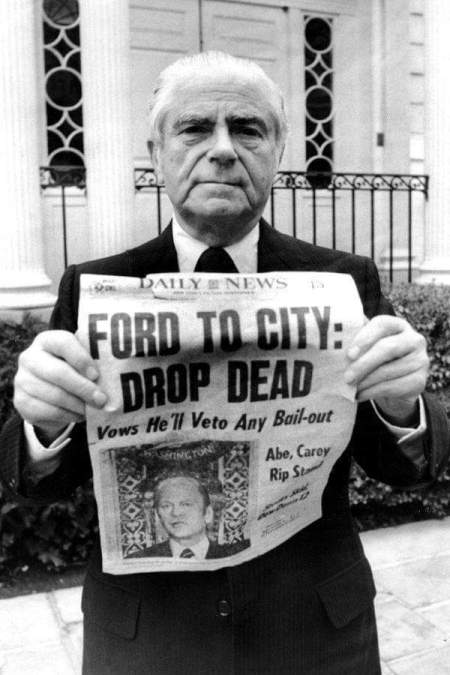
The demise of NYC was predicted in the 70s (Ford to NYC: Drop Dead – an actual headline), the 80s and 90s, and – after 9/11 – again at the dawn of our new century. Not happening. And it’s not happening because whatever the reports of this or that challenge currently facing NYC or any other center of global finance, arts, culture and population, life goes on, and the appeal of a metro area is real; not for everyone, but real. The population in NYC actually grew in the decade after 9/11. And while Covid19 turned normally busy streets and avenues into a near post-apocalyptic desert, it was temporary; the Big Apple has bounced back, like every other major, medium, or barely a city, suburb, or small town that seemed drained of action after a once a century global pandemic sent us all scrambling into our dens, while triggering the darker fear centers of our brains.
Fear is a powerful driver of human belief and behavior. It is often driven by ignorance, ignorance that includes a lack of plain old fashioned familiarity with whatever the object of fear actually is, in reality. I was and remain a fan of Supreme Court Justice Sandra Day O’Connor, the first woman on the high court, yet after 9/11, visiting the Big Apple for – perhaps – the first time, or one of very few times – I’m not sure – I was disappointed to read that she was surprised to find so many normal, average American people there. Who did she think drove the buses, delivered the mail, took notes at meetings, cleaned the buildings, fought fires and kept folks safe?
NYC, like any place you know, love, or visit, is so much more than any one person, film, book, TV show or news broadcast can describe or sum up. As someone who lived there for over two decades, and has visited numerous times since, I can tell y’all that in my opinion, an opinion based on reality, on real experience, NYC is doing fine, as is America. I often think Americans are unconscious and very spoiled; too many of us simply don’t know how lucky we are and how great this country actually is. And as for migrants, of which I have known, worked with, and hired quite a few, good men and women from all over the globe, to me they look like future Americans seeking opportunity, like those nice white folks from Ohio’s grandparents or great-grandparents did, back in the day.
*from the archive and oh maybe the early 2000s? who knows at this point, but, in increments I will share and, knock wood, you will enjoy, this old-ish story. Mildred Jensen was an actual math teacher I had in middle school, she was tall and leggy, but everything else is entirely fictional here. I really liked her, a lot, even if – at the end of her career when I had her as an instructor – she was showing not only her age but the age of some of her ideas (boys are better at measuring things, for one).
Thanks for reading, and subscribing!!
Mildred spent her early long summer vacations back at her family’s farm; she loved having something useful to do. She also spent time furthering her studies, getting her Masters finished not long past her twenty-seventh birthday. She could have visited some of her old college classmates or newly wed colleagues, yet felt uncomfortable in the kitchens of her married friends, holding babies for a moment or two, or feeling her hands hang uselessly by her side. The farm was easier, familiar; they always needed help. Her parents were getting older, getting on, and her baby brother was a baby no more, had taken – right out of high school – a wife, a nice girl from a farming family several towns over he’d met at the county fair, showing cows. Mildred enjoyed her new sister-in-laws company, for although the girl – woman – was not nearly as bright as Mildred was herself, her cares were cares Mildred understood, the cares of a farmer’s wife.
Mildred admitted to her family that she missed them, missed the pace and closeness of the farm; working and living in a village was different, and good, but she missed the animals, too, their silent sweetness, their slow paced calm. She wondered, too, if she would ever be able to afford, on her own, a house, a place where she could plant flowers – iris, daffodils, peonies, roses, and have a kitchen garden, too, like the one her parents had at home. Her brother was a sweet, hard-working young man, very much in love with his sweet, silly bride. They were expecting already and made much of telling this to Mildred, the future aunt and dedicated career woman. She was glad for them, glad for her parents, who longed for grandchildren to fill the empty bedrooms of their missing sons.
Entering her forth decade, Mildred had to admit to herself that she yearned for something more. Her students needed her, no question, and there were those among them she really enjoyed, farm kids, especially, the boys and girls who came into town in hand-me-downs that reminded her of the shirts and dresses she used to wear herself. She knew the families now, chatted with former students and parents while chaperoning basketball games, class hops, and the senior play. She had by this time taught whole family groups of several siblings and cousins, branches of a single clan; the knowledge gained through this kind of contact over the years was good, and deeply rewarding in its own way. She was respected in the community for her combination of good sense and steel, her humor, high standards and warm heart; her students did well and several were recognized in state testing as showing ‘superior skills in math’.
At thirty-four Mildred met a young farmer and thought nothing of it; she was standing in her classroom late one early fall day; the school was having an open house for the parents and community. He was slim and shy, the much older brother of a student, one of those kids to whom she had taken such a shine. He admitted to her he’d never done well in school, felt tied to his desk against his will while he itched to get away. They laughed together over this; he’d had dropped out of school and was, it seemed to her, embarrassed by this, admitting that he was a stranger to her because of this ‘early exit’. He’d gone to serve overseas, in Europe, felt lucky to have lived through it all. He thanked her for her kindness to his brother, the ‘smart one’ in his family, the one he hoped might go on to college, as he had not. He had hopes for the boy, the youngest of the bunch, as he showed such aptitude for machinery, for building things, for fixing things though yes, he said ‘they’d miss him terribly on the farm.’ He lingered for a while, disconcerting Mildred, as he had so little to say, but his brother was in the building somewhere, sure to come and take this fellow off and away; perhaps he was showing their father, a widower, the new science labs. “Perhaps,’ his brother said, still leaning against her desk. She walked to the door and pointed the way, standing in the gleaming marble hallway, plucking at her sweater nervously with her left hand, wondering what he was hanging around for, the gangly fool.
After that it seemed Mildred kept running into this young man in town and that he always wanted to chat; the school secretary, a long time local, told her that he was twenty-six, younger than her kid brother, Mildred thought. She saw him at the grocer, the post office, and in the school, where he’d taken to stopping by for a chat, bringing her vegetables, taking his bother home by truck, sparing him a long bumpy ride on the bus. He was a quiet man by the name of Bill Gray; his family, he told her, had farmed in the valley to the north east of town for three generations; he was the fourth.
It took a married friend, one of those girls Mildred had tried gin and cigarettes with, now a full time mom who liked to reminisce about the good old days of her carefree single years, to point out that the young man was interested in Mildred, ‘In’, she whispered in her ear with relish ‘a romantic way’. The woman laughed to see the stunned look on Mildred’s face, adding ‘Oh well, I wouldn’t let it worry me if I were you. Tom says he’s not the marrying type.’ Here she took a drag on yet another cigarette, the end stained red with her lipstick, ‘He was in Tom’s brother’s class, and has always been a little scared of women, so Tom says, and Tom usually knows. Tom’s terribly clever about people, you know.’ Mildred didn’t know, and she also didn’t know if she were more horrified by the thought that Bill Gray might be interested in her romantically (and what that might mean for her), or by the way in which her once lively friend kept quoting her husband of seven years. Is that what happened to intelligent women when they married? Surely she would never know, herself, personally, first hand. But back to what she should do about this Bill Gray, if in fact he were interested? But he can’t be, she thought. She was at least four, almost five years his senior! Mildred put it out of her mind, no use making a fuss about stuff and nonsense, as Grandma Jensen used to say. And it was just not possible. Unlikely. Improbable. Tom would know, and at this last thought before she closed her eyes to sleep, she snorted softly with laughter into her pillow.
Bill Gray was interested, inviting Mildred to his family farm for Easter supper; one fine spring day, hat in hand, he’d shown up once again at the door of her classroom, holding a bunch of lemony daffodils wrapped at one end in a damp cloth and gripped tight, almost as if his life depended on it, by his large, work-roughened hands. Looking at him Mildred found she was unable to say no, taken aback by the invitation and his halting words, the hopeful stance, the nervousness of him, the vulnerability. And so she said, simply, ‘Yes’. He would call for her at three, he said, smiling slightly while sidling out her classroom door, and with his father’s car, not the truck with which he believed she was familiar. And then he was gone. What just happened, Mildred thought? What was that? Am I familiar with his truck? Had he seen her, looking out her classroom window, as she and his brother drove away. She blushed to think it could be so. Had she really said yes/ And did he know, how could he know, where she lived?