Thanksgiving at Studio 54

Thanksgiving at Studio 54

You might think that of all the holidays throughout the year, Halloween would be the most exciting, most packed, most insane and over-the-top at Studio 54, but it wasn’t. Halloween was good fun, and full moon nights were crazy, sometimes dangerously so, but the most energy, the biggest celebrations, the busiest and funnest night at Studio was Thanksgiving. Thanksgiving. I came to believe that this was because the people who were dancing – and Thursday was gay night, after all – were celebrating having got that god-awful dinner with mom and dad and sister and brother (all them straight, or pretending to be so) TF over with, and now, let us shake off the bullshit and dance, dance, dance. 

I felt that way too, elated, celebratory, shaking my twenty-something ass off in the coat room tucked away under the DJ booth, yet still on the dance floor. I worked that open, shout in my ear to be heard space all alone, which suited me to the ground. They filled me up first, opening the club between nine and ten p.m.; by ten thirty I was essentially done, free to watch, listen, and move, another willing slave to the rhythm. 

I hadn’t gone home, gone upstate to the big dinner with three different types of stuffing for picky eaters of all kinds. I had stayed in the city, alone again, which also suited me. When I went home, it was a reminder of who I wasn’t anymore, a girl who never quite fit the rural setting and tight-lipped, look the other way mold of my childhood, as well as who I was becoming – a foul-mouthed New Yorker, a city girl who asked my mother to ‘pass the fucking sweet potatoes’. Occasionally too, early on, I chose the disorientating experience of sitting amidst another family, this time in New York City; their particular food choices and dysfunction were like visiting a foreign land, yet without the excuse of not knowing the language. Less charming, just as isolating. 

1983 or ’84? Maybe ’85? Not ’82 for sure. There were whispers of what was to come, the ‘gay cancer’ that was killing young men and old in San Francisco, and elsewhere. I read the gray lady daily, and remember seeing the early headlines. Gay cancer? Young men? As a student I had the ability to pick the choicest bits and pieces of what mattered out of our texts, and the lectures given by teachers whose passion, if not burned out, quenched, squashed, or distracted by the messiness of their personal lives and choices, was at least softened, like a flaccid penis, used up for now; let’s try again later. 

Then there were those instructors who were distracted in another way, thoughts of history and literature impinged upon by what must’ve seemed like a natural desire to fuck teenaged female students, especially the girls who played sports for real, finally, thanks to Title IX. ‘Hot pants’ were in that year, and that decade; the school board reluctantly provided crotch wedging short shorts as one-half part of new uniforms for all four sports the girls played. What’s a man to do, watching that?

How had I ever walked those marble New Deal halls, so happy-seeming, so involved, such a good student, if just a little too assertive, one might even say mouthy, for a girl? How had I ever sat at that dining table, silent but attuned to the undercurrents, the undertow: my sister starving herself or binging before another session with the porcelain god, my mother hating my grandfather with every cell in her body, doing the right thing hosting the old people even if it killed her, always a fucking martyr, my grandmother deaf and for a good reason, my dad enjoying it as if it were sport. Hell, at least no one was getting back-handed, slapped around, or punched by the old man, like when he was a kid in that same space. That, I think, was his point of view; it’s an improvement, right? Why would I go home to that, given the choice? Let me dance, let me move in the dark, let me be overtaken by music.

They were my people, those dancers, those party boys doing poppers in tight jeans and leatherette pants that made them sweat buckets. They too were lost and disjointed, didn’t fit in, weren’t what ‘mom and dad’ back in Rye, Stamford, Jersey or Brooklyn, Queens, Staten Island, the Bronx, and all over Manhattan expected, wanted, demanded, required. They were there after enduring dinner with the folks and siblings and the roof might have been lifted off the place, the relief, the joy, the release was that palpable, that much of an outdrawn breath – volcanic in scope. We all screamed in relief, screamed. We were young and dumb and had no idea what was coming down the pike, even if those gay cancer stories persisted, even if my friends from college had odd rashes and strange health diagnoses monthly, daily, and, ultimately, by the hour.   

They were my people and they were not, because they were soon, too soon, dying, and I was a woman, and straight, and not sweating every moment over who, what, when and how long, viral loads and T cells. T cells, which the AIDs pandemic led to be ‘discovered’, impacting many other illnesses. Still, I was among them, a witness, yet I wasn’t ‘of them’, just like those dinners in foreign families, people being nice by including me but – ultimately, no thanks, not that tribe, either. And I had enough on my plate, escaping and surviving the one I was born into, unable to not see what was going on, and be struck by it in all families, still the middle child, wanting everyone to get along or at least own it, own your jealousy, mom, own your illness, big sis, let’s fix it, isn’t that a good thing, opening my mouthy mouth? Better to stay away. Pointing out that the Emperor has no clothes on (and there are almost always Emperors, oftentimes several, in families) is not a happy undertaking. 

We’re there, still, dancing in the dark under the lights, the machine-made fog hiding us from view, if anyone was looking, the bass notes lifting us off our feet, rumbling our bones, Sylvester or Madonna or whoever had the latest hit dance tune on the cat walk above our heads. The tips those nights of gratitude were off the charts, another sign of the relief and joy felt by the boys, the men, the women, too (not many), who came out after the football and turkey had been consumed to the extent found endurable. I can feel it in my marrow, that music, that joy, that deep releasing breath of familial social obligations met, let me be free, let my people come.
September Tomatoes

September Tomatoes

*a poem by Karina Borowicz, who is a Massachusetts born and bred poet with an MFA from the U of New Hampshire. Her first collection of poetry, The Bees Are Waiting, was published in 2013, and her second, Proof, was published in 2014. A link to Borowicz’s website is posted below this poem of summer ending, check it out. 🙂

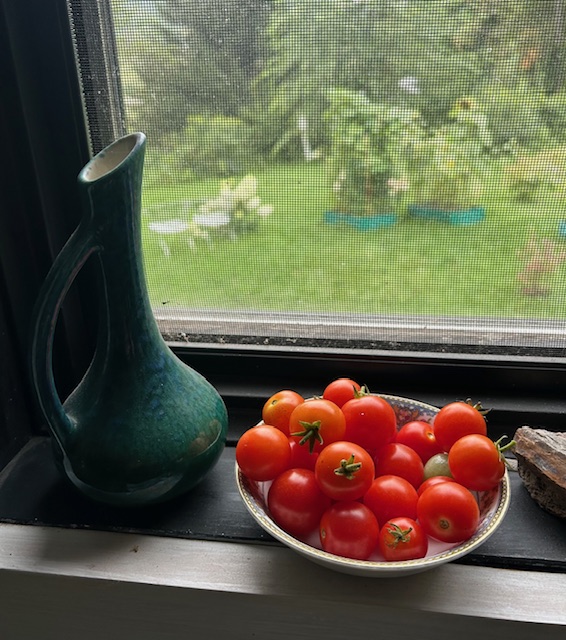
The whiskey stink of rot has settled

in the garden, and a burst of fruit flies rises

when I touch the dying tomato plants.

Still, the claws of tiny yellow blossoms

flail in the air as I pull the vines up by the roots

and toss them in the compost.

It feels cruel. Something in me isn’t ready

to let go of summer so easily. To destroy

what I’ve carefully cultivated all these months.

Those pale flowers might still have time to fruit.

My great-grandmother sang with the girls of her village

as they pulled the flax. Songs so old

and so tied to the season that the very sound

seemed to turn the weather.

https://karinaborowicz.com

The World Is So Beautiful

The World Is So Beautiful

Fall Hydrangeas… one of the beauties of the world, on my back lawn, and any year now it’ll be ten times this size… fingers x’ed, & Diego willing (he took off a chunk – at least 1/3 of the whole, chasing a rabbit, this summer. sigh.) 🙂

Virginia Woolf Said…

Virginia Woolf Said…

“There is a kind of sadness that comes from knowing too much, from seeing the world as it truly is. It is the sadness of understanding that life is not a grand adventure, but a series of small, insignificant moments, that love is not a fairy tale, but a fragile, fleeting emotion, that happiness is not a permanent state, but a rare, fleeting glimpse of something we can never hold onto. And in that understanding, there is a profound loneliness, a sense of being cut off from the world, from other people, from oneself.”

I’ve read most of Woolf’s writing, and have enjoyed it; among so many others I think, ‘y’know, you should read Woolf again, see if – being older – it resonates differently, or more deeply or something.’ But – I won’t. She was and is among the writers I have loved, but not LOVED. We all find inspiration in different places and from different sources, at different times – and TBH, until November’s election is done and dusted I will be way too restless to do much other than blog, read new fiction (mostly), and watch comedies on the boob tube while fretting over the outcome. Can’t come soon enough!!

And, the Indigo Girls wrote the following song, entitled Virginia Woolf, which is among my favorites of theirs, and such a lovely tribute to the power of words shared – written by Emily Saltier.

Some will strut and some will fret
See this an hour on the stage
Others will not but they’ll sweat
In their hopelessness and their rage
We’re all the same the men of anger 
And women of the page

They published your diary
And that’s how I got to know you
The key to the room of your own and a mind without end
And here’s a young girl
On a kind of a telephone line through time
And the voice at the other end comes like a long lost friend
So I know I’m all right
Life will come and life will go
Still I feel it’s all right
Cause I just got a letter to my soul
And when my whole life is on the tip of my tongue
Empty pages for the no longer young
The apathy of time laughs in my face
You say “each life has its place”

The hatches were battened
The thunderclouds rolled and the critics stormed
The battle surrounded the white flag of your youth
If you need to know that you weathered the storm
Of cruel mortality
A hundred years later I’m sitting here living proof
So you know you’re all right
(All right)
Life will come and life will go
(Life will come and go)
Still you’ll feel it’s all right
(All right)
Someone’ll get a letter to your soul
(Someone gets your soul)
When your whole life is on the tip of your tongue
Empty pages for the no longer young
The apathy of time laughed in your face
Did you hear me say “each life has its place”

The place where you hold me
Dark in a pocket of truth
The moon had swallowed the sun and the light of the earth
And so it was for you
When the river eclipsed your life
And sent your soul like a message in a bottle to me
And it was my rebirth
So we know we’re all right
(All right)
Though life will come and life will go
(Though life will come and life will go)
Still you’ll feel it’s all right
(All right)
Someone’ll will get a letter to your soul
(Someone gets your soul)
Then you know you’re all right
(When my whole life is on the tip of my tongue)
Then you feel you’re all right
(Empty pages for the no longer young)
And your hear dry you eyes
(You said)
And you know it’s all right
(Each life has it’s place)
And your hear dry your eyes
(You said)
And you know it’s all right
(Each life has it’s place)
And it’s all right
(It’ll be all right)

What Were You Wearing? The Exhibit.

What Were You Wearing? The Exhibit.

*If you haven’t read about this exhibit or seen the website, I highly encourage you to do so with the caveat that it’s painful, triggering for victims/survivors of sexual assault, and powerful. I couldn’t tell you for the life of me what I was wearing the first time, or the third or fourth. In my view, what I was wearing is immaterial, other than that I was ‘wearing’ a female body, a child’s female body, and that meant – or so it seems – I was fair game for predators of all kinds.

****I hope this link works, I am technologically inept, so if it doesn’t pls GOOGLE What Were You Wearing Exhibit, Dove Center, UTAH

From the website: The purpose of this exhibit is to dispel a victim-blaming myth that clothing somehow invites a sexual assault. Victims of crime are not responsible for crimes committed against them. Survivors of rape/sexual assault are often asked, “What were you wearing?” We need to stop asking this. We encourage you to look at these stories and outfits of local survivors to see that clothing is irrelevant when it comes to sexual assault. As you read what these survivors shared, please take a moment to reconsider what may be your own long-held beliefs about sexual assault that are, in reality, myths and stereotypes that can aid perpetrators of crime in avoiding accountability for their choices.

*About the Dove Center, which sponsored the exhibit:

At DOVE Center, we are committed to cultivating an informed community free from domestic abuse and sexual violence.

We work to empower those impacted by domestic abuse and sexual violence. We do this by:

Relentlessly pursuing community education to increase bystander awareness and shift culture norms.

Providing safe shelter and trauma-informed services in order to facilitate safety, healing, and assault recovery;

Engaging children and youth to understand safe, healthy relationships and mutual respect, to break cycles of violence in families and in the community;