Apr 30, 2025
Our bodies are riddled with scars. Some fade over time, but others remain, telling stories while reminding us of our encounters with cutting surfaces, hard facts and hard knocks. I have a scar on the middle finger of my right hand that, gently curving, still shows up after all these years, from at least 50 years ago. I got it opening a can of dog food for our dog, Sandy. I remember watching the edge of the can, the can top, cutting through my finger as it happened, as if in slow-mo. And I remember how much it bled. It probably needed stiches, but that wasn’t likely, not in our house. Anyway, it didn’t happen, the stitches, the taking to a doctor, the actual treatment of a 2” gash. I doubt my mother even got out of her chair to look; I certainly, by that time, would not have insisted she do so.
I have a scar on the back of my right hand that I got carrying a friend from my hometown over the threshold of her college dorm in the fall of our freshman year. We were both extremely drunk, but I was used to holding it together (I’d been the designated drunk driver in high school) in a way she was not; plus, she’d just been puking her guts out, in the bushes adjacent to her dorm. My hand got caught trying to catch the door before it shut behind another teenager from my hometown, another friend from the past who was also drunk as a skunk. Do skunks even actually get drunk? On sour apples, or something like that? I know I didn’t cry or even register the pain all that much. I was that blotto, that inebriated. Inebriated. What a word. Blotto, too. Blotto. Blot.
I have a long couple of scars on my arms, both arms, from a day when, returning home with my adopted dog, Lottie Lenya Lou Mueller, we surprised my roommate’s cat, sitting on the open, unscreened windowsill in the kitchen; it went screeching out into the summer’s day air; I ran to find it hanging on by its claws to the side of the window, and building. I reached down trying to bring it back in, resulting in five- and six-inch scars where its claws gouged out tracks as it fell from my outstretched arms to the ground, five stories below. It haunts me still.
I have a barely discernible scar on my right arm from a mad dash to kill my little sister when I was four years old, maybe? Unable to stop myself when she stepped out of the way (if I was four, she was 2.5, but quick, I guess), I crashed through the glass window of the back door to our house on the corner of Maple and Main streets. Perhaps she was able to get away because I announced I was going to kill her, like cartoon villains who expound upon their intentions before attacking, giving the game away. I don’t recall, and I definitely don’t remember why I was so angry; I only know where the scar is, still, all these many years later, stretching from my elbow where it is a circle of faded whiteness resembling a large drop of water, extending almost all the way up my forearm, in a thin, thready line of more lightened, lighter skin.
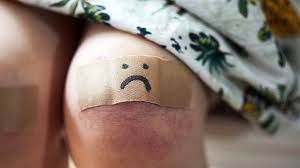
On my knees I have many scars, including from a knee down fall last year in the snow. Mostly, most prominently, however, are the scars I got when I was 6 years old, on another snowy day. I’d walked down to the Hubbell’s house, just a few doors away on Church St. (the second house we lived in during my childhood), to see if anyone wanted to come out and play, but no one was home. On the way down their steep driveway, despite going slowly as I was afraid of falling, I went bang, onto my knees, and it hurt like absolute hell. All I had on was a thin onesie snowsuit and some cotton pants, I think. I cried all the way home. My mother, in the kitchen, was on the phone and don’t you dare interrupt me, you’re fine, stop crying, go back outside, which eventually, finally, I did.
Later, she removed my snowsuit to find it filled with blood. More gashes, and on both knees, gashes that were two or more inches long, sluggishly bleeding still; they also needed stitching they never got. I wear those scars to this day like the badges of honor they are; whose I’m not sure. Mine, I guess? Mine, of course. They’re quite impressive, even now, all these many years later. They never seem to fade. Sometimes in bed or in the bath, my fingers trace their outlines; they don’t tan, or not as well as the rest of my skin, not that that’s saying much.
“Scars have the strange power to remind us that our past is real.” – Cormac McCarthy, All the Pretty Horses

Apr 29, 2025
*this is my progressive column for the month of April, which I post after the fact so that the newspaper in question has a temporary monopoly, because up with the print media, y’all!! There are so many options – endless – to write about during the 2nd run of this absolutely shit-show, I had two different versions of this column and two others that were on other insanities but, ultimately, it had to go out and I have to stop, already. Thanks for being here, and for reading. – Moj (the newspaper is the Daily Star, in upstate NY – pls consider supporting it, as local news, journalism and opinion matter now more than ever)
When I was in the business of show, I did a play with Peter Bergman, who was and remains a lovely human. Known for playing Jack Abbott on The Young and the Restless, I remember him best – outside our shared theatrical experience – for absurdly declaring, ‘I’m not a doctor, but I play one on TV!’ in a Vicks44 ad.
Right now, folks, we have an entire batch of absurd, mostly filthy rich, non-doctors and fake-experts running and/or gutting our government’s vital agencies, putting us all in danger. Help!
Government efficiency is a good thing – we can all agree on that, but cutting without considering the consequences or nuances of public need and policy, particularly to poor children, the elderly, farmers, and vets? Defunding cancer research, senior meals, libraries? Absurd, scary, and wrong.
Veterans hold 30% of all government jobs, filling almost 50% of the VA’s positions, yet slash and burn without a thought to their service is the name of the DOGE game. By the way – and for full disclosure I have relatives who work for the Federal government – the vast majority of government jobs pay significantly less than the private sector; some Americans, however, believe public service is worth it.
Eliminating the Dept. of Education, the EPA, and Consumer Finance Protection Board? Firing and re-hiring scientists and inspectors general; placing, then pulling tariffs, and then placing them again, creating chaos and uncertainty in the markets here and abroad; threatening the sovereignty of Greenland and Panama as well as our neighbors in Canada? Help!
A boondoggle is work or activity that is wasteful or pointless but gives the appearance of having value; that’s DOGE in a nutshell. Billionaire Elon Musk refers to the majority of his fellow human beings as ‘NPCs’, non-player characters, a gamer term for the nameless figures populating the background of video games. Having multiple billionaires in cabinet positions – #47’s cabinet is the richest on record – with another drug-addled billionaire who refers to most Americans as ‘NPCs’ in charge of government ‘efficiency’? Beware.
Beware, especially when those delivering ‘efficiency’ ignore the law, deny due process, and ask ‘we the people’ to trust them – while they disappear programs, policies, regulations, and actual human beings. Beware.
During the 13 years the Conservative Party held power in the U.K., they took many steps to ‘improve government efficiency’, including privatizing numerous public water systems; this would, they promised, lower costs to consumers while providing the kind of innovation that private companies do well.
By the summer of 2024, when the Labour Party finally ousted the Tories, privately run water companies had actually increased costs to middle- and low-income users; they had also rendered all but 2 rivers in the whole of England unfit for swimming. Innovative efficiency, y’see, included ignoring regulations while eliminating local oversight, the better to save money while dumping raw sewage into Britain’s waterways.
The conservatives did, however, succeed in increasing shareholder profits in privately held public service companies (what a twisted misnomer that is!), efficiently making the rich richer, while ignoring that many of their fellow citizens in lower income brackets were drinking brown water.
Here’s the thing, government – whether it’s local, state, or federal – is a non-profit customer service business, offering a menu of civic amenities and services prioritized by values; what we value we spend money on. In upstate we value roads (we have to!), we therefore budget a large segment of our taxes toward our vital thoroughfares of commerce and travel.
At the Federal level, far too much of our income – the collective taxes we pay – is being used to service our collective debt, instead of serving what we value, including helping the neediest and most vulnerable among us. This is government gone awry, yet cutting IRS staff, crippling collection, will only exacerbate the problem, as will another series of planned GOP tax cuts for the uber-rich and corporations who are already swimming in moolah.
If we want to improve services to ‘we the people’, and get back to funding our values instead of our debts, we must tax the wealthiest among us, including multi-national corporations and tech titans.
When elected, unelected, or appointed billionaires slash public services and servants to ‘save money’, while cutting taxes to boost themselves and their ilk, never thinking through the consequences to other human beings (us lowly NPCs), they put everyone at risk of drinking brown water.
Governments run ‘like a business’ simply do not serve the greater good or greater number of citizens; they’re autocracies, oligarchies, or kleptocracies that lack bedrock democratic principles and values, serving only the rich, exploiting labor, and criminalizing those who run afoul of the party line, like the Turkish doctoral student recently disappeared for co-writing an op-ed supporting Palestinians in a campus newspaper.
Is this who we are now, America? Beware.

Apr 28, 2025
*This sexist, homophobic, transphobic b.s. makes me so angry, my chest tightens and I can almost not breathe, let alone write and keep my wits about me but, and, however, that’s what we are all required to do during these odd, enraging times. The 19th is worth following – https://19thnews.org – if you don’t already, an independent, non-profit news outlet named for the 19th amendment giving women – U.S. citizens at the time it was adopted (supposedly) – the right to vote at last. As the current administration continues to attack ‘diversity’ including programs and research that studies WOMEN – HALF THE POPULATION – we must continue to make sure we are informed (activists and concerned citizens helped reverse the shuttering of decades worth of research into women’s health this past week) as well as being ready to act. Read, support the 19th, and whatever else is working – and working for you – in stopping the onslaught of bullshit from orange menace & co., and thanks for being here. & remember to rest, and work out – we might need to outrun the racist/sexist bastards trying to turn us into baby-incubating handmaidens….
*it’s a long article, which I have edited down slightly for blog-length accessibility, forgive me, and all credit due to author Shefali Luthra who covers women’s health issues and more for the 19th.
Daniella Fodera got an unusually early morning call from her research adviser this month: The doctoral student’s fellowship at Columbia University had been suddenly terminated. Between the fellowship application and scientific review process, she had spent a year of her life securing the funding, which helped pay for her study of the biomechanics of uterine fibroids — tissue growths that can cause severe pain, bleeding and even infertility. Uterine fibroids, an under-researched condition, impact up to 77% of women as they age.
“I’m afraid of what it means for women’s health,” Fodera said. “I’m just one puzzle piece in the larger scheme of what is happening. So me alone, canceling my funding will have a small impact — but canceling the funding of many will have a much larger impact. It will stall research that has been stalled for decades already. For me, that’s sad and an injustice.”
Fodera’s work was a casualty of new federal funding cuts at Columbia University, one of several schools targeted by the Trump administration. The administration is also reducing the workforce at the NIH, an agency that oversees public health research while also trying to slash NIH funding to Universities.
Researchers say threats to federal research funding and President Donald Trump’s promise to eliminate any policy promoting “DEI” are threatening a decades-long effort to improve how the nation studies the health of women and queer people, or improve treatments for the medical conditions that affect them. Agency employees are been warned not to approve grants that include words such as “women,” “trans” or “diversity.”
That could mean halting efforts to improve the nation’s understanding of conditions that predominantly affect women, including endometriosis, menopause, infectious diseases contracted in pregnancy and pregnancy-related death. It could also stall research meant to treat conditions such as asthma, heart disease, depression and substance abuse disorders, which have different health implications for women versus men, and also have outsized impacts on LGBTQ+ people and people of color — often underresearched patients.
“I want every generation to be healthier than the last, and I’m worried we may have some real setbacks,” said Dr. Sonja Rasmussen, a professor and clinician at Johns Hopkins University who studies the consequences of pregnancy-related infections and the causes of birth defects.
The United States already lagged in promoting scientific inquiry that considered how sex and gender can influence health — and has a recent history of focusing research on White men. Less than 50 years ago, the Food and Drug Administration (FDA) actively discouraged researchers from including women who could become pregnant in clinical trials for new medical products, leaving it often unclear if U.S.-based therapeutics were safe for them. It wasn’t until 1993 that clinical trials were legally required to include women and “individuals from disadvantaged backgrounds.”
Around that same time, the federal government launched offices within the NIH, the Department of HHS (*now run by RFK Jr. goddess help us all) and FDA that focused on women’s health and research. Since then, efforts to consider gender in medical research have progressed unevenly. A report last fall from the National Academies of Science Engineering and Medicine found that in the past decade, the level of federal funding devoted to women’s health had actually declined relative to the rest of the NIH’s budget.
The report, requested by Congress, also found that researchers still struggled to understand the implications of common conditions such as endometriosis and uterine fibroids, the long-term implications of pregnancy, or gender gaps in mental health conditions — all areas where Black women in particular experience worse health outcomes or face heightened barriers to appropriate treatment. Investments had stalled in looking at how sex and gender interact with race or class in influencing people’s health outcomes.
The report ultimately called for an additional $15.8 billion over the next five years to address the gaps. Now, efforts to cut federal research funding and limit its acknowledgment of gender could thwart forward momentum.
“If we are banning this study of these issues, or deciding we’re not going to invest in that work, it freezes progress,” said Alina Salganicoff, a lead author on the report and vice president for women’s health at KFF, a nonpartisan health policy research organization.
Already, researchers whose work touches on sex or gender are anticipating losses in federal funding, which they fear could imperil their work moving forward. Some have already had their grants terminated. Many specified that they were not speaking as representatives of their employers.
Whitney Wharton, a cognitive neuroscientist at Emory University, learned on February 28 that she would no longer receive federal funding for her multi-year study looking at effective caregiving models for LGBTQ+ seniors at risk of developing Alzheimer’s. Research suggests that queer adults may be at greater risk of age-related cognitive decline, but they are far less likely to be the subject of research.
Wharton is one of numerous scientists across the country whose work was terminated because it included trans people, per letters those researchers received from the NIH saying: “Research programs based on gender identity are often unscientific, have little identifiable return on investment, and do nothing to enhance the health of many Americans.”
Though Wharton’s work focused on queer adults, it proposed caregiving models that could apply to other people often without family support structures who are at heightened risk for Alzheimer’s as they age.
“The sexual and gender minority community is more likely to age alone in place. We’re less likely to be married or have children,” Wharton said. “These additional roadblocks are not only unnecessary but they are unnecessarily cruel to a community that’s already facing a lot of hardship.”
One of Wharton’s collaborators on the study is Jace Flatt, an associate professor of health and behavioral sciences at the University of Nevada, Las Vegas, who also received separate notice from the NIH that their research beyond the study had been terminated. Flatt studies LGBTQ+ people and their risk for Alzheimer’s disease and related dementias, as well as thinking about their needs for care.
Flatt said NIH funding for three of their studies have been canceled in recent weeks, as well as a Department of Defense-funded grant looking at veterans’ health that included LGBTQ+ people. The defense letter stated the research did not align with an E.O. that recognizes only two sexes, male and female.
Flatt estimates about $4.5 million in federal funding was cut from their research, requiring some staff layoffs.
“I made a personal commitment to do this work. Now I’m being told, ‘Your research doesn’t benefit all Americans, and it’s unscientific,’ and basically that I’m promoting inaccurate research and findings. The tone comes across as like it’s harmful to society,” they said. “I’m a public health practitioner. I’m about improving the health and quality of life of all people.”
Jill Becker, a neuroscientist at the University of Michigan, uses rodent studies to better understand how sex differences can affect people’s responses to drug addiction and treatment. Her work has helped suggest that some forms of support and treatment can be more effective for male rats and others for female ones — a divide she hopes to interrogate to help develop appropriate treatments for people who are in recovery for substance use disorder, and, in particular, better treatment for cisgender men.
Becker’s studies were singled out in a Senate hearing by Republican Rand Paul, who characterized it as the type of wasteful research that shouldn’t continue. Because she looks at sex differences, she anticipates that when her NIH funding finishes at the end of the year, the agency will no longer support her — a development that could eventually force her lab and others doing similar work to shut down entirely.
“If we no longer include women or females in our research, we’re obviously going to go back to not having answers that are going to be applicable to both sexes,” she said. “And I think that’s a big step backward.”
The NIH did not immediately respond to a request for comment.
In interviews with The 19th, academics broadly described a sense of widespread uncertainty. Beyond federal funding, many are unsure if they will still be able to use the government-operated databases they have relied on to conduct comprehensive research. Others said the NIH representatives they typically work with have left the organization. Virtually all said their younger colleagues are reconsidering whether to continue health research, or whether a different career path could offer more stability.
The government’s rhetoric is now deterring some scholars from certain areas of study, even when they recognize a public health benefit. One North Carolina-based psychologist who studies perinatal mental health and hormone therapy for menopausal people said her team had considered expanding their research to look at that treatment’s mental health implications for trans people.
“It’s important, and I don’t have any way of doing that work at the moment,” said the psychologist, who asked that her name be withheld from publication because she fears publicly criticizing the NIH could jeopardize research funding. “There is potential for that line of research in the future, but not in this funding environment.”
The concerns spread beyond those who receive government funding. Katy Kozhimannil, a public health professor at the University of Minnesota, doesn’t receive NIH support for her research on pregnancy-related health and access to obstetrics care in rural areas. Her work has looked at perinatal health care for Native Americans, including examining intimate partner violence as a risk factor for pregnancy-related death. The findings, she hopes, could be used to help develop policy addressing the fact that Native American and Alaska Native people are more likely to die during pregnancy than White people.
But future studies may not be possible, she fears, because of an interruption in data collection to PRAMS, a comprehensive federal database with detailed information about Americans’ pregnancy-related health outcomes. Within the first weeks of the new administration, the CDC reportedly told state health departments to stop collecting data to maintain the system, while saying that it will be brought back online once it is in compliance with the new government diversity policies.
Kozhimannil and other scholars in her field are worried about what that means — and whether PRAMS will continue to publish information showing outcomes by race or geography. Those would be tremendous omissions: A vast body of data shows that in the United States, Black and American Indian women are at elevated risk of dying because of pregnancy. People in rural areas face greater barriers to reproductive health care than those in urban ones. Without the information PRAMS is known for, Kozhimannil said, it will be exceedingly difficult, if not impossible, to conduct research that could address those divides.
It’s not clear if or when that information will be available, she added. One of her doctoral students requested access to PRAMS data in January and has still not heard back on whether it will be made available to her — a delay that is “not normal,” Kozhimannil said.
“It’s hard to imagine getting toward a future where fewer moms die giving birth in this country, because the tools we had to imagine that are not available,” she said. “I’m a creative person and I’ve been doing this a while, and I care a lot about it. But it’s pushing the boundaries of my creativity and my innovation as a researcher when some of the basic tools are not there.”
Paul Prince, a spokesperson for the CDC, acknowledged “some schedule adjustments” to PRAMS to comply with Trump’s executive orders, but claimed it does not affect the program’s continuation.
It’s unclear the scope of long-term ramifications to health research, but Kathryn “Katie” Schubert is tracking it closely. She is the president and CEO of the Society for Women’s Health Research, an organization that has advocated on decades of congressional policy. In 2005, the group released a report that found just 3 percent of grants awarded by NIH took sex differences into consideration.
In February, her organization and other groups sent a letter to the administration highlighting the need to continue prioritizing women’s health research.
“We have gotten to the point where we know what the problems are. We know where we would like to try to solve for — so how are we going to find these solutions, and what’s the action plan?” she told The 19th.
Still, when pharmaceutical companies began developing vaccines against COVID-19 in 2020, they at first did not include pregnant or breastfeeding people in clinical trials, despite federal policy encouraging them to do so and data showing that pregnant people were at higher risk of complications from the virus. Those same vaccine trials also initially excluded people who were HIV positive, only changing their policy after public outcry.
#47 returned to power on the heels of a renowned federal focus on women’s health research and gender equity. In 2023, President Joe Biden announced the first-ever White House Initiative on Women’s Health Research to address chronic underfunding.
#47’s administration rescinded the council that oversaw the research initiative.
Fodera, the Columbia doctoral student, will continue her research on uterine fibroids for now, due partly to timing and luck: The fellowship had already paid out her stipend for the semester, and her adviser pooled some money together from another source.
But the future of her fellowship is in question, and such research opportunities are closing elsewhere. Fodera is expected to graduate in a few months, and plans to continue in academia with the goal of becoming a professor. She’s looking for a postdoctoral position, and is now considering opportunities outside of the United States.
“This is really going to hurt science overall,” she said. “There is going to be a brain drain from the U.S.”


