*ever heard of SUN Bucks? Neither had I – until last week, although I knew there was a summer food program created by the Biden Admin., I hadn’t heard the term SUN Bucks. FYI, SUN Bucks is another Federal program under SNAP benefits, which are Food Stamps, funded through the Department of Agriculture (agriculture = food production = food distribution = food consumption.) Project 2025 moves SNAP from the Dept. of Ag. to the Dept. of Health and Human Services, and for good reason: Dept. of Agriculture money rarely gets cut; we heavily subsidize Ag in this country but kids and families, not so much, yet attaching it to Ag means the program survives ‘pro-family’ GOP depredations. A second You-Know-Who administration wants to drastically cut what is already a minuscule program, and – additionally – serve only ‘traditional families’ as in one working man and one procreating women GACK.
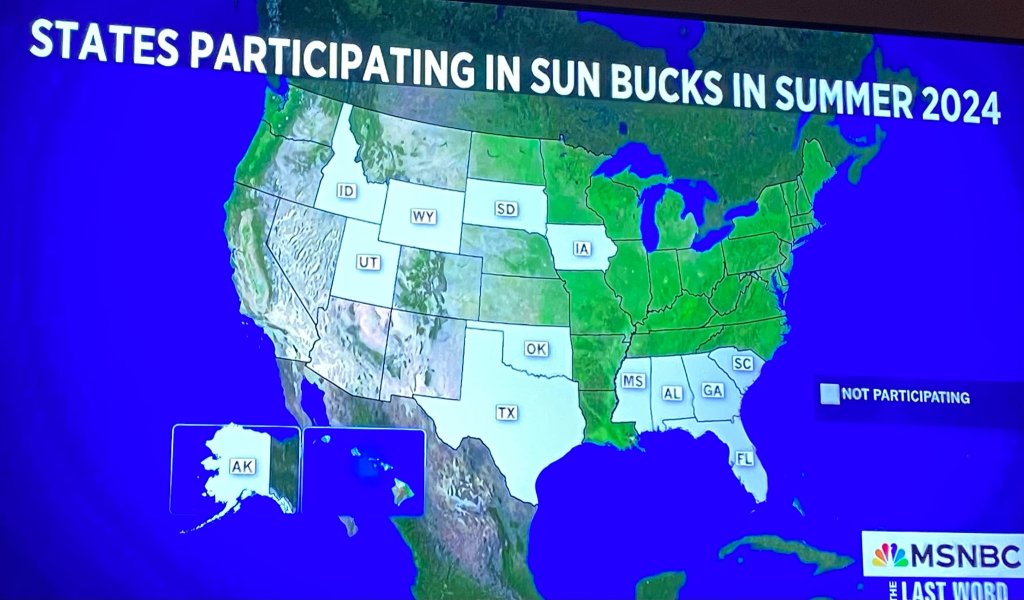
SUN Bucks were created by the Biden administration to help kids and families get groceries – get fed, in other words – during the summer months, which are coming to an end, and which – OF COURSE – overwhelmingly GOP led states opted out of participating in. In other words, the GOP talks a great line about protecting our kids from nonsensical fake harms like exposure to drag queens and Maya Angelou while doing fck all about feeding them. The following excerpts are from the SUN Bucks website as well as the Center for Budget and Policy Priorities (CBPP), which is a “nonpartisan research and policy institute that advances federal and state policies to help build a nation where everyone — regardless of income, race, ethnicity, sexual orientation, gender identity, ZIP code, immigration status, or disability status — has the resources they need to thrive and share in the nation’s prosperity.” Sounds good to me.
Links to both the SUN Bucks program and CBPP are included, but I’ve done the reading for you; you’re getting the highlights, only, with my thanks for being here, and for voting for and donating to candidates that actually GAF about kids and families. And by the way, SUN bucks ain’t a lot – in fact it’s an embarrassingly small amount of money. Why would ANY state reject the program? Good question.
Summer Grocery Benefit for Kids
SUN Bucks is a new grocery benefit available across most of the U.S. Families with eligible school-aged children can get $120 per child to buy groceries during the summer. SUN Bucks may have a different name depending on your location.
Summer EBT (SUN Bucks) will not be available in the following states: Alabama, Alaska, Florida, Georgia, Idaho, Iowa, Oklahoma, Mississippi, South Carolina, South Dakota, Texas, Utah and Wyoming. Those states may choose to participate in future years.
From the CBPP:
Expiration of Pandemic Relief Led to Record Increases in Poverty and Child Poverty in 202 Overall poverty and child poverty rose in 2022 by the largest amounts on record in data back to 1967, a sharp retreat from the historic progress made during the COVID-19 pandemic:
- In 2021, bolstered by federal pandemic relief, economic security programs drove the poverty rate down to a record low of 8.0 percent. The expiration of that aid drove poverty back up in 2022, to 12.4 percent. The number of people living in poverty fell by 14.5 million between 2019 and 2021 and rose back up by 14.5 million in 2022.
- The American Rescue Plan’s Child Tax Credit expansion and stimulus payments, in conjunction with other relief measures, spurred the largest one-year drop in child poverty on record in 2021. In 2022, the expiration of that aid led to a historic increase in child poverty. (See Figure 1.) As a result, 5 million more children lived in poverty in 2022 compared to 2021.
The significant backsliding on child poverty that occurred after Congress allowed the Child Tax Credit expansion to expire underscores the fact that the number of children living in poverty is a policy choice. Recently there have been encouraging signs of bipartisan interest in a modest expansion. On January 31, 2024, in a strong bipartisan vote, the House passed a tax bill that included a Child Tax Credit expansion that, while far smaller than the Rescue Plan expansion, would help about 16 million children and lift a half million or more children above the poverty line in 2025. Unfortunately, the legislation has been stuck in the Senate.
In the late 1960s, assistance programs were fewer and weaker and a substantial number of families with children were taxed into poverty, making child poverty modestly higher than it would have been without accounting for taxes and government benefits. In 2020 and 2021, in contrast, taxes and government benefits — bolstered by pandemic relief legislation — cut child poverty by 59 percent and 76 percent, respectively, both all-time highs in data back to 1967. In 2022, due to the expiration of pandemic relief, taxes and government benefits cut child poverty by a smaller though still sizeable 41 percent, dropping the child poverty rate from 20.9 percent to 12.4 percent.
Recent studies of nutrition assistance and the EITC, for example, have found evidence that children whose families receive assistance earn more as young adults. Other studies have linked income assistance programs with healthier birthweights, lower stress for mothers (measured by reduced stress hormone levels in the women’s bloodstream), better nutrition in childhood, higher scores on reading and math tests and other measures of school performance, more high school completion, higher rates of college entry, and better health in adulthood.
The American Rescue Plan’s Child Tax Credit expansion, in effect only in 2021, not only reduced poverty for all children, but also helped narrow racial and ethnic inequities in child poverty. In 2021, the poverty rates for Black, Latino, and AIAN children exceeded those for white children by 6, 6, and 5 percentage points, respectively — the narrowest such differences on record. Prior to the pandemic, the poverty rates for both Black and Latino children were always at least 13 percentage points above the rate for white children.
After Congress allowed the Child Tax Credit expansion to expire, the credit reverted to a smaller and less equitable design that denies full participation to families with low or no earnings. As a result, in 2022 an estimated 46 percent of Black children, 39 percent of AIAN children, 37 percent of Latino children, 17 percent of white children, and 15 percent of Asian children received less than the full credit or no credit at all because their family incomes were too low.
The U.S. can afford these kinds of investments — indeed, other similarly wealthy nations invest larger shares of their economies in family benefits such as child payments and allowances, parental leave benefits, and child care support. But this will require the right fiscal policy choices, including raising revenues from high-income people and corporations so we have the resources we need to make important investments that improve economic security and broaden opportunity. The 2025 tax debate over the fate of the 2017 tax cuts provides an opportunity to shift from policies that hollow out our revenue base to policies that raise revenues for important national priorities