A very long time ago – let’s say thirty-five years – a friend of mine was invited to meet the Dalai Lama in a smallish setting of fifty to seventy people somewhere on the coast of California. It was to be a several hours long session; he would speak at length, thereafter taking questions as well as meeting privately with some members of the group. It made sense to me that she had obtained this gift, this opportunity and access, for she was a spiritual leader in her own way, working as a trained psychologist with individuals as well as holding retreats and group healing sessions, primarily in her home state of Montana. She had also been given this opportunity as a result of having married into a family of both theatre and film royalty, which, even for a relatively well-off girl from Montana, was a pretty big step (Montana well-off is quite different from NYC/LA well-off). Adjusting to a world she had never imagined herself to be a part of was interesting to watch; this, the relationship, the event with the Dalai Lama, and more all occurred during the years in which we were friends.
She went to the session with the Dalai Lama, taking her daughter, then a toddler, as well. The little girl interacted with the Buddhist leader, approaching him spontaneously during his opening talk to present him with an orange, which, delighted, he accepted with laughter and affection. This of course thrilled my friend, who shared this story with me when we spoke after the event. I asked her what she had got from the encounter, from the talk, from the day – what had stood out most, to her, for her, other than the adorable moment between her daughter and Tenzin Gyatso? Had he said anything she found particularly memorable, or powerful? Eat less, she said. Eat less, I repeated, questioning her, eat less!? Yes. Eat less. He said that? Yes. And, that’s – that’s what you got, most of all, from meeting the Dalai Lama? Yes. It was so powerful. He really believes that we, especially in the west, and you can’t disagree, and I know you don’t, are consuming too much in every possible way.
Okay. Yeah. Sure. Absolutely. Was there anything else? That stood out, I mean?
Not really. Eat less. He was brilliant. It was wonderful.
I bet.
Here’s the thing, though. Y’gotta respect whatever people get from whatever relationships and encounters and choices they have and make, right? Right. Or try to. Try. And, y’know, sometimes you gotta not take shit so seriously, girlfriend! Did I say that to her? Regrettably, no. Regrettably, also, almost immediately after this gift of a meeting with the Dalai Lama, my dear, sensible, grounded friend, a woman who had helped so many people heal, decided to stop eating; she then spent the following fifteen years or more off-the-charts sick and crazy, often medicated up the wazoo, breaking down repeatedly, until she finally landed in a place of nightmare and pulp-fiction: a mental institution in a mid-western city she described to me as a waking nightmare of snow and ice, of cold as impenetrable as the padded room in which she was, for her own safety and that of staff, locked.
Eat less. I had observed that my friend’s pregnancy was tough for her, a physical and emotional experience that had stripped her of something she deemed essential; she was having trouble reconciling her new present with all that she had previously known about herself. She had also been suffering since her daughter’s birth with intense pain in her hands, pain that made her unable to pick up, hold or cradle her daughter (what would Freud say?), pain that was wearing her down. Further complicating things was the fact that she was not a young mother, being about thirty-eight when her daughter was born, and prior to that time she was very much the mistress of her circle of friends and family. Being a mom within the context of her new husband’s family and world, a circle of a very different kind in which she was anything but mistress, was another destabilizer. I saw that motherhood, marriage, family, all of it was full of momentarily and even hourly delight for her, but the cumulative effect had my friend teetering on an edge, and at that exact moment she encountered a transformative energy she experienced and interpreted as punishing, because coming away from meeting the Dalai Lama with ‘eat less’ as your main take-away is simply not a sensible and reasonable response. It’s just not.
My friend and I are estranged, not in a deliberate, angry blow-up sense, just strangers to one another because life and circumstance led us in very different directions, and, once she was (mostly) healed, we’d been completely out of touch for several years. I also, after her recovery, found her a different person, altered in a manner I could not embrace for a variety of reasons. She had changed, as had I. Her daughter was grown by the time we reconnected and had a longer talk, catching up, but I had not seen either of them for a decade or more. For most of her child’s life, from about age four to twenty-two, her mother was absent, getting treatment, and the reason my friend got in touch with me again was specific: would I read and consider editing a memoir of her time of illness and recovery. Of course I would read it, and as for editing, well, let’s talk after I’ve taken a look. It was, she said, to be dedicated to her daughter.
What can I say? She was and is an intelligent woman who had and I am sure still has many skills and talents, but writing is not one of them. It was long, it was disjointed, it was unbearable. It also disturbed me that in a book ostensibly – as she told me – dedicated to her beloved daughter, the young lady herself was barely mentioned, while she wrote often, at length, and with great depth of feeling about her dogs in the memoir’s pages. Yo. Hello. I am a dog person, but – dogs. You barely mention your kid, yet go on for pages about the healing importance of your dogs? I told her I was not available to assist on editing her work, and wished her well, and did not go into any other detailed critique. I also said, look at this again, and think about what you want to put out there for your sake, but also for your daughter, your child, your blood, the human being you’re dedicating this to. And then, friend, think again.
Every day, as I age and knock wood gain a little wisdom, I am reminded how each of us sees and experiences the world differently. A film discussion renders me full of wonder, that my BFF recalls a moment of which I have zero memory, nor she of the moment I cannot forget. We see through no eyes, and lived experiences, but our own. What would I have taken away from meeting the Dalai Lama? I don’t know, and I will never know; I wasn’t there. Would I have noted ‘eat less’ – maybe, possibly? We all travel such interesting and very specific roads. I wonder how my friend is doing now? Hopefully, she is having a very good life, filled with joy.
*I often wonder if my neighbor realizes he’s being watched. Not by me, but by the Big Guy, who is fascinated by the activity next door. My neighbor cuts wood to burn, heating his house with a wood furnace, and is often outside doing garden work whatever the season. He also has several bird feeders, feeders he thinks the local bear has given up on because the Big Guy has put him or her off.I’ve seen the bear, but not this winter, yet!
“I always feel like, somebody’s watching meeee….” I’ve never asked my nabe if he feels those black eyes on him. He’s one Diego’s favorite humans, why mess with happiness in a relationship by interjecting even a whiff of snoopiness? It’s the Big Guy, after all, and whatever he’s seeing, he ain’t telling, not even me.
Was it 1970? ‘71? There must be a photo somewhere, I’ll look, one of those black and whites with the date stamped in the pure white surrounding frame, delivered from who knows where (Binghamton? Albany?) back to the store in a rectangular paper sleeve filled with Kodak memories! How I loved opening those colorful envelopes to see what we’d got. My dad had found a partner for his business, an independent pharmacy in rural upstate New York, and was looking for things to do in his new, welcome free time. Why not get a calf? It was my mom’s idea, because, after all, he was forever grousing about grocery bills, we have all this acreage, honey, and he had been brought up as a farmer’s kid, so – doesn’t it make sense to buy a calf? Just pay a fee for butchering? They might possibly have come up with the idea jointly, but regardless, we got a calf. I have no idea from where, or whom.
It was cute. Baby anythings are pretty cute, generally speaking. We named it. Sam? Harry? Bucky? Chip? Beefy (one of my dad’s contributions, the heartless beast)? It kept breaking out of the enclosure my dad created, attached to a space in the barn, and after many attempts at keeping it inside the fenced area – given we lived in the only house at the end of a long dirt road – we just let the little buggar out. Hey, it will help keep the grass trimmed. And thus little Chip was allowed to roam freely on our very large lawn, where it began to ape the behavior of the family dog: caracoling and playing in the manner of a friendly puppy, curling up to sleep in the sun or shade near the stone patio, trotting out to meet and greet cars and people as they – we – arrived home. It was pretty endearing, but we knew, we all knew, where this was going to end, which was in Chip or whoever’s death, and eventual consumption on our family dinner plates in various cuts of meat. Cuts. There would be cutting.
The calf got big, bigger, as calves will do. It was a little scary, a little, when it came running at you, greeting you with the dog after school. But, okay, whatever, it’s a temporary thing, and our dad and our parents’ friends thought the thing was hilarious. It was. It was ridiculous and hilarious except to my mother, who did not think it was funny, and furthermore had begun to dread the slowly approaching and inevitable end. A woman who rarely went outside if she could help it, my mother was terrified of mice, didn’t like dogs, or any animal, really, tolerated cats because they hopefully eliminated the horrid, horrifying mice, and yet, here she was falling for a calf who was bound for slaughter, destined to be stored in packages of varying sizes in one of our several freezer compartments, after which ol’ Chip’d be consumed by her entire family of meat eaters.
She wept. She cajoled. She got angry. She said the kids would be traumatized (we were not). She called my dad heartless, cruel, lacking proper feeling, and he pointed out that it was her idea, originally, and she didn’t have to eat the beef if it bothered her that much. It did. I vividly remember the first meal we had from the calf, beef stew, in gravy. She would have made it, I am positive. Did she weep? That I don’t remember. She sat at her end of the kitchen table, hungry (when was she not?), yet unable to take a bite. If she eventually did partake of any of our calf, I don’t recall, but – I don’t think so. Our adventures in owning beef on the hoof were at an end.
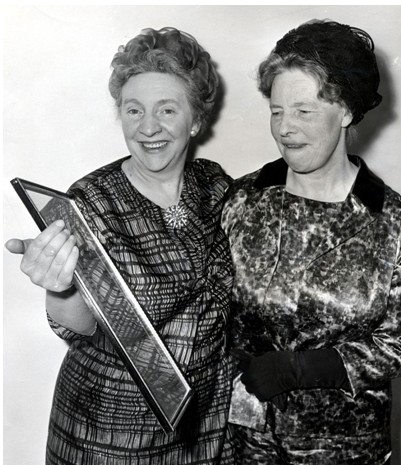
Ida and Louise Cook. Cook. Never heard of ’em. But, maybe I should have, and for now, a short post celebrating these ladies is in order, Yay Ida and Louise!
But who TF were they? They were unmarried sisters who, in their mid thirties, still lived with their parents, commuting to jobs in London where they both worked as typists in the British civil service. Ida also had a career writing romance novels (112 total) for Mills and Boon (England’s version of Harlequin) under the name Mary Burchell, and yes, I actually read Burchell’s books as a teen; my mother had a box of Harlequin’s delivered monthly under my name until I was almost thirty, when I was definitely not living at home. The sisters, Louise was born in 1901 and Ida in 1904, wore home made clothes throughout their early work and social lives, and were each educated at The Duchess’s School in Alnwick. The sisters shared a love of opera, so much so that they would travel to Germany for the weekend simply to attend the opera there throughout the 1930s.
But here’s the thing, in their ill-fitting but serviceable clothes, the sisters were unremarkable in every way except one: they were smuggling money, jewels and other goods – as well as people – out of Germany in the lead up to World War II. Their ability to be ignored as dowdy English spinsters when they crossed into Germany and then back out again wearing furs and diamond necklaces was genius. These valuables would help refugees who would follow the sisters out to survive in their new lives in England. Additionally, back home, Ida and Louise found sponsors for the refugees, individuals and families who would house them, as well as assembling the proper documentation and even, at one point, renting an apartment as an initial resting place for those who were newly arrived. The Cook sisters always used their own money in these efforts, in order for the refugees to have no up front obligations in setting up their new lives.
Ida and Louise Cook cleverly entered and left Germany via various different checkpoints, thus the same guards wouldn’t be able to notice a sudden acquisition of the accessories of wealth; they also lied about valuables kept in their purses: ‘we can’t trust them in our apartment when we aren’t there!’ Most impressively, in all the trips they undertook, they were never caught. Eventually the sisters had to halt their trips into Germany, but prior to doing so they were directly responsible for rescuing 29 people, bringing them to safety in the U.K. The Cook sisters, however, didn’t stop working for the cause, continuing to raise money and awareness regarding the widening crisis for Jews in Germany and Europe, and they continued to help refugees in England.
In 1964 the Cook sisters were honored as Righteous Among the Nations by Yad Vashem, the World Holocaust Remembrance Center. Ida Cook wrote a memoir that was republished as ‘Safe Passage‘ in 2008. In it, she plays down their role, saying that what they offered wasn’t much. In exchange for saving lives, they only needed “some trouble, some eloquence, and some money.”
And bravery. And empathy. And the anonymity endowed by being a dowdy middle-class women in the 1930s (and possibly even to this day). And oh were they clever! Yay Ida and Louise Cook. Now you know.
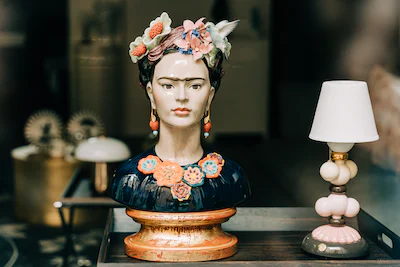
*A deeply imagined poem written by Marty McConnell, often misattributed to Frida Kahlo, who was a very talented person, but no, she didn’t write this, McConnell did, channeling Kahlo. Inspired by her. Capiche?
leaving is not enough; you must stay gone. train your heart like a dog. change the locks even on the house he’s never visited. you lucky, lucky girl. you have an apartment just your size. a bathtub full of tea. a heart the size of Arizona, but not nearly so arid. don’t wish away your cracked past, your crooked toes, your problems are papier mache puppets you made or bought because the vendor at the market was so compelling you just had to have them. you had to have him. and you did. and now you pull down the bridge between your houses, you make him call before he visits, you take a lover for granted, you take a lover who looks at you like maybe you are magic. make the first bottle you consume in this place a relic. place it on whatever altar you fashion with a knife and five cranberries. don’t lose too much weight. stupid girls are always trying to disappear as revenge. and you are not stupid. you loved a man with more hands than a parade of beggars, and here you stand. heart like a four-poster bed. heart like a canvas. heart leaking something so strong they can smell it in the street.”