When I bought my first home, a co-op, after a decade plus of renting generally cramped, over-priced apartments in a college town, in London studying abroad, on an island in the Atlantic Ocean, as well as in New York City, I was thrilled. Security, permanence, equity ~ an elevator! A laundry room! Oh happy day! However, it also required I move myself and my stuff for the third time in under two years. Please lawd, no!! Or if yes, can we at least not move all of it, again?! Everything that I owned had to be examined in the light of ‘you’re packing this again, carrying this up or down stairs again, including into that blessed elevator, carting it to the next place of residence, again, really?! Really?!’
This amalgam of stuff new and old, my stuff, included an ancient trunk that had belonged to my Great-Aunt Martha, a large trunk full of journals and letters, all of the journals used and all of the letters I had received to that point since childhood. Every. Single. One. There were a lot. No. Not again. I decided I’d had enough with the saving ephemera thing; it stops here and now. Having to move yourself and your accumulated crapola on multiple occasions in a short amount of time is a magic equal to any advice from Marie Kondo, as I can attest. I let go of most, not all, of the letters and the journals. I unloaded. I lightened up.
That this process of unloading and moving into an actual owned piece of real estate happened after cajoling, forcing, threatening, and dragging my sorry ass family of origin into family therapy was no coincidence, but rather a happy, semi-intentional series of falling dominoes, a cornucopia of major and minor (so many levels!) breakthroughs, a crack in the wall, a rising from the dead or near dead, a tornado-sized blast of relief, a declaration of value: mine. Along with a rise in self-valuation, it seemed, came a reckoning with things saved commemorating others value to me, and my own past selves in both letter and journal form. What, if anything, would I save?
My siblings and I were raised in a time of letter writing, by parents whose handwriting was pretty much illegible, but who, nevertheless, believed in the power of personal notes, thank yous, Christmas cards that included a brief handwritten update on family, and, eventually, typed missives chock full of my father’s misspelled words and corny advice, and various admonitions re: safety and good behavior from my mother. We were raised in a time before email, a time when letters arriving at the post office for me, me?!, meant that I existed, I mattered; those letters were a big deal, or so it seemed to this little punkin’.
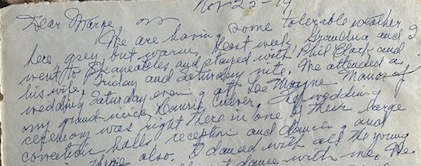
Among the letters I had preserved? Several bunches from a pen pal, a teenaged counselor I met at Girl Scout camp; she was kind to me, but I don’t recall her name. She wrote to me for at least two years, and was starting at Keuka College the fall after we met. I was half her age, but because she was intent on teaching grade school, I believe she was motivated to stay in touch by an interest in little kids? Maybe? What I do remember was that her spelling was pretty bad, like my dad’s, although her childishly loopy handwriting was legible; her grammar wasn’t great, either. I think, too, that she felt sorry for me as I was one of, if not the only kid at camp without a friend or group of friends present, attending with me. Those two-week periods away from home, surrounded by peer Girl Scouts all under fourteen years of age from towns in central New York I had never heard of, let alone visited (they’d never heard of my home town, either), were long, and if not lonely, they were at the least very solitary. I loved being in the woods, though; still do.
Out of all the bunches and bunches of letters contained in that big old trunk, I kept very few, including several from my brother (two to three lines at best, yet quite revealing and dear, for all their brevity), and a couple of the best from my dad and mom. I kept a response letter from LBJ’s White House; I’d written the President in my grade school years, complaining about the disrespect shown him by a caricature version of his face on a Time Magazine cover. They’d made his nose and ears too big; it wasn’t nice. A different world. Many of those who had written me I simply could not remember, at all, which made me sad. I had started the clearance looking at every letter then realized I’d never in a million years get through them all; it was time to just let go. I filled several garbage bags with them, dragging them out to the curb in the middle of 45th street between 9th and 10th avenues where they would be picked up by midtown’s sanitation crew. G’bye, y’all.
I kept two letters from my grandparents, one of which included a quote my grandfather transcribed in his best Edwardian script, several lines from Shakespeare’s Two Gentlemen of Verona, a play I had seen but didn’t know very well; it’s an early work, possibly his first play, and it shows, but the quote intrigued me, delighted me, studying acting in London at the time. It was so unlike him to wax poetic, even if I knew, deep down, that he had it in him, that under his crusty caustic armor there lived a romantic, a poetry spouting charmer. The thin blue airmail envelopes had arrived at the base location for theatre students abroad, and were welcome during a very transformative, powerful time for me, the longest period in my life to that point away from my family of origin. I received more letters weekly than most of my peers, it was remarked upon numerous times, because the pick up location was public, and the amount of letters I got really was remarkable. My family, trying their best to keep me in the herd, is what I thought then, even if I would not say it aloud. Not yet. Not then.
One of my deepest concerns before leaving was that my grandmother might die when I was that far away, across a big ocean, in the land before cell phones and easy communication across various platforms. I was named after her, my dad’s mother, and she was a consistent loving presence in my life, a truly kind and decent human, filled with humor and intelligence. She had been suffering with shingles, had lost a great deal of weight, and was, at the time, an increasingly frail eighty-five years old. I visited Scotland in part to send her postcards of her family’s ancestral homeland, which she’d never been able to visit; in London, I found and bought a kilt in the family pattern, her family, the Davidsons. I own it still.
I traveled to Ireland, north and south, before heading back to London and a Freddy Laker flight (sardines, I feel you) into JFK. I’d had a dream while staying in a youth hostel in Dublin, a premonition of death and loss, my grandfather, which made no sense as he was fine, yet the anxiety this vision struck into my heart had me cut my travel short to get home as soon as possible.
I called, long distance, sinking a mess of British sterling into a pay phone on a noisy city street, all to ask, ‘Is everyone okay? How’re grandma and grandpa?’ ‘Everyone is fine. When are you coming home?’ I didn’t say, about the dream, and the anticipation of loss and of death. ‘Okay. Tomorrow, I’m coming home tomorrow.’ And there they were, my grands, in the self-proclaimed Knoll House on Cemetery Road, hale and hearty – or at least as hale and hearty as one is at eighty-plus years old in the sticky heat of an unseasonably humid day in early May. My grandfather had been outside chopping wood in ninety-degree weather. I dropped in on my way home to the farm, promising another visit right away, a long visit, full of stories and sights seen.
The next day my mother dragged me around showing me off, or so I felt, her newly coined, ‘studied abroad’ daughter. Her hairdresser’s place on Southside Rd., her favorite lunch spot, a friend on Main St., an old lady from her church, and another on a back road, where I sat mostly in silence unless questioned directly. My mother was an Olympic level talker; I was there for presentation purposes only. It was dreadful, in part because I was exhausted, jet-lagged, still feeling the humming anxiety of that dream. Still, she was being nice to me, which was different, interesting and new.
I’d been away long enough to get a dollop of perspective, after an explosion of clarity that past Christmas – as if seeing my family for the first time – when I’d surprised everyone by returning home mid-year abroad. I no longer saw her as I had, as an inevitable, implacable force, a tsunami of anger and resentment; she was just a small round woman full of frustration and desire, more to be pitied than feared. Implacable, but – not inevitable. I would, ultimately, escape her; the process had begun years before; time was on my side even if my natural and temperamental impatience made days spent in her home feel like lifetimes. Let her have her fun; I’ll see the old folks tomorrow, as I told them when I called later that day to apologize for not showing up.
The following morning I went by their house on the knoll, where I found my grandfather in his favorite red velvet wing chair, bent over and in pain; he’d been up vomiting much of the night, but other than agreeing to go lie down, he refused to go to the ER. I called my dad, who left the store to come take a look at the old man, the invincible one, the terror of his own childhood. He called an ambulance, and – three hours or so later – the old man was dead, a series of heart attacks over several days, they said, culminating in this last one, which killed him. He’d had no blood pressure, none at all, when the EMT took it, or tried to, but he was talking up a storm, even offering to do a headstand at the hospital, if the doctor thought that might help get his blood moving.
I spent the next two weeks living my my grandmother, cooking bacon (he’d forbidden her any), buying donuts (ditto) and mourning a difficult, complicated man we had both loved. I have those letters still.
Vouchsafe me for my meed but one fair look;
A smaller boon than this I cannot beg,
And less than this I am sure you cannot give.
– William Shakespeare, Two Gentlemen of Verona