*a poem from Danish Lameris, more on her below, including a link to her website, yet as I read it I thought, it all comes down to that Einstein quote (which I will now butcher), “we all have a choice to make, we have to decide whether we live in a friendly or unfriendly universe.” Friendly, despite the dolts, dopes, and haters. And you do know they’re just afraid, right?
I’ve been thinking about the way, when you walk down a crowded aisle, people pull in their legs to let you by. Or how strangers still say “bless you” when someone sneezes, a leftover from the Bubonic plague. “Don’t die,” we are saying. And sometimes, when you spill lemons from your grocery bag, someone else will help you pick them up. Mostly, we don’t want to harm each other. We want to be handed our cup of coffee hot, and to say thank you to the person handing it. To smile at them and for them to smile back. For the waitress to call us honey when she sets down the bowl of clam chowder, and for the driver in the red pick-up truck to let us pass. We have so little of each other, now. So far from tribe and fire. Only these brief moments of exchange. What if they are the true dwelling of the holy, these fleeting temples we make together when we say, “Here, have my seat,” “Go ahead—you first,” “I like your hat.”
*Danusha Laméris is a poet and essayist raised in California, and is of Dutch and Barbadian ancestry. Her first book, The Moons of August (2014), won the Autumn House Press Poetry Prize and was a finalist for the Milt Kessler Book Award. Her work has been published in: The Best American Poetry, The New York Times, Orion, The American Poetry Review, The Kenyon Review, Ploughshares, Poetry, and Prairie Schooner. Her second book, Bonfire Opera, was a finalist for the 2021 Paterson Poetry Award and recipient of the Northern California Book Award. She was the 2018-2020 Poet Laureate of Santa Cruz County, California, and is currently on the faculty of Pacific University’s MFA program. Her third book, Blade by Blade, is forthcoming from Copper Canyon Press.
*a poem by Madeleine Cravens, which I cut out of the New Yorker months ago, because I loved the words, the cadence, the emphasis on – well, you’ll see. It is taken from her debut book of poetry, Pleasure Principle, published June 2024. For More on Cravens, first, enjoy the poem, and see below!
Not the pleasure of lovers but the pleasure of letters, a pleasure like weather, delayed and prepared for, not the pleasure of lessons but the pleasure of errors, of nightmares, of actors in the black box of a theatre, not the pleasure of present but the pleasure of later, the pleasure of letters and weather and terror, asleep by the lake, unable to answer, the pleasure of candles, their wax on the table, not the pleasure of saviors but the pleasure of errors, not the pleasure of marriage but the pleasure of failure, the pleasure of characters like family members, their failures and errors, their laughter and weather, the pleasure of water, terrible rivers, not the pleasure of empire but the pleasure of after, our failure to keep an accurate record, not the pleasure of tethers but the pleasure of strangers, the terrible strangers who will become your lovers, not the pleasure of novels but the pleasure of anger, your failure to answer all of my letters, the pleasure of daughters, the pleasure of daughters writing letters in April, the failure of orchards, the terror of mothers, not the pleasure of planners but the pleasure of errors.
*the emphasis on error, failure, imperfection.Madeleine Cravens was a 2022–2024 Wallace Stegner Fellow at Stanford University. She received her MFA at Columbia University, where she was a Max Ritvo Poetry Fellow. She was the first-place winner of Narrative Magazine’s 2021 Poetry Contest and 2020 ’30 Below’ contest (she’s in her 20s, still, I think), and was a finalist for the 2022 James Hearst Poetry Prize. Her poems have been found in The Adroit Journal, Best New Poets, The Kenyon Review, The New Yorker, and The Washington Square Review. She was raised in Brooklyn and lives in Oakland, CA.
*And in case you don’t know who Wallace Stegner is, please allow me to introduce you to him; he is a writer of fiction and non-fiction. His novel Big Rock Candy Mountain, published in 1943, is one of my favorites. He writes of the west, primarily, and was a founder of the conservation movement in the western part of the U.S. Why he isn’t as well known and as well-read as Steinbeck, I do not know, as they share themes and settings. Maybe because Stegner didn’t write a slim novel perfect for high school English! Regardless, if you haven’t read him, do.
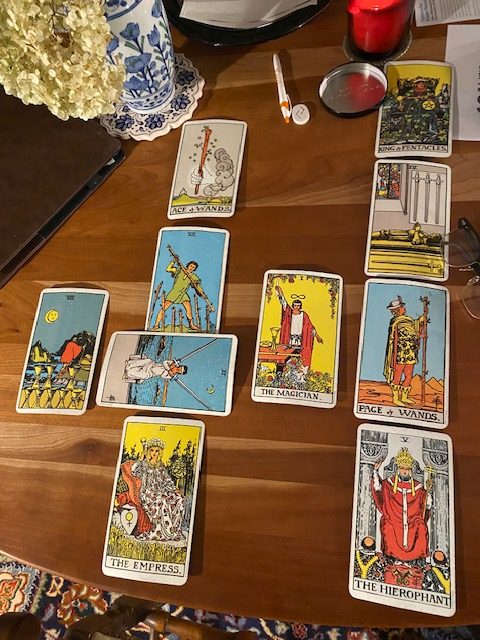
I read tarot cards, and have done so for over 30 years. I don’t read for people a lot, and very rarely for myself; I can’t be objective on the subject of my own life. I don’t enjoy reading for strangers, and if I do, I charge a much, much higher rate for people who creep me out, but I do enjoy reading for friends in the right setting. My besties and I have been reading tarot and consulting the runes and animal cards for a long time. It’s fun; it’s the esoteric sciences at their best; it focuses our attentions and energy. Plus, we happen love it, all of it, the woo-woo-ness, the witchy-ness, the magic, the patterns that repeat, all revealed in the cards, or rune stones. That one, again?! Must be telling you something, GF!! Y’think?!!
In the early 80s a friend, one of the other coat-check girls at Studio 54, gave me a name, Kevin J., to call for an astrology and tarot reading. I wanted to do something different for my upcoming birthday; this fit the bill perfectly. His apartment was in the teens in Chelsea, and when I walked in, I remember thinking, ‘Holy shit, girl, whatchu got yourself into now?’ It was a railroad configuration, a series of narrow, boxy rooms, several of them one after the other, although I didn’t go – or ever get – past room two. I could see further into the apartment’s murky depths (the windows were heavily curtained), but was immediately struck by the fact that the walls were painted black; I was also, suddenly, surrounded by more interesting objects and symbols than I’d ever seen outside either the British or Hermitage museums. The décor was high end Hollywood vampire film meets Celtic witches lair, meets Buddhist temple, meets Maxibles and Mandibles, a long-time famous store near the Museum of Natural History that closed in 2011, may it rest in peace.
It was something else. It was fabulous, and so was he. Kevin long ago moved to a light, airy apartment in the same neighborhood, but oh I still remember with great fondness those first few enchanted sessions, because therein began a relationship that lasts to this day. I have sent many, many friends to Kevin J., and I studied the tarot with him for a year in the early 90s. It was, and remains, a wonderful series of memories; Kevin is a prince, and I am so grateful to have met him. And, I don’t read tarot often because when I have – for strangers – it has been such a mixed bag, why do it? Why go there? My time and attention matter, to me at least, and if you’re going to be a dick about it (the self-righteous rage or outrage – it’s blasphemous! – some people feel toward this stuff is hugely boring), I’m out.
Case in point: I read for a fund raiser once, about 5 different groups of people came to see me in the reading room of an upper east side brownstone. One was sure this was going to condemn us both to hell, me especially, but the rest were okay, fine, no biggie until a woman came in with her mother. We chatted, and when I read for her it was clear from the cards that she was pregnant, or soon would be. Nope, I just got married, and I don’t want kids, neither does my husband. Huh. Maybe a step-child is coming into your life? Nope, first marriage for us both, and no other kids. Heck we’re only twenty-seven (or whatever)!! This went on for about 45 minutes; I used several different tarot spreads, and, finally, after offering numerous scenarios (maybe a new business? a new home – it’s something big, a big change), she said, ‘well that’s enough for me’ (they both got up to leave), ‘and by the way, hahahahahahahahahahahahaha, I am pregnant, we were just testing you ‘cause it’s all dangerous nonsense, and you shouldn’t do this kind of thing, we only did this to see what you would say’. I bit my tongue (what I would say if I weren’t in this lovely home trying to raise funds for a non-profit, is this: what a dick move, you asshole), packed up my self and my cards, and vamoosed.
The thing I always start any reading with is that the tarot, like the runes, doesn’t tell you anything you don’t already know. It simply affirms it. Affirmation is a good thing in an anxious age, a necessary thing. This affirmation by the cards or stones is, however, challenging for some, particularly those whose shit is unexamined, because then the tarot will simply confuse or dismay, provoke insecurities, and make little Johnny or Janey, hold on harder to what is very possibly a state of denial. Oh, the humanity. I’ve been thinking about this because a friend asked me to donate something to a local charity event, and I offered a reading, which she has labeled ‘A Tarot Reading From the Giggling Witch’. JHFC. Girl, have you met me? But I’ve said nothing. We’ll see. Fingers x’ed!
Never heard of ‘em. Well, duckies, Lisa Lane was the first chess player to ever appear on the cover of … Sports Illustrated. The 1959 Women’s U.S. chess champion, Ms. Lane dropped out of Temple University to enter competitive chess playing, which she also abandoned after making a lot of news, largely because of the media’s obsession with her looks, and the unequal treatment of women in the sport. This was in the late 50s and early 1960s, so I think we can pretty much say treatment (shitty treatment) from Male Media, Male Writers, Male Editors, Male Photographers, Male, Male, Male. Lisa Lane, you see, was both young and pretty; she was also, unlike many of her female competitors, not well-off, having to figure out a way to make chess work for her on a day to day scale, paying the rent.
Lane was also impatient (oh, girl, I feel you) with the perception that being good looking meant she was somehow ‘tricking’ her male competitors, distracting them, or that she was the front for a genius male chess master pulling her strings. At the time she was playing, women received $600 for winning the US Women’s Championship; male champs received $6000. Several previous contemporary winners of the female competition donated their winnings back to the U.S. Chess Federation where these funds were used to sponsor – you guessed it – men’s tournaments and male chess-players. Let’s just say this didn’t sit well with Lane. Why would it?
Lane was also known for being volatile, and, again, I feel you, girl. She wasn’t the proper lady type the powers that be wanted, or expected. I am reminded of the wonderful film, I, Tonya about Tonya Harding’s incompatibility with the posh types and perceptions of the skating world. Like Harding, Lane was not the quiet, submissive type; she was young, working class, had grown up in Philly without a father and learned chess in coffee houses in her neighborhood, not in her father’s den while he sipped brandy.
Lane stopped playing chess in her early thirties, after a decade of trying to make it work while being at the receiving end of ‘enough already’ sexist bullshit. In the early 70s she played against an IBM computer programmed to play chess, winning every single game. The computer, she was quoted as saying at the time, didn’t resent her beating it at the game, unlike the majority of her male competitors.
My mother was one of twelve siblings, and throughout my childhood I heard about her favorite brother, Bob, and favorite sister, Polly. Her younger sister Betty’s favorite brother was Jim, except sometimes it was Fred, and Betty’s favorite sister was also Polly, which led to a battle royal over who would manage Polly’s memorial mass at the local Catholic Church in my hometown; there were, ultimately two programs for that event, one that I created and made multiple copies of for my mom, and another that Betty created and – did I also make copies for her? Maybe the local Priest at the time made them? Not sure, and it’s also possible she brought them from Florida, all printed out. It was a long time ago.
All to say that I was very aware that having favorites was a thing, a theme, a way to make someone in one’s life feel and be special, and, consequently, make other someones feel less so, less special, when not ‘the favorite’. Here’s the thing about favorites in my childhood home, though, while my mother regularly insisted she loved all of her children equally (one of many giant, huge, lies she told throughout our upbringing), she proved daily in the way in which she treated each of us that, in fact, she preferred and absolutely favored my two older siblings. Big time.
My brother Fred was served dinner second after my dad, and offered another helping as a matter of course, which none of his sisters were – although, yes, my older sister was anorexic and then bulimic during a significant chunk of this time (so deeply weird, really). My brother was also the openly acknowledged ‘owner’ of our second family car, a VW Rabbit; he was shown how to balance a checkbook, and do his laundry, although my mother did it until my brother’s wife took over, when he was nearly thirty. He was also allowed use the ride around lawnmower but was exempt from any household chores other than taking the garbage out, which I mostly ended up doing because he was in his room, not to be disturbed! He was given respect, along with rights and privileges I could only dream of at the time, although I was only a year behind him in school. All of this, and more, was heavily sexist, but it was also favoritism.
My sister Polly was offered a horse, riding lessons, ballet lessons, music lessons an hour away, given carte blanche on all things relating to clothing and jewelry, and, upon completing high school her graduation gift was an emerald solitaire ring (mine was a trunk). Her college choice – out-of-state and private – wiped out my parents’ saving to date, but that was what she deserved, and needed, endowing her with an education worthy of her immense talent (fine art painting). It didn’t help, either, that my mother regularly referred to my younger sister and I as her ‘spares’. Our mother also liked to remind me that she hadn’t wanted children, at all, and that while she was willing to have them because our dad so wanted them, once she’d had given him a daughter, Polly, as well as a son and heir, Fred, she was done, a reluctant mother at best to my younger sister and I.
When I was in therapy decades ago (we’ll call it mid-that long, multi-pronged journey), I reminded my younger sister of these statements from our mom; she told me she had never heard either of them. Or, at least, she sure didn’t remember our mother calling us spares, or talking about not wanting children. Never. Not ever. Personally, given my younger sister saved my mom from yet another unwanted pregnancy (she was her fourth child and caesarian in five point five years, and her birth was accompanied by a hysterectomy), it’s very possible my mom didn’t say those things to her.
Who is your favorite uncle, was something I was asked by my mom. Um, I like them all? Not acceptable. Who?! Um, okay, Uncle Jay? Of course, of course – you would say that. Uncle Jay was my dad’s brother, not one of her seven male siblings, and yes, of course I would say that. But he was, sorta, my favorite, if I had to have one (why do I have to have one, again?). Uncle Jay was a lot like my dad, funny and playful, willing to toss a softball around, young at heart; he grew sideburns the same year my dad did, and both my cousin Marsha and I exclaimed over our respective uncle’s matching and so, so groovy, shades of Jack Lord ‘burns’ the next time they visited us at the farm, and within minutes of one another, ‘Your dad grew sideburns!!!’
The other thing is, in all of this I was also turning the concept of favoritism inward, toward myself. My right side was the favored side, the good side. My left was the bad side. I would not wash the left side of my body in the bath, or if I did, it was cursory, quick, not sufficient. Ditto my face, teeth, and hands. In school I would only seek out one favorite friend in all my years there, even though I wanted more friends, more connection; it was important to have a favorite, and stick with that person and relationship through thick and thin (my choice led to a lot of thin), and to resist spreading my ‘favor’ – for what little it was worth – too slim. This continued until my older sister noticed my one-sided, lop-sided cleaning rituals in the bathroom, and got in my face about being a weirdo, which I definitely was, only – given she was bingeing and purging literal gobbums of food following a handful of years spent of trying to get below 70 pounds – how was I the weirdo and freak?
I was not the favorite. Eventually, ultimately, I was in disfavor with myself, because I could not (me, smart me!), figure out how to fix it, get out of the box of dis-favorment I was stuck in, a box that pinched and squeezed and hurt and hurt and hurt, so much. Favorite-ing is dangerous. Stupid. Harmful. Nonsense. Commonplace. Very commonplace, sadly. I needed more friends. I needed uncomplicated, whole-hearted love. My grandparents, given I was named after my gram, did seem to slightly, ever so slightly favor me, but their base line principle was to not ever show favoritism to any of their many grandchildren, because of course they didn’t, couldn’t, wouldn’t.
Grandpa, my dad’s father, now he had favorites, but they were whichever of his children was most obedient or made him proudest, and which of his daughters-in-laws were comely and buxom, and – vitally – not Catholic (his sons-in-law were both useless). But all of that was long before my time. He did start to favor me, actually, once he realized I was a good bowler, abandoning my older sister for my earthier, practical capacity to knock down pins, his favorite hobby in retirement. But, he died when I was twenty, a handful of years into my being elevated, and – given my mother’s intense dislike of him, of us both – was his favor doing me any?
Everyone, every single person on this planet, deserves to be a favorite of some other person, knock wood someone with the ability to positively support, love, and affect their beloved favorite’s life, without doing harm to others, or to the beloved themselves. Maybe I don’t mean favorite, maybe I just mean everyone, every child for sure, deserves to be loved, and supported by at least one other person in their lives, someone who has their back, and thinks they are terrific. No favorites, because that implies, again, others who are not favored, making the favorite a standout for affection among many or even just a few, which is potentially, probably unkind.
I was not the favorite. And when, as she did many times, my mother accused my dad of loving me more than he loved her, of my being his favorite, he would laugh, and say ‘that’s because she reminds me of you, Dorothy!’ But in reality, my father tended to avoid me, to protect me from her jealousy and wrath – when he was home, that is, which was not often. Finally, when the questionnaire comes around asking who my favorite person is on the planet, I say ‘me, I am my own favorite’, because sometimes, oftentimes, I am, we are, all of us disfavored ones, all that we’ve got.