Part one is in the books of a wonderful, terrible time. I am back from a weekend long wake for my best friend’s little boy, where I saw two of my other best friends, stayed in one of their homes, had dinner out in Soho, walked around in the east and west village – in spring!! – which were both blooming, visited The Strand, one of my favorite places – and bookstores – in the world, and took the N train to Astoria where I met another best friend’s granddaughter, Nora, and bought breakfast for us all at a fabulous Italian bakery (spinach and feta croissant – ohmygoodness). This gave me the opportunity to make best friends with the baby, who, in a major win, sat on my lap, which – I was assured – she never does…(*blushing)
It was wonderful. It was terrible. The wake was filled with people each night, there was all kinds of yummy finger-y food available to meet my emotional eating needs, there was no alcohol (thank goodness), and there were many kids running like mad around the place, as well as beautiful flowers and photos of the kids – and of the kid – all over. The undercurrent of sadness was fathoms deep, bubbling up in tears that were everywhere you looked, hugs too, as was laughter. Small talk, one of my least favorite things ever, was abundant; much of my time was spent re-meeting people who were there when my friends married almost fourteen years ago.
At several points my other two best friends and I absconded to a sofa upstairs where we chatted and caught up and mourned our collective loss, speculating on what had happened, what we knew, and wondering how our darling pal will survive her grief. We also hid in a corner of the kitchen (it’s very big) early on, where we saw – of course still hanging – the deceased child’s lunch bag right next to those of his brothers. Fathoms deep.
Once during the second night of the wake, the father of this beautiful dead boy pulled me into the guest bedroom where he collapsed on my shoulder, sobbing. We both sobbed, and I tried to do what friends do, tell him he did everything he could, that his child was loved and loved deeply by him and knew he was loved, that he is a great dad, with so much to live for, and celebrate, including this no longer living child. It’s unnatural, I said, what has happened, losing a child, when we are meant to outlive those we bring into the world, or meet as babies, and therefore natural you should and must struggle, dealing with this heartbreak. I don’t know that it helped. He is a highly intelligent, loving person and knows all of what I said already. Yet, in anxious, challenging times, we all need reassurance.
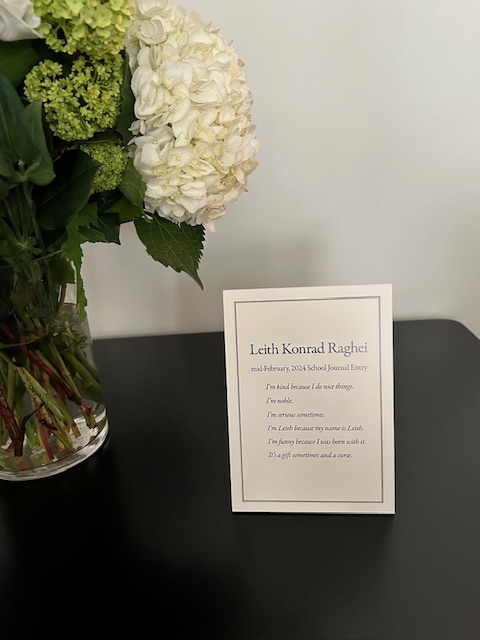
It was a wonderful, terrible time. His parents copied a few lines from his journal from February of this year, which they had printed up and stood in various places in their home; his last words were in the ambulance, on his way to the hospital April 15th, answering a question the EMTs kept asking, ‘Do you know your name, can you tell us who you are?’: “I’m Leith. I’m Leith!”
His name was Leith. Leith means lion in Arabic. He was a beautiful ten-year-old boy, and I loved him. His funeral, part 2 of a wonderful, terrible time, will be in June.
*if you have missed the ‘man vs. Bear conversation – congrats, you do not spend much time on the internet, and deserve the highest praise available to women.It has been entertaining, to say the least, for those of us who are not surprised AT ALL by the overwhelming number of women who have chosen meeting a bear in the woodsovermeeting a male stranger. The following is a reprint of a post from ‘La Zenska’, one of many interesting human being’s pages I found via a friend of mine, and, FYI, unless you’re a friend of hers, La Zenska, I mean, y’ain’t getting anything more than the name and a couple of photos, and public posts!
The point of the whole thing is that too many men don’t get it, how dangerous the world can feel to women and girls. And, relying on men to behave well, like people of color relying on white peeps to not be vicious, violent racists, is not a healthy or safe way to live. Trusting men not to kill us, rape us, abuse or harass us (etc.), has not ended well for far too many women and girls. Thank you, La Zenska, for this post!
Over the past two weeks, Man vs. Bear posts have inundated my feed. Many of the comments were tense, but insightful. One man labeled the meme as “toxic and divisive”, and refused to share his “nuanced thoughts”, claiming it would be would be met with hostility.
But perhaps the most disturbing theme within these discussions was the undercurrent of implicit violence, men who professed a desire to see women harmed as a way to prove that men are indeed safer than bears.
Men who were excited by the thought of women being injured for the opportunity to say “I told you so.” This isn’t new. Women hear these statements as part of their daily lives.
• We hear it when we talk about random women being attacked, and men insist that she must have done something to incite it.
• We hear it when men speak in mocking tones about “independent women”, sneering at women who are struggling with the common trials of life; car repairs, financial troubles, home renovations – as if the presence of a man could ward off bad luck.
• We hear men saying “If you didn’t want to be independent, if you weren’t a feminist, we would work alongside you, but since you’re going to behave this way, we can’t help” as if cooperation and human kindness shouldn’t exist outside their control.
All of this is rooted in patriarchal violence. The force these men want to wield against women to compel them to submit to their terms.
Some men just can’t handle the idea of non-transactional, egalitarian exchange because they’ve been conditioned to believe that all they need to do is withhold violence and provide financial support to earn the respect and admiration of women.
But now that women can no longer be legally coerced into providing services to men in exchange for financial support, it doesn’t work that way anymore.*
Men of low skills ultimately turn back to violence because it’s the only thing they know how to do, but it will never earn them respect from women.
All they can hope for is coerced and/or forced respect – something that wasn’t ever real to begin with. And deep down they know it. They don’t have skills or adaptability. All they have is their impotent rage, and it will never be enough.
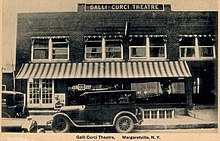
The Galli-Curci was the only movie house in my rural upstate town that was open during my childhood. It was just down the street from our first house, and I snuck into the theatre one day when I was three or four years old; even then I knew, as did – clearly – the universe, that I was meant to be addicted to movies. It was a Perry Mason film, or at least featured that guy, whatshisname, Raymond Burr, and there was a car crash over a steep hill after a chase with guns, and people were in the car so they died, they died!! It seemed very real. This along with the menacing music, scared me right out of the theatre and back home, where Mrs. Murphy wasn’t even aware I’d been and gone. My little sister was ‘her baby’; mom had gone back to work, mornings only, and I was – happily – on my own.
Amelita Galli-Curci was a well-known opera singer during the early part of the twentieth century; she had an estate near our village from 1922 until 1937. She performed on opening night of the theatre as a favor, which was in 1922 or ’23, once it was determined that it would be named in her honor. It still stands but has been dormant for many years. There was a plan by a gay couple to revive it, a plan that was stymied by the idiot who converted the very nice house next to ours (our former home) into a gun shop sometime, I believe, in the 1980s. Such an ugly decade. He may have been motivated by homophobia; I’m not sure, but I sure wouldn’t be surprised. After litigation for a handful of years, the couple moved on, and the building has sat there, pretty much abandoned, ever since. The gun shop guy? He’s still in business, and was – might still be – on the village board. A village board member stops the re-development of a main street attraction. Small town living! Did I mention he’s a Republican? I know, I didn’t need to say it but…
It was in the Galli-Curci that I had my second real kiss (ala francais, mais bien sûr), and a few more besides, watching Zefferelli’s Romeo and Juliet (sort of, I was mostly snogging). It was there I saw MASH after a ‘Battle Royale’ with my mother because she considered it to be too risqué, too adult for me at twelve or thirteen. Thank you, Aunt Carc, for letting your kids go see it, so that I could too. It was there I sat with a young man (who shall remain nameless) with whom I was not on a date, until I realized that, ugh, he thought so; concerns about how the hell to get out of there without hurting his feelings or getting further stuck in the muddiness of co-ed relations ruined whatever the film was, which I cannot for the life of me recall. How many times did I date or even kiss men I didn’t want to date or kiss because I didn’t want to hurt their fragile feelings? Not a lot but still, too many times. But not much longer after this muddy moment; I fully stopped during my junior year in college, thank gawdess, except for that one massive, huge, stupid AF mistake I made (pity fuck) and have written about here previously. Sigh.
My dad took my brother and I to the Galli-Curci during Halloween week in 1970 or ’71. He had a partner in his business, and after many years of working seven days a week, he also had a few regular nights off; this made it a special treat. The theatre scheduled a 5 horror film marathon to give patrons an entire night of scariness, and while the first two films (The Raven and The Fall of the House of Usher) weren’t too awful, the third – Premature Burial – scared me crapless, giving me nightmares for years afterwards. I remember a moment in the film when the entire audience jumped in their seats, including me; out of an abundance of caution re: tonight’s dreams, I won’t go into detail, because why risk stirring things up?
My brother was a projectionist there for three or four years, maybe more, and once, as a favor, he cut me a frame of Gone With The Wind, a tiny piece of my idol Clark Gable, laughing in the study after Miss Scarlett has tossed a vase at his handsome head. Sigh! I still have it. I’m not sure where it is, exactly, in part because I love coming across it unexpectedly, triggering fan bliss and tickling my teenaged self pink. It’s in an envelope that is old school, covered with white, raised dots, see through but not.
The Galli-Curci also showed porn movies at midnight during hunting season for several years, which was determined to be okay regarding my brother being the projectionist so late (weekends only!) and so – steamy!! I remember casually eavesdropping on the parental discussion about it, in the kitchen, was it appropriate, wasn’t it; my brother was given the go-ahead, getting once more the respect and dignity in life we’re all owed but often don’t receive. His judgement, his character, his temperament and future? Those were already well-establish in the gleaming marbled stones of positivity and respectability, largely because boy. Yes, it’s also who he was and is, but what comes first, the chicken or the egg – because the expectations and automatic endowment of his rights and respectability were real, were sunny, and were significant. Lucky guy, eh? Eh. Nice too, actually, if a tad spoilt and unconscious, yet that tiny Gable frame, so sweet.
It’s much easier to be nice, and easy going, I have observed, when people treat you with respect, when expectations are high, and uniformly positive from the get go. It much, much easier to be a nice, moderate person when you’re not ‘interfered with’, pursued, muddied by numerous men in your family and community who think they have a kind of ownership of your space and your body because vagina. It’s much easier to be nice, and kind when you’re never told you are ‘less than’, and can’t do this or that because, again, vagina. Sigh.
It was at the Galli-Curci I first fell in love with the movies. Settling in with a red and white striped box of popcorn, I was – other than Romeo and Juliet – not to be distracted by any social nonsense or horseplay going on in the rows; I was intent on the big screen. Still am, although yes, I stream films all the time now. The closet movie theatre is 45 miles away. If only. Who knows, maybe one day the Galli-Curci will rise again. Who knows?
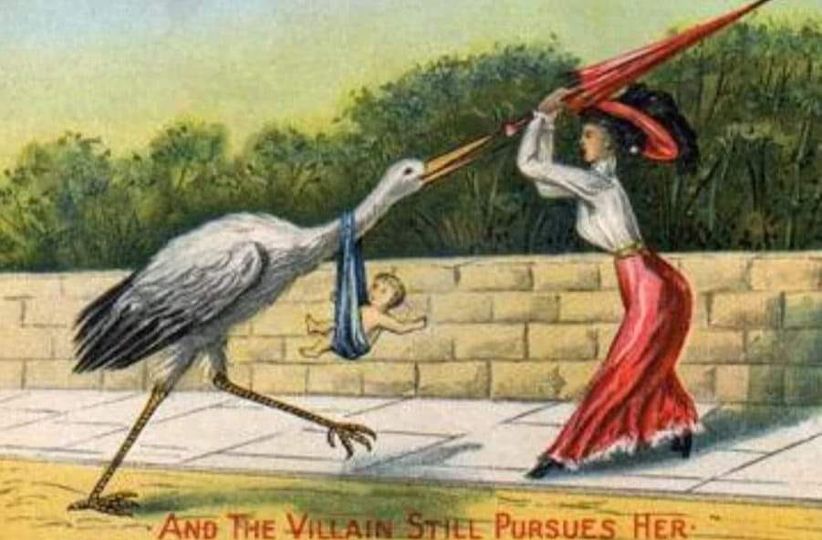
*because this never gets old, must be repeated, and remembered, is all a part of centering women’s lived experiences in a world that likes to pretend every instance of pregnancy is a happy dance in fcking field of wildflowers …
They asked me to tell you what it was like to be twenty and pregnant in 1950 and when you tell your boyfriend you’re pregnant, he tells you about a friend of his in the army whose girl told him she was pregnant, so he got all his buddies to come and say, “We all f*cked her, so who knows who the father is?” And he laughs at the good joke….
What was it like, if you were planning to go to graduate school and get a degree and earn a living so you could support yourself and do the work you loved—what it was like to be a senior at Radcliffe and pregnant and if you bore this child, this child which the law demanded you bear and would then call “unlawful,” “illegitimate,” this child whose father denied it … What was it like?
It’s like this: if I had dropped out of college, thrown away my education, depended on my parents … if I had done all that, which is what the anti-abortion people want me to have done, I would have borne a child for them, … the authorities, the theorists, the fundamentalists; I would have born a child for them, their child.
But I would not have born my own first child, or second child, or third child. My children.
The life of that fetus would have prevented, would have aborted, three other fetuses … the three wanted children, the three I had with my husband—whom, if I had not aborted the unwanted one, I would never have met … I would have been an “unwed mother” of a three-year-old in California, without work, with half an education, living off her parents….
But it is the children I have to come back to, my children Elisabeth, Caroline, Theodore, my joy, my pride, my loves. If I had not broken the law and aborted that life nobody wanted, they would have been aborted by a cruel, bigoted, and senseless law. They would never have been born. This thought I cannot bear.
What was it like, in the Dark Ages when abortion was a crime, for the girl whose dad couldn’t borrow cash, as my dad could? What was it like for the girl who couldn’t even tell her dad, because he would go crazy with shame and rage? Who couldn’t tell her mother? Who had to go alone to that filthy room and put herself body and soul into the hands of a professional criminal? – because that is what every doctor who did an abortion was, whether he was an extortionist or an idealist.
You know what it was like for her. You know and I know; that is why we are here. We are not going back to the Dark Ages. We are not going to let anybody in this country have that kind of power over any girl or woman. There are great powers, outside the government and in it, trying to legislate the return of darkness. We are not great powers. But we are the light. Nobody can put us out. May all of you shine very bright and steady, today and always.
*this quote – which made me laugh out loud when I read it – is from the wonderful book Drive Your Plow Over the Bones of the Dead by Olga Tokarczuk, a Nobel Prize winning Polish novelistI had never encountered previously but – the entire book, and this half-paragraph, are just faboo – a lot better than my perception of its darkness as suggested by the title, which meant this book stayed on my shelf far too long, unread because oh hell, that sounds so GRIM.
I love encountering new to me authors, especially female ones, especially too when they make me laugh, featuring female characters I can relate to, however different their lives might be from mine in details big and small.
Also, if we’re going to feminist the language, which we’re gonna have to do, y’all, we have to come up with more terms for the many ways in which men are testerical.
Published in 2009, this novel was translated into English by Antonia Lloyd-Jones; the English language version was published in America in 2019 by Riverhead Books.
“It’s hard work talking to some people, most often males. I have a Theory about it. With age, many men come down with testosterone autism, the symptoms of which are a gradual decline in social intelligence and capacity for intrapersonal communication, as well as a reduced ability to formulate thoughts. The Person beset by this Ailment becomes taciturn and appears to be lost in contemplation. He develops an interest in various Tools and machinery, and he’s drawn to the Second World War and the biographies of famous people, mainly politicians and villains. His capacity to read novels almost entirely vanishes; testosterone autism disturbs the character’s psychological understanding.”