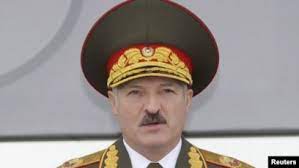
Ever since I saw the idiot below, the leader of Belarus, in his big-ass hat, I have been obsessed with dickheaded men like him and their fucking oversized, often bling encrusted hats. I almost used Dick Cheney as the featured photo here because he literally is a Dick in a hat, in every way, but instead I’ll put him where he belongs, not featured, just hanging with the rest of these power-obsessed penis-brains in their big-man, big-dick costumes. Some of them are dead (thank goodness), and others are still living, more’s the pity. Let’s start with Lukashenko, who is a Putin puppet, brutally repressing democratic protesters and the vote in his European-leaning, Russian-backed country. You won’t see Putin in a clown hat, his background isn’t the military, but rather the former Russian secret service, but he sure surrounds himself with big-hatted dicks, and he’s a real penis-brained DICK, for sure.
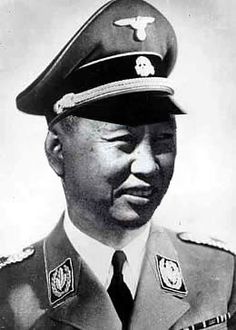
The dick-in-a-hat above is Pol Pot, one time leader of Cambodia, where from 1963-1981 he managed to systematically oppress, terrorize and murder the citizens of his country. Also, don’t you think his uniform has a slight “I aced the Nazi leaders workshop” look? I sure do. Or perhaps it’s just that all dicks look alike when they’re wearing hats? What a dick!
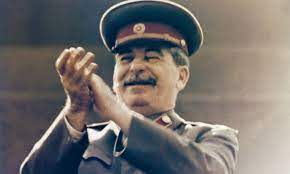
Stalin. Uncle Joe. Mass murderer, and a clear inspiration for Lukashenko’s fashion and suppression choices. What a dick!
Below we have a still living embodiment of a true dick in a hat, a current cult leader of a man, one who has a tiny mushroom dick, I suspect (and isn’t that what Stormy reported, basically?). What a dick!
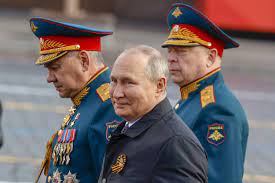
And after the 4x’s indicted Donald Dick, we have his BFF Putin, sans hat, but pictured with two of his big-dick, big bling hatted, terrorism enabling generals, in a photo that manages to capture three dicks in their native habitat, on parade. What a bunch of dicks!
The next dick in a hat is Franco – who made Spaniards, especially those who disagreed with him politically – miserable from 1936 to 1970. What a dick!
Behold below Idi Amin, president of Uganda for eight short, brutal years. Just look at all of that bling! What a dick!
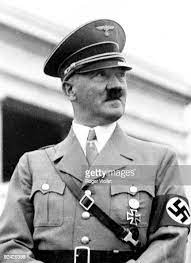
Hitler. What an utterly evil fucking dick. Cheney. What a dick. Pinochet. Total dick. Reagan. A complete dick and anyone who thinks differently, well, fine, but he was a slick, vile dick – charming, if you fall for that kind of dick in a blanket nonsense. Dicks in hats. What total dicks!!
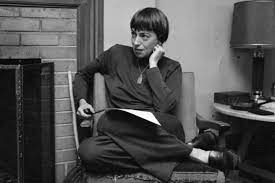
*Ursula Le Guin edition – I am embarrassed to admit I’ve never read LeGuin, as I generally avoid fantasy and sci-fi, but – her words, quoted everywhere, inspire me, always, when I discover them. Eventually, I must must must get to it, read her classic works. It’s time.
Change is freedom, change is life. It’s always easier not to think for oneself. Find a nice safe hierarchy and settle in. Don’t make changes, don’t risk disapproval, don’t upset your syndics. It’s always easiest to let yourself be governed.
There’s a point, around age twenty, when you have to choose whether to be like everybody else the rest of your life, or to make a virtue of your peculiarities. Those who build walls are their own prisoners. I’m going to go fulfil my proper function in the social organism. I’m going to go unbuild walls.
The unread story is not a story; it is little black marks on wood pulp. The reader, reading it, makes it live: a live thing, a story.
As great scientists have said and as all children know, it is above all by the imagination that we achieve perception, and compassion, and hope.
I certainly wasn’t happy. Happiness has to do with reason, and only reason earns it. What I was given was the thing you can’t earn, and can’t keep, and often don’t even recognize at the time; I mean joy.
I believe that maturity is not an outgrowing, but a growing up: that an adult is not a dead child, but a child who survived.
The only thing that makes life possible is permanent, intolerable uncertainty; not knowing what comes next.
I talk about the gods, I am an atheist. But I am an artist too, and therefore a liar. Distrust everything I say. I am telling the truth.
*I wrote this in 2017, and as I reflect back on where and who I was then, it makes complete sense.
The place I come from is steeply graded and rocky, fragrant and fraught. It is a land of many shades of green, brown, orange, red and winter white, a place where the best days are long gone and everyone knows it, if even if no one dares say it aloud.
The rich buy homes they use for weekends and summers parties on vast lawns, visiting the declining Main Streets as if touring a broken down zoo, ‘Look at the lion whose teeth are gone! Does anyone in this town have all their teeth?’
The other place I come from – we all come from – is mother and father – grandparents, uncles, aunts, cousins, friends, neighbors, priests and ministers, teachers and bus drivers and the woman who cleaned your teeth twice a year, making your gums bleed, all the while talking to your mom, who never takes her coat off.
And I come from my father’s place of work, the scent of one-hundred plus years of dry goods, sundries, solutions, pills, remedies, ice cream sodas and condoms in special wrap, drawn from the back room where he would, laughing, take the men to make their choice.
I am my mother’s work too: text-books and mimeographed sheets of paper, Cicero, Caesar, Marcus Aurelius, and the sonnets of Homer – poems by Keats, Byron – and other books too, histories and essays, Etruscan art, and Shakespeare. These are from worlds beyond the rocky valleys her marriage brought her to, the dark places and lonely hours while my father peddled drugs, hair gel and porn but most of all kindness and humor – the dark hours that led her to overeat and read her own version of porn: bodice rippers filled with buxom virgins, blond, brunette, chestnut sirens who were instantly orgasmic, saved by Rex or Colt, or Steel or Thor. Yes, fucking Thor.
Most of the time I’m just mystified I survived. But I did. Most of us do, one way or another. All those children born in the prosperous, hopeful 50s and 60s of Eisenhower, Kennedy and even LBJ. Kennedy quoted Frost, got us further into Vietnam, and LBJ and Tricky Dick led us further down the rabbit hole, typifying, embodying a new America split in two, each side taking one of both roads the twentieth century poet described and that has made all the difference.
All the things we didn’t talk about: everything. Almost everything. All the things we didn’t know or acknowledge but mostly didn’t know were there sitting next to us in class, or at the church picnic: beatings and child abuse, incest, sexual abuse, alcoholism, suicide, depression, key parties and drug abuse. La-la-la-la-la-la-la. If I can’t hear you, or see you, if it hasn’t happened to me, it’s not real, it can’t happen, it doesn’t happen. Not in my world, not in my backyard, not in my lifetime.
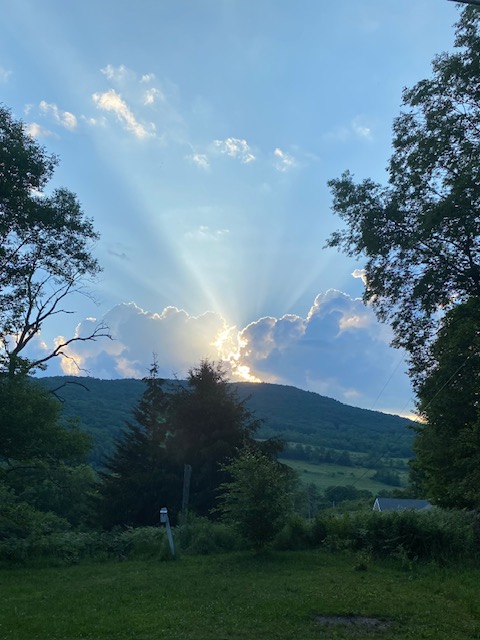
An almost sun set on the mountain across from my wee casa.the world really is so beautiful, let’s hope we keep it that way for future generations.
From a recent interview in the NYT with Braiding Sweetgrass writer Robin Wall Kimmerer: In “Braiding Sweetgrass,” you write about nature as capable of showing us love. If that’s true, doesn’t it also have to be capable of showing us the opposite? The answer that comes to mind is that it’s not all about us. What?! [Laughs.] Some of these cycles of creation and destruction that promote change might be bad for us, but we’re one of 200 million species. Over evolutionary time, major changes that are destructive are also opportunities for adaptation and renewal. Another message in your work is that prioritizing the objective scientific worldview can close us off from other useful ways of thinking. But how does one keep an openness to other modes of inquiry from tipping over into skepticism about scientific authority? When we do conventional Western science, our experimental designs are designed to optimize objectivity and rationality so that we come to some perceived truth about the natural world — minus human values and emotions. That means that the questions that we can validate with Western scientific knowledge alone are true-false questions. But the questions today that we have about climate change are not true-false questions. What are the keys to communicating a sense of positivity about climate change that’s counter to the narrative we usually get? So much of what we think about in environmentalism is gloom-and-doom, but when you look at examples where people are taking things into their hands, they’re joyful. That’s healing not only for land but for our culture as well — it feels good.
There were two of us witches, and then there were three, and then four and ultimately, we were five of us for several years, until one witch-y witch turned away from the rest, and disappeared into the ether. And so, we were and are four, like the four directions, four elements of the zodiac, and four humors of the body, and we have remained together as friends through thick and thin and all the in-between spaces. We recommend books, we text baby pictures and doggie pictures (seven total dogs, one grandchild so far), we share our joys, troubles, and our favorite memes, and we reminisce about times past and piece together where the hell he or she went, or was from, or who met who, where and when, exactly?
There are two ex-husbands we keep track of (vaguely), and seven children and two step-children between us. We have been to funerals, wakes, and memorial services together and in support of one another, as well as weddings and baby and bridal showers. We have been friends for over three decades and we know what we know what we know about one another and have forgotten almost as much, probably. We have gone into hospitals and abortion clinics with one another; we have traded info on therapists and gynecologists, intuitives and psychics; we are women of a certain age and have been through the wars, even though our wars have been softened by privilege, and money. We read cards and consult the runes and one of us studied astrology at Oxford one summer; the Brits take their astrology seriously, folks. We compare eating habits and injuries from years ago taking a toll on our aging bodies; we adore one another’s partners as needed and we never give advice unless it’s asked for, and reluctantly even then. We listen to one another without judgment, an essential quality of true friends, new or old.
We made a pact after that other witch left the group and we had a few dust ups, a pact covering gossip and sharing tales out of our regular sessions; we met once a month for years, until one of our number went all left coast on us, dammit. She returns every summer, Persephone-like, and we try to merge but now, more often, we rely on Zoom, and Facetime and texting chats, a lot.
One of or number is a red-head, and ages ago we decided, at her request, to call ourselves The Goddesses, not The Witches going forward, because she was tormented on her elementary school playground for being a flame-haired witch, and had never liked the label. We do refer to ourselves as Goddesses, and still – on occasion – as the witches, when we are in pairs, and forgetful. We have and claim no special powers, other than those of women who have indeed survived the various wars, and those of good and old friends, to know and understand and comfort and love and enjoy one another. The comfort of those we’ve known forever is great, like a bed we love to return to at night, allowing total relaxation, and healing of the kind we gain when surrendering to deep sleep.
We have names that were given in classes – acting, or the business of – years ago, or so one of us remembered: Brandy Snapdragon (the red-head), Dimples McSnakecharmer (yours truly), Frisky Fish (the Piscean), and Wilder Snowleopard (our resident Leo). We have so much collective history, and memory, perhaps we really do have special powers, concerning love, and healing, and humor. Our husbands and partners and exes and various family members have sometimes looked askance on all this talk of witches and goddesses, but the ones who have stuck and stuck around are appropriately humble in our collective presence, or when one or another of us reaches out, because need or curiosity is great. The kids call us Auntie this or that, and know our bond is true, deep and lasting; they say they hope for the same thing or something very like with their best friends; we hope that for them, too.
We all had difficult mothers. One of us (not me) puts it more bluntly: they were all narcissists, unhappy, angry women who, like so many of their generation, were profoundly frustrated by the narrow road women were expected to travel. One of them married a gay man, and forged a lucrative career in real estate; another was the first of four wives who never recovered fully from being left so far behind; another did the leaving when her two daughters were both under six years old, moving to France, marrying well the next time around, for money. Three of the four of us lost our moms to breast cancer, two of whom died as a result of the aftereffects of then current breast cancer treatments, radiation poisoning. Male doctors in the seventies were doing the best they could, but with much less research or other funding at their disposal because ‘a women’s issue’, one that was marginalized by sexism. Women, and their health, are not a niche or fringe issue. My mom, the only one of the four mothers to not die as a result of breast cancer, was lost instead to dementia, brought on, by uncontrolled type-II diabetes and the after-effects of anesthesia given during a late surgery. The surgery was performed to remove a softball sized tumor enveloping her remaining ovary; the rest of her reproductive organs had been removed four decades earlier by two doctors – both male – who decided it was for the best, because she was not capable of making the right decision, they believed, about birth control, having had four caesarians in under six years. My dad was relived and grateful, but what would that have been like, coming out of anesthesia at thirty-two years old to be told you would never bleed again? All of our mothers, all of them without exception, hated their bodies. Were they narcissists, or simply – appropriately, I would argue – angry and in pain?
We’re all twisted sisters, ain’t we? Doing the best we can. Sisterhood, wherever you find it, is powerful, and necessary. My gratitude to all of my female friends is boundless, limitless, necessary. We have lifted one another, and will, knock wood, continue to do so for as long as we live. Ho!