
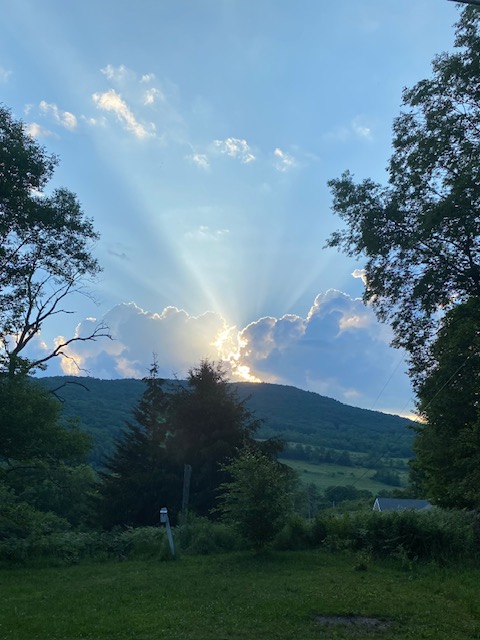
An almost sun set on the mountain across from my wee casa. the world really is so beautiful, let’s hope we keep it that way for future generations.
| From a recent interview in the NYT with Braiding Sweetgrass writer Robin Wall Kimmerer: In “Braiding Sweetgrass,” you write about nature as capable of showing us love. If that’s true, doesn’t it also have to be capable of showing us the opposite? The answer that comes to mind is that it’s not all about us. What?! [Laughs.] Some of these cycles of creation and destruction that promote change might be bad for us, but we’re one of 200 million species. Over evolutionary time, major changes that are destructive are also opportunities for adaptation and renewal. Another message in your work is that prioritizing the objective scientific worldview can close us off from other useful ways of thinking. But how does one keep an openness to other modes of inquiry from tipping over into skepticism about scientific authority? When we do conventional Western science, our experimental designs are designed to optimize objectivity and rationality so that we come to some perceived truth about the natural world — minus human values and emotions. That means that the questions that we can validate with Western scientific knowledge alone are true-false questions. But the questions today that we have about climate change are not true-false questions. What are the keys to communicating a sense of positivity about climate change that’s counter to the narrative we usually get? So much of what we think about in environmentalism is gloom-and-doom, but when you look at examples where people are taking things into their hands, they’re joyful. That’s healing not only for land but for our culture as well — it feels good. |