Sorry to say this is not a post about mindfulness, or meditation, taking time out of my or your day to reflect in a state of gratitude. Nope. It’s about the utter JOY I feel as I watch in the present moment men having to deal with consequences, consequences that come about as a result of their ACTIONS, white men in particular.
I’ll insert one specific asshole’s mug shot here…because this POS has been getting away with crap ever since the 60s, if not before, when his daddy first bailed him out of financial trouble by gifting him with – was it $200 million? Not to mention the nonsense about bone spurs preventing this self-described ‘super athlete’ from being drafted into fighting in the Vietnam War. FEH.
Sorry to ask you to play this mind game, but what kind of human must you be to determine that this – this me so scary – pose is the way to go when getting your mug shot taken? I just reduced it in size because however many followers he may have and have conned, to me he is a small man, petty, narcissistic, grandiose, in denial and the day he no longer occupies ANY media of any size any where will be a great day.
In other asshole news, I just heard that the Spanish FIFA president, Luis Rubiales – the one who forcibly kissed a female World Cup winning soccer player without her consent – that asshole’s mom has locked herself in a church and will be on hunger strike until her little boy (he’s forty-six) is cleared of all consequence resulting from his actions. You can’t make this shit up, and of course she would lock herself in a church, symbolic of the patriarchy whose privileges her little boy has been leveraging his entire life, I suspect, and for whom she works as a dedicated servant to the system. FEH.
Kenny Parcells, fifty years of age, a nice little boy from Utah, as also been outed as a serial sexual harasser of women and resigned from his post as the president of the National Realtor’s Association this week after the NYT did an article outlining his infractions against women. Yay. Here’s his non-mug shot; doesn’t he look sweet? Wanna bet he’s a nice Mormon boy, trained from infancy in the ways of male superiority? Yup. He went on missions for the cult known as LDS in Texas for two years, then played football for Brigham Young U. FEH.
And, then there’s the twenty-something white male – and white nationalist – who shot and killed three people of color in Jacksonville, FL this week. Yes, he killed himself, so – consequences, I guess, but, unless and until our media start reporting that the shooters in these all too common mass killings are WHITE MALES, I ain’t gonna be satisfied, and we won’t be demonstrating any understanding or cultural shift. Saying ‘the shooter was in his twenties’ is not the same as ‘the white male shooter was in his twenties’, y’dig? And believe me if these killings were being committed by men of color that fact would be front and center. AND, WOMEN ARE NOT DOING THIS. This specific killer had been previously brought to the attention of law enforcement and the mental health department in his community yet still, he was able to legally buy guns, guns he used to traumatize a community and kill other human beings. Fuck This Shit. Seeing and hearing Gubbner Ron DeSantis booed when he came into he community to pretend commiserate, given he forbids the teaching of actual and accurate black history in his state, another joy filled moment, amidst the ongoing bullshit of this moment.
The sign below was posted in my small rural community the second time I ran for office, for re-election as it happened, by the husband of the village Mayor. His name is obviously Bruce, and he didn’t like me because I voted against a county-wide resolution objecting to the NY Safe Act passed by then Governor Cuomo and a heavily Democratic legislature after the Newtown, CT. shooting massacre of 1st graders and their teachers. Bruce is a gun enthusiast, you see. Bruce is also a well-known asshole, and my reaction to the sign was pretty much along the lines of ‘what an asshole’, and ‘how assholic of his wife, the Mayor, to allow it’. She said, when questioned, that she’d told him he could not post any political signs directly supporting my opponent, and this was his workaround, one that she literally shrugged her shoulders at when I asked, as if to say, ‘oh well, that’s Bruce for ya’ or maybe I’m misinterpreting and it was more of a ‘well, that’s marriage for ya’ shrug. Possibly both. Bruce is an asshole, and this kind of personal attack is assholic, unnecessary, and – in a small community like mine – both stupid and cruel.
At the time this sign went up I did what was probably a mistake, but was my best effort, speaking to her about it briefly before moving on, failing to suggest that as Mayor it was inappropriate for her to have this on her lawn ~ because it was. It’s years ago now, and once we were both out of office, I did tell her it was inexcusable of her to have let her husband do this; I no longer had to put the interests of the Town, and my need to work with her, ahead of my own personal needs, or those of my brother and his wife, who lived down the street from well-known asshole Bruce and Diana, passing this sign numerous times a day.
When women run for office, or hold office, they are often the targets of specific, gendered, sexist commentary, hate, and pure crazy – particularly women of color. Before winning my first election, I had been president of my co-op in New York City, and been involved in my life as both librarian on numerous volunteer committees and boards; during those instances I certainly ran into sexism and gender bias, including a married fellow board member sexually harassing me. I’d been attacked verbally by a neighbor in NYC who was perennially in legal trouble because she was so far behind in her maintenance payments to the co-op – but nothing quite prepared me for the hate, sexism, sexually inappropriate emails, and commentary etc., etc. I received when I was in public office. This sign might be among the least of the stupidity, and the hate – but, it all adds up, and is a form of bullying men have perfected to try and keep women out of public spaces and public office, where women – and different points of view – are desperately needed. Bruce might be a well-known asshole, but – he’s no different from a lot of other men, and men – all men – need to do and be better.
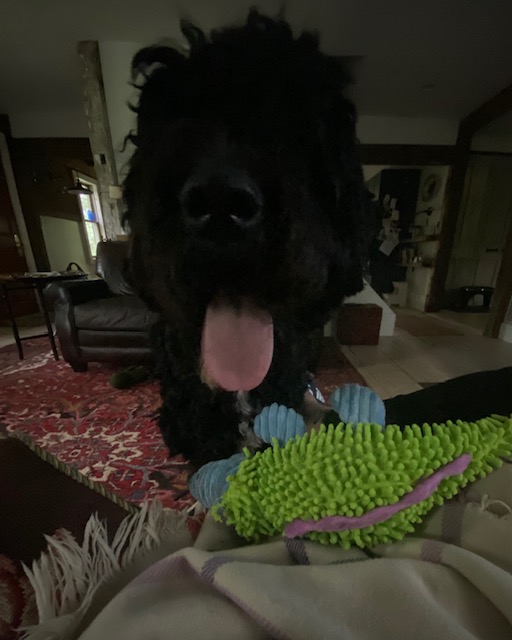
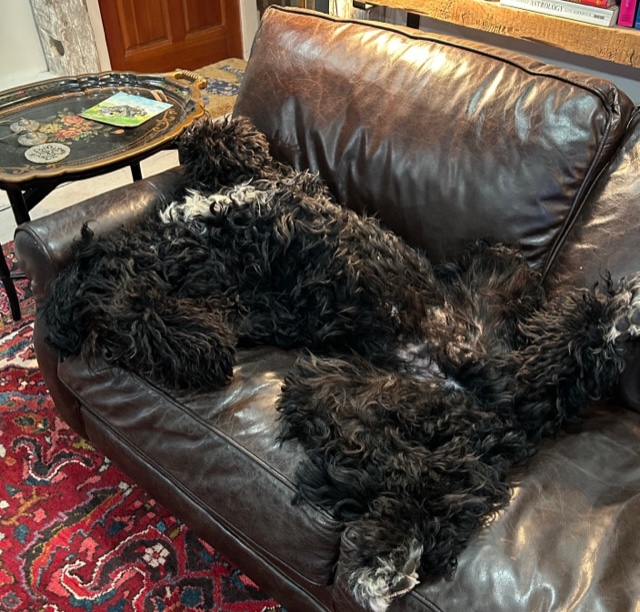
When momma is away, Big Boy Diego goes to doggie overnight camp, for although last year he went to the lake with me, this time around I decided that I needed a BREAK because I did. I also knew that there were, moreover, seven other dogs at the lake, and adding one other huge fur baby seemed like an invitation to utter chaos. One of the seven is also very sadly on his last legs, which was heart-breaking (he was such a super athlete, swimmer and ball-chaser), and I knew that his vulnerability might not mesh well with Diego’s still-a-puppy energy. Diego is also a tad clumsy, and our old darling doesn’t need that around, at all. And so, overnight camp for two weeks where he had a blast, was very popular, returning home in great shape – if slightly constipated, but that quickly worked itself out, literally!!
During the first week of my break, I dreamt Diego was stolen, one of those dreams where you’re upset and crying, and not getting an answer, a feeling that remains after waking. While he was found in my dream, and the thieves apprehended, I was unable to get him back – more tears, and frustration – because the state troopers who’d done the rescue were out at a class learning about vegetables? Or vegan-ism? Weird. I wrote to the kennel owner who reassured me he was fine, because why not reach out. I missed him, and was very happy to pick him up, and he was happy to be home, passing out as you see above on ‘his’ couch. Life is good, vacations are great, and – it’s great to be home. ~ New Yorker Cartoon by Harry Bliss…
August is almost over – aggggggg! And, lucky me, I spent time at the beach and at the lake, a lake I have been visiting for thirty years in central New York, where friends own a home and are inclined toward hosting…it’s gorgeous there no matter the weather, and the lake water is clean and cold and every time I get in it feels like renewal and rebirth. Among the annual rituals are a boat ride to a middle spot in the 16+ mile long lake for a swim; this time we went into town for donuts and egg sammiches, and then dove in, along with two of the hosts’ labradors, of which there were a total of six in various houses along a lane primarily occupied by my host’s family members. There’s a cockapoo around as well but she’s over 15 years old, and isn’t doing much running around, let alone boating and swimming. Here are a few pictures from one of my favorite places in the world, where I get to hang out with a few of my favorite peeps in the world as well. #LuckyAF #GratefulAF
*from the always brilliant Professor Heather Cox Richardson…while I recover from such a busy day my feet and everything else including my eyelashes hurt!interesting to learn that women supported polygamy in Utah when allowed to vote, but then, these women were indoctrinated into their cult religion, and derived a sense of purpose from it. Still, makes me a little queasy, as the Mormon Church’s treatment of women and girls in the 19th and 20th Centuries into today is abysmal, more like livestock than thinking human beings…religion, an opiate for the masses indeed.
On this date in 1920, the U.S. Secretary of State received the official notification from the governor of Tennessee that his state had ratified the Nineteenth Amendment to the Constitution. Tennessee was the 36th state to ratify the amendment, and the last one necessary to make the amendment the law of the land once the secretary of state certified it. He did that as soon as he received the notification, making this date the anniversary of the day the Nineteenth Amendment was ratified.
The new amendment was patterned on the Fifteenth Amendment protecting the right of Black men to vote, and it read:
“The right of citizens of the United States to vote shall not be denied or abridged by the United States or by any State on account of sex.
“Congress shall have power to enforce this article by appropriate legislation.”
Like the momentum for the Fifteenth Amendment, the push for rights for women had taken root during the Civil War as women backed the United States armies with their money, buying bonds and paying taxes; with their loved ones, sending sons and husbands and fathers to the war front; with their labor, working in factories and fields and taking over from men in the nursing and teaching professions; and even with their lives, spying and fighting for the Union. In the aftermath of the war, as the divided nation was rebuilt, many of them expected they would have a say in how it was reconstructed.
But to their dismay, the Fourteenth Amendment explicitly tied the right to vote to “male” citizens, inserting the word “male” into the Constitution for the first time.
Boston abolitionist Julia Ward Howe, the author of the Battle Hymn of the Republic, was outraged. The laws of the age gave control of her property and her children to her abusive husband, and while far from a rabble-rouser, she wanted the right to adjust those laws so they were fair. In this moment, it seemed the right the Founders had articulated in the Declaration of Independence—the right to consent to the government under which one lived—was to be denied to the very women who had helped preserve the country, while white male Confederates and now Black men both enjoyed that right.
“The Civil War came to an end, leaving the slave not only emancipated, but endowed with the full dignity of citizenship. The women of the North had greatly helped to open the door which admitted him to freedom and its safeguard, the ballot. Was this door to be shut in their face?” Howe wondered.
The next year, Elizabeth Cady Stanton and Susan B. Anthony formed the National Woman Suffrage Association, and six months later, Lucy Stone and Julia Ward Howe founded the American Woman Suffrage Association.
The National Woman Suffrage Association wanted a larger reworking of gender roles in American society, drawing from the Seneca Falls Convention that Stanton had organized in 1848.
That convention’s Declaration of Sentiments, patterned explicitly on the Declaration of Independence, asserted that “all men and women are created equal” and that “the history of mankind is a history of repeated injuries and usurpations on the part of man toward woman, having in direct object the establishment of an absolute tyranny over her,” listing the many ways in which men had “fraudulently deprived [women] of their most sacred rights” and insisting that women receive “immediate admission to all the rights and privileges which belong to them as citizens of these United States.”
While the National Woman Suffrage Association excluded men from its membership, the American Woman Suffrage Association made a point of including men equally, as well as Black woman suffragists, to indicate that they were interested in the universal right to vote and only in that right, believing the rest of the rights their rivals demanded would come through voting.
The women’s suffrage movement had initial success in the western territories, both because lawmakers there were hoping to attract women for their male-heavy communities and because the same lawmakers were furious at the growing noise about Black voting. Wyoming Territory granted women the vote in 1869, and lawmakers in Utah Territory followed suit in 1870, expecting that women would vote against polygamy there. When women in fact supported polygamy, Utah lawmakers tried unsuccessfully to take their vote away, and the movement for women’s suffrage in the West slowed dramatically.
Suffragists had hopes of being included in the Fifteenth Amendment, but when they were not, they decided to test their right to vote under the Fourteenth Amendment in the 1872 election. According to its statement that anyone born in the U.S. was a citizen, they were certainly citizens and thus should be able to vote. In New York state, Susan B. Anthony voted successfully but was later tried and convicted—in an all-male courtroom in which she did not have the right to testify—for the crime of voting.
In Missouri a voting registrar named Reese Happersett refused to permit suffragist Virginia Minor to register. Minor sued Happersett, and the case went all the way to the Supreme Court. The justices handed down a unanimous decision in 1875, deciding that women were indeed citizens but that citizenship did not necessarily convey the right to vote.
This decision meant the fat was in the fire for Black Americans in the South, as it paved the way for white supremacists to keep them from the polls in 1876. But it was also a blow to suffragists, who recast their claims to voting by moving away from the idea that they had a human right to consent to their government, and toward the idea that they would be better and more principled voters than the Black men and immigrants who, under the law anyway, had the right to vote.
For the next two decades, the women’s suffrage movement drew its power from the many women’s organizations put together across the country by women of all races and backgrounds who came together to stop excessive drinking, clean up the sewage in city streets, protect children, stop lynching, and promote civil rights.
Black women like educator Mary Church Terrell and journalist Josephine St. Pierre Ruffin, publisher of the Woman’s Era, brought a broad lens to the movement from their work for civil rights, but they could not miss that Black women stood in between the movements for Black rights and women’s rights, a position scholar Kimberlé Crenshaw would identify In the twentieth century as “intersectionality.”
In 1890 the two major suffrage associations merged into the National American Woman Suffrage Association and worked to change voting laws at the state level. Gradually, western states and territories permitted women to vote in certain elections until by 1920, Colorado, Utah, Wyoming, Idaho, Washington, California, Oregon, Arizona, Kansas, Alaska Territory, Montana, and Nevada recognized women’s right to vote in at least some elections.
Suffragists recognized that action at the federal level would be more effective than a state-by-state strategy. The day before Democratic president Woodrow Wilson was inaugurated in 1913, they organized a suffrage parade in Washington, D.C., that grabbed media attention. They continued civil disobedience to pressure Wilson into supporting their movement.
Still, it took another war effort, that of World War I, which the U.S. entered in 1917, to light a fire under the lawmakers whose votes would be necessary to get a suffrage amendment through Congress and send it off to the states for ratification. Wilson, finally on board as he faced a difficult midterm election in 1918, backed a constitutional amendment, asking congressmen: “Shall we admit them only to a partnership of suffering and sacrifice and toil and not to a partnership of privilege and right?”
Congress passed the measure in a special session on June 4, 1919, and Tennessee’s ratification on August 18, 1920, made it the law of the land as soon as the official notice was in the hands of the secretary of state. Twenty-six million American women had the right to vote in the 1920 presidential election.
Crucially, as the Black suffragists had known all too well when they found themselves caught between the drives for Black male voting and women’s suffrage, Jim Crow and Juan Crow laws meant that most Black women and women of color would remain unable to vote for another 45 years. And yet they never stopped fighting for that right. For all that the speakers at the 1963 March on Washington for Jobs and Equality were men, in fact women like Fannie Lou Hamer, Amelia Boynton, Rosa Parks, Viola Liuzzo, and Constance Baker Motley were key organizers of voting rights initiatives, spreading information, arranging marches, sparking key protests, and preparing legal cases.
And now women are the crucial demographic going into the 2024 elections. Democratic strategist Simon Rosenberg noted in June that there was a huge spike of women registering to vote after the Supreme Court in June 2022 overturned the 1973 Roe v. Wade decision recognizing the constitutional right to abortion, and that Democratic turnout has exceeded expectations ever since.