*Major snaps to the very first respondent to The First Time, who sent the following, anonymously not two days after I requested submissions re: The First Time, and which I repost today as I wait patiently for other stories to come in, with my deepest thanks to those who have already responded:
My first time having sexual intercourse was a letdown. I remember lying there, in my boyfriend’s dorm bed during freshman year of college, thinking what a bore it was, wondering what all the fuss was about and that I’d stick with the oral or manual variety any day of the week. I felt kinda sad and somewhat puzzled, especially when oral sex was just so divine.
I felt like I missed out on so much because I didn’t understand how orgasm happened during intercourse and until I was in my forties, guys didn’t either. I thought there was something wrong with me since I didn’t get it right.
I had one or two almost moments with women but it never got beyond the attraction phase.
*This response reminded me of the Peggy Lee song, Is That All There Is. I suspect more women than not are underwhelmed by their initial sexual encounters, but…unless and until women and girls share their narratives, we won’t know, will we?
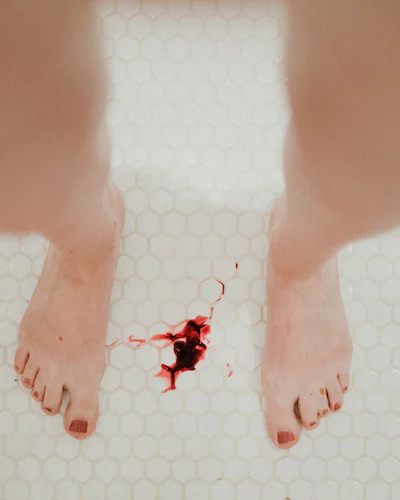
The study linked above, courtesy of Notre Dame University, which also gave us Amy Coney Barrett, is perhaps a slight redemptive move for that earlier and continuing outrage now located, sadly, on the Supreme Court. The study, conducted by a team of female scientists, can be purchased via the link if you’re a science nerd, and is interesting for many reasons, not the least of which is a little side fact that the authors used actual blood in testing menstrual products. This is significant as previously period products were tested with water, which makes so much sense. Not. So, gals, those heavy flow products you were relying on, they were referring to a heavy flow of water. This is so funny and so typical of science and marketing and everything I have to laugh, only it’s not fucking funny, it’s as serious as death, because when menstrual products or medicines or anything else is tested without reference to the lived reality of women and girls, efficaciousness suffers, women and girls suffer.
In a similar and similarly ridiculous news, I just finished reading Lady Justice by Dahlia Lithwick, where I learned the sadly unsurprising fact that in 1965 when an all male Supreme Court was determining the right of married women (and married women only) to access birth control, not once in the course of oral arguments was the actual name of the birth control device being discussed spoken aloud by any of the male litigants or justices. One can only presume because they were too delicate to name it? Men are so fragile. Insert eye-roll here, please __________. And, despite the fact that over 50% of all graduates of law and medical schools in the U.S. are now women, we still have a long way to go to fix the injustices baked into our various systems by decades of excluding women from legal and medical spaces – and so many others. Men, white men, still hold the vast majority of executive, partner, and leadership positions in almost all arenas of power; men, when given a choice, hire and promote men; men are still, in our biased culture, seen as natural leaders – and as less likely to be corrupt despite statistical evidence to the contrary.
Insert another eye-roll here please ______________.
And, in case you missed it on the efficaciousness and suffering front, the NYT has a new-ish podcast out called The Retrievals , which describes in strong stomach required detail the various way in which women’s pain was ignored, dismissed or questioned (or all three) while having their eggs retrieved at a fertility clinic. Turns out, a nurse at the clinic was taking the fentanyl meant to control patient pain even though she had been an IVF patient herself, using the drugs to feed her addiction. Over 200 women went without serious pain control meds for what is a very painful procedure. I once merely had my cervix scraped, scraped, not punctured; this was decades ago and was done with an application of local anesthesia applied by needle, which was not fun, and was very painful. At the time this was the standard form of care (things have improved immensely since, thank Gawdess) when there were abnormal cells found present during a Pap smear. I was assured the procedure was minor and that while there might be bleeding, it would be minimal, as would be any pain. WRONG. I actually bled for several days and it hurt like a sum-uva-bitch in a place so deep and vital I cannot properly describe it. Men, especially male doctors, need to imagine that in order to retrieve sperm for fertilization or any other purpose, a ten inch needle must be inserted into the tip of the penis, and oh, by the way, this local anesthetic will fix you right up, and I’m just gonna use this other needle right here in your dick to get that numbing going. You know they’d put themselves out with the best drugs available, right, wrapping their dicks after the procedure in the finest feathers of down inside linens stitched by ninety-year-old nuns in France... MEH. And the patients at this swanky clinic were well-off white women, so imagine as well being a woman of color complaining – if they dared – about pain. FEH.
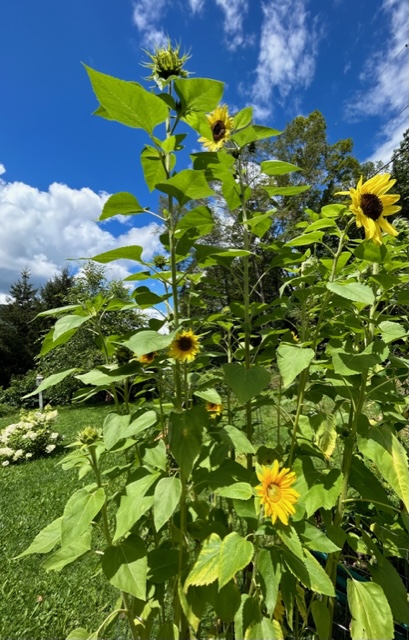
*all of my life but especially as an adult, I have loved flowers and wanted to grow them, but until the last three years I haven’t lived in a space where I had the ground and sun exposure to do so…growing these sunflowers from seed has given me such a thrill, and I am so, so grateful.
*from yesterday’s NYT The Morning, and worth repeating, reported by David Leonhardt
A natural response. This morning, I want to tell you about a story that’s difficult to read but also eye-opening. Jen Percy, a contributing writer for The Times Magazine, has spent months reporting on a frequently misunderstood aspect of rape — why victims often freeze rather than scream or fight back. Jen’s story opens with a list of examples, some well-known and some from her reporting. “I froze,” said a woman who was assaulted during a military training exercise. “I just absolutely froze,” the actor Brooke Shields said, describing how she felt while being raped. “I just froze,” Lady Gaga said, about being assaulted when she was 19. “I was like a dead person,” Natassia Malthe, a Norwegian actor, said. One study of rape victims at a Boston hospital found that more than one-third of them reported experiencing a version of this freezing, which in its extreme form is known as “tonic immobility.” Researchers say that it is an automatic defensive response with roots in evolutionary behavior. There is a cliché, dealing with a different kind of threat, that captures the same idea: a deer in the headlights. Jen writes: For more than a century, scientists have studied similar phenomena in animals, and over the years they have been named and renamed — animal hypnosis, death feigning, playing dead, apparent death and thanatosis, an ancient Greek word for “putting to death.” Tonic immobility is a survival strategy that has been identified across many classes of animals — insects, fish, reptiles, birds, mammals — and draws its evolutionary power from the fact that many predators seem hard-wired to lose interest in dead prey. It is usually triggered by the perception of inescapability or restraint, like the moment a prey finds itself in a predator’s jaws. As Amy Arnsten, a neuroscientist at Yale, says, “Under stress, your brain disconnects from its more recently evolved circuits and strengthens many of the primitive circuits, and then these unconscious reflexes that are very ancient kick in.” Yet many people remain ignorant of the frequency of freezing during sexual assaults. Instead, friends ask victims why they didn’t fight back or yell for help. Doctors and nurses are sometimes confused, too. Most significantly, police officers have long treated reports of freezing as a basis to doubt an assault allegation. That attitude is one reason that such a small portion of reported rapes lead to criminal charges. All of which suggests that more widespread understanding of the freezing phenomenon could change the way that both the medical system and the criminal justice system handle sexual assault. In her story, Jen describes the work of Nancy Oglesby, a prosecutor, and Mike Milnor, a former police officer, who teach a class that trains investigators to recognize freezing and respond appropriately. In the class, Oglesby and Minor teach police officers how to conduct empathetic interviews that gather potential evidence. Afterward, Milnor said, officers sometimes get emotional as they reflect on prior cases that they have mishandled — a feeling that Milnor said he himself had. “I can’t tell you the number of times that I’ve had these tough, seasoned, burly cops coming up to me with tears in their eyes,” Milnor said, “saying how they’re thinking about the victims that they treated poorly, not out of malice, but out of ignorance.” You can read Jen’s magazine story here.
*I wrote this in 2011, which is – unbelievably – already over a decade ago. Wow. Thanks for reading…
She died of a cerebral hemorrhage. I read it on Wikipedia. Weird, looking someone up because you’re thinking about them and bam, they’re dead, have been for a few years, and suddenly you’re mourning a person who you haven’t seen for 3 decades, sitting on your couch staring at a screen in the middle of a summer day, weeping, simply because curiosity and – memory – spurred you to look them up, just for fun.
Her name was Julia Wilson-Dickson, and she taught acting and speech in London, where I met her in the fall of 1979 as a junior studying abroad for a semester that turned into a year away from the states and my family. She was tall and brilliant and funny and charismatic and warm; Julia was also not driven by ego, as many of our instructors up to that point had been, or so I felt, and because of all of this, we, her students, fresh off the plane, fell in love with her. She spoke occasionally of her mother, a former actress and great beauty; her mother was everything she, Julia, was not, petite, feminine, fragile and desirable in every way required. This was disconcerting, because we were all of us, all of the students, smitten with the living, breathing woman in front of us, and whose idea of feminine doesn’t include a 5’10” juggernaut of humor and expertise and precision and intellect and warmth? Or if her height and intensity (she was intense) were less than traditionally feminine, who cared? Who could not love her? She could not. This became clear over time, as did the fact that neither could her mother love her, her mother whom – it seemed – shamed her tall, awkward, terribly bright daughter every chance she got.
That semester flew by, and was revelatory in every way. I didn’t know it then, but being away from my family was one of the greatest gifts I could have been given, was given, by myself. Being away from family, though I missed everyone terribly, and missed the farm, was liberating, freeing, re-defining, definitive, a breakthrough, even if I didn’t see it until I returned, when the blinkers of habit, having been dropped by necessity somewhere over the Atlantic, were no longer in place, and I could see them, and myself, clearly. More clearly. The benefits of foreign travel, indeed.
Julia had a partner, and until one of my gay male (clearly just a phase!) classmates spelled it out for me, I didn’t realize she was gay, was a lesbian, whose existence as a group I was pretty sure, to that point, was apocryphal. Huh? Women don’t do that, and even if they do, why would they and how would they? Ew. And men – look, everyone is like my mom and dad, ultimately, right? No. I was twenty years old, very inexperienced, and very dumb; I was a theatre major – a theatre major – who didn’t believe homosexuality really and truly existed. Hilarious, when you think about it, as I have. Complicating and speeding up my education in these matters, Julia Wilson-Dickson fell in love with me. I was flabbergasted, flattered, but most of all I was frightened. She was older, a teacher, British, and a woman! She had a live-in girlfriend, even if two weeks prior I hadn’t believed such people and arrangements existed. Sheesh. I was also thousands of miles from home. Redefining myself sans parental oversight and sibling side-eye is one thing, being romantically pursued by a woman was another. Yet, I had nothing to fear as Julia was too ashamed of who she was to pursue me openly or aggressively; she also felt shame because I was her student – what a change that was. Having been sexually assaulted by two of my male married with children teachers within days of my high school graduation, I was struck and made safe – or safer – by her hesitancy, although my whole body shook as she confessed her feelings for me, in a noisy, crowded pub over tea (mine) and some dark ale (hers). Of course my body shook: I had been primed and programmed to encourage, seek and want male desire, as well as to fear it, ignoring my own desire, my own wants, my own sexuality. This experience, however, was a horse of a different color, but still I wanted to please, to be compliant, to be kind and affirmative of the person in control who was not me, never me, who was by definition the other, the one who desired me and who could be, it seemed, male or female, holy shit! And I did love Julia, as a person, for to me she was beautiful and wonderful, a marvelous human being, so worthy of love.
But. I didn’t want to sleep with her, and I wasn’t gay. I loved her but I could not return the love she felt for me and unlike the many male assholes who, fast forward in life, could not accept I was not attracted to them or into them ‘that way’, she took it like, well, like a woman.
A decade later I would go through a ‘maybe I am gay’ phase after a string of lousy relationships with men. I wrote to Julia – ohmigawd I cringe when I think of what I must have written to her – and she, typically wrote me back, long letters updating me on her life. I have long since destroyed the evidence of my asininity and her generosity, and that brief phase ended when I realized that the real problem was not that I dated shitty men (well, not the central problem, anyhoo) but rather that I didn’t feel good about being a woman, that being female felt less than, and that feeling needed to change. I needed to change it.
Funny that. Julia and I shared not feeling good about who we were as women, the kind of women we were, and both of us weren’t our mother’s idea of a proper, and properly feminine, woman. Sometimes I wish I had taken that leap with her, because she was that special, and to be loved by anyone is a gift, and miracle. But I didn’t, and I don’t regret it, although I still weep thinking of the girl I was, and of that woman who taught me and us all so much about how to be a good and passionate human, full of warmth.