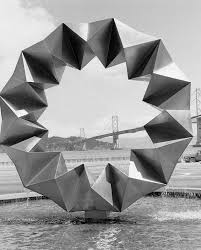
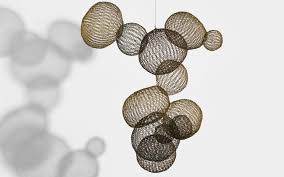
Again, glad you asked. Asawa was a 20th c. Japanese-American sculptor who adopted a wire-crocheting technique she had observed in Mexico to create intricate abstract wire sculptures for which she primarily became known. She created her first representational work in 1968, a mermaid fountain in San Francisco’s Ghirardelli Square that has become a famous landmark in that city. She went on to design other public fountains throughout the city, becoming known at the “fountain lady.” There are worse nicknames, eh?
Asawa, a California native, was interested in art very early in life, and, ironically, she was encouraged by her third grade teacher to create her own artwork, receiving first prize in a school arts competition in 1939 for her piece about what makes someone American. Which is another reason I am interested in talking up the talented Ms. Asawa. Because here we are AGAIN, folks.
During WWII, Asawa was interned with her family first at the Santa Anita racetrack and later at the Rohwer War Relocation Center in Arkansas. While for most a devastating and harrowing experience, Asawa first learned to draw from three Disney Studios animators who were also interned at the racetrack, where stalls generally used for horse were tuned into holding pens for entire families (classic racist America, right there, I wonder what Uncle Walt thought, or did, if anything about his interned animators?). Asawa said in 1994: “I hold no hostilities for what happened; I blame no one. Sometimes good comes through adversity. I would not be who I am today had it not been for the internment, and I like who I am.”
That right there is what I call mental health, resiliency, and forgiveness, y’all.
After the war Asawa trained and was considering going into public school education, but was advised against it, as the recent conflict put her in danger given negative sentiments toward the Japanese people despite the fact that she was BORN IN AMERICA. Deep breaths. That said, this too Asawa later characterized as a blessing, as it pushed her toward following her bliss, and what would ultimately become her very successful career as an artist, instead of stepping into mid-century ‘get a good job with a pension’ expectations (teaching).
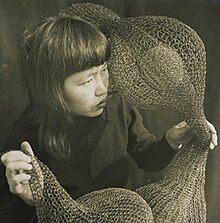
Later in her life, Asawa, who died in 2013 at age 87, became a passionate advocate for arts education, helping to found a public arts high school, which was renamed in her honor the Ruth Asawa San Francisco School of the Arts in 2010.
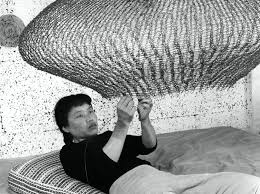
https://en.wikipedia.org/wiki/Ruth_Asawa

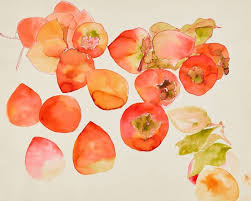
One of her drawings is included below, because I happen to love it – although her main medium throughout her life was wire sculpture.