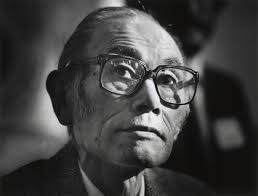
I have a brother Fred, had an uncle and great uncle Fred and great-grandfather Fred (on both side of the fan-dam-ly!!) – and, absent those beloved humans – I would unquestionably have a dog named Fred. Fred and Betty, imo, are perfect dog names. End of tangent. Fred. Koramatsu. Never heard of him, until earlier today. Hey, I love learning about groovy heroic people, and Fred Koramatsu was certainly that, and his heroism is notable due to the moment we are (again, FFS) in with regards to what and who constitutes a ‘real American’ and who gets to decide.
Fred T. Korematsu was a civil rights icon, even if you’ve never heard of the guy. one of three sons born in Oakland, California to Japanese immigrant parents (a.k.a. a birthright citizens per the 14th Amendment). When the U.S. entered World War II, Fred – who died in 2005 – tried to enlist in both the U.S. National Guard and U.S. Coast Guard, but was turned away because of his Japanese ancestry.
In 1942, Fred, then aged 23, refused to go to the government’s concentration camps for Japanese Americans, choosing instead to go on the run and live as a free, loyal American because, shocker!!, he was one. After he was arrested and convicted of defying the government’s order, he appealed his case all the way to the Supreme Court, which ruled against him in ’44, arguing that mass incarceration was justified due to military necessity.
Following World War II and the release of Japanese Americans from the camps, Korematsu attempted to resume life as an American citizen, but his conviction and notoriety hurt him in gaining employment and other opportunities. He moved to Detroit, where his youngest brother lived, and where he met his eventual wife, Kathryn, a student at Wayne State University. Kathryn, originally from South Carolina, wanted to marry Fred but, at the time, anti-miscegenation laws prohibited interracial marriage in both of their home states, CA and SC. In Michigan, however, their relationship and marriage were legal. Fred and Kathryn married in Detroit before moving to the Bay Area in 1949, a year after the top court in the state of California ended discriminatory, race based, marriage bans.
In 1980, President Carter instigated a federal review of the incarceration of Japanese Americans during World War II, and in June 1983, the Commission on Wartime Relocation and Internment of Civilians concluded that the decisions to remove people of Japanese ancestry to U.S. prison camps occurred because of “race prejudice, war hysteria, and a failure of political leadership.” (Y’think?!!)
During this time, U.C. San Diego’s instructor Peter Irons, together with researcher Aiko Herzig-Yoshinaga, discovered previously unknown Justice Department documents in government archives. Included were memos written in ‘43 and ‘44 by Edward Ennis, the U.S. Justice Department attorney responsible for supervising the drafting of the government’s brief against Koramatsu in the Supreme Court case. As Ennis searched for evidence to support the Army’s claim of ‘justifiable military necessity’, he instead found the opposite: J. Edgar Hoover, the FCC, the Office of Naval Intelligence and other intelligence agencies declared that in their various assessments Japanese Americans had committed no wrongdoing, and were not a threat. These official reports were never presented to the Supreme Court as they were intentionally suppressed, or destroyed.
On November 10, 1983, Judge Marilyn Hall Patel of the U.S. District Court of Northern California formally overturned Korematsu’s conviction. It was a pivotal moment in U.S. civil rights history. Mr. Korematsu stood in front of Judge Patel and stated, “According to the Supreme Court decision regarding my case, being an American citizen was not enough. They say you have to look like one, otherwise they say you can’t tell a difference between a loyal and a disloyal American. I thought that this decision was wrong and I still feel that way. As long as my record stands in federal court, any American citizen can be held in prison or concentration camps without a trial or a hearing. That is if they look like the enemy of our country. Therefore, I would like to see the government admit that they were wrong and do something about it so this will never happen again to any American citizen of any race, creed or color.” Although Judge Patel’s ruling cleared Korematsu’s conviction, the U.S. Supreme Court’s 1944 ruling still stands.
Once his conviction was overturned, Fred Koramatsu became an active member of the National Coalition for Redress and Reparations, traveling to D.C. to lobby for the passage of a bill which would grant an official apology from the U.S. government and a token compensation of $20,000 for each surviving Japanese American that was incarcerated. Although President Ronald Reagan initially opposed the legislation, he reversed his position due to political pressure. In August of 1988, President Reagan signed the redress and reparations legislation into law, and in 1998, Fred Koramatsu received the Presidential Medal of Freedom, the nation’s highest civilian honor, from then President Clinton.
After 9/11, Korematsu continued to speak out. In 2003 and ‘04, he filed amicus briefs with the U.S. Supreme Court for cases appealed before the Supreme Court of the United States, on behalf of Muslim inmates deemed ‘threatening’ to the U.S. government. In the brief, he warned that the government’s extreme national security measures were uncomfortably reminiscent of the past.
https://korematsuinstitute.org
https://en.wikipedia.org/wiki/Fred_Korematsu