Mary Jane Rathbun. Rathbun? I had a friend in college (we’re still Fakebook friends) with that last name. Related? Doubtful. I’ll have to ask, but the point is I never heard of her as in this MJ Rathbun. Should I have? Well, maybe. Well, yeah, sure. Yes. She was a waitress (so was I at the time, albeit on the opposite coast), but so much more than that – and given this is Gay Pride Month – MJR was an advocate, and a good human in a time and concerning a population where a lot of other humans behaved badly, horribly, stupidly, and hatefully.
I am speaking, of course, of the AIDs crisis, and Mary Jane – also known as Brownie Mary – was working waiting tables in San Francisco, the epicenter of that pandemic’s rise.
Ms. Rathbun became an unlikely frontline activist in the early 1980s, when people with a constellation of as yet unidentified illnesses later connected to HIV/AIDS were wasting away from pain, nausea, and loss of appetite. At that time, governments across the board offered little or no help, and the community was not only in distress, it was in panic mode. Not calm, cool, collected – and very determined – Mary Jane (and isn’t it perfect her initials are MJ? it is but read on…) as this unlikely heroine decided to bake cannabis-infused brownies, thereafter distributing them to the sick and dying. And what’s more, Mary Jane Rathbun didn’t frame her work as radical or activist; she called what she was doing compassion, and she was right.
Brownie Mary was arrested multiple times for giving medicine to gravely ill patients abandoned by the healthcare system. Each arrest, however, widened public sympathy while exposing the cruelty of criminalizing what was desperately needed palliative care. Nurses, doctors, and other activists rallied around her; her work helped legitimize cannabis as pain relief and appetite inducing medicine rather than a moral threat. As her unasked for ‘celebrity’ grew, Rathbun also raised funds for AIDS wards while volunteering at San Francisco General Hospital, often sitting with patients no one else would touch.
Brownie Mary’s activism directly influenced public opinion and policy, helping pave the way for California’s first medical marijuana laws. She called herself an anarchist activist, but however you or she labeled her work, MJ was an effective advocate for a community that was being marginalized and ignored. Rathbun neither sought nor wanted fame or power; she wanted to help, and she achieved that, showing up with food, compassion, and relief, while treating all who were suffering with dignity. Her work, her example, forced the country to confront a hard truth: when the law refuses to care for the sick and vulnerable, compassion becomes an act of resistance.
P.S. – I link her wiki page here but in case you don’t have time, I so love that when Mary Jane was 13, a nun at her school tried to cane her, and she fought back. You Go Girl!! https://en.wikipedia.org/wiki/Brownie_Mary#Personal_life
John Steinbeck’s East of Eden is one of my favorite novels, and along with Wallace Stegner’s Big Rock Candy Mountain, it depicts intense family dynamics and dysfunction while also encapsulating that American moment of expansion into and existence within the western U.S., especially in the great state of California. The U.S. flexed its ‘youthful country’ muscles during that period of history in other ways, ways not always healthy, wise or good. Another series of plot points in the book revolve around the lead up to, prejudices of and our eventual involvement in WW1.
We are, at this moment, in difficult times, and we will get out of them better and stronger. I have to believe this. I do believe it. We have been in difficult and challenging times before, and can be secure that while “the arc of moral justice is long, (but) it bends toward justice.” Steinbeck wrote the following – all of the quotes below are from his personal journal – on January 1, 1941, as war was looming once more in Europe and in Asia; there were rumors of camps and internment horrors; what would come of this?
Speaking of the happy new year, I wonder if any year ever had less chance of being happy. It’s as though the whole race were indulging in a kind of species introversion — as though we looked inward on our neuroses. And the thing we see isn’t very pretty… So we go into this happy new year, knowing that our species has learned nothing, can, as a race, learn nothing — that the experience of ten thousand years has made no impression on the instincts of the million years that preceded.
Not that I have lost any hope. All the goodness and the heroisms will rise up again, then be cut down again and rise up. It isn’t that the evil thing wins — it never will — but that it doesn’t die. I don’t know why we should expect it to. It seems fairly obvious that two sides of a mirror are required before one has a mirror, that two forces are necessary in man before he is man. I asked [the influential microbiologist] Paul de Kruif once if he would like to cure all disease and he said yes. Then I suggested that the man he loved and wanted to cure was a product of all his filth and disease and meanness, his hunger and cruelty. Cure those and you would have not man but an entirely new species you wouldn’t recognize and probably wouldn’t like.
It is interesting to watch the German efficiency, which, from the logic of the machine is efficient but which (I suspect) from the mechanics of the human species is suicidal. Certainly man thrives best (or has at least) in a state of semi-anarchy. Then he has been strong, inventive, reliant, moving. But cage him with rules, feed him and make him healthy and I think he will die as surely as a caged wolf dies. I should not be surprised to see a cared for, thought for, planned for nation disintegrate, while a ragged, hungry, lustful nation survived. Surely no great all-encompassing plan has ever succeeded.
*I think we can safely compare the efficiencies of our current administration in Washington, the blueprint provided by Project 2025 and its desire to control Americans, especially women and brown people – as a not very nice companion to past efficiencies of the Nazis. We will get through this. Deep breaths.
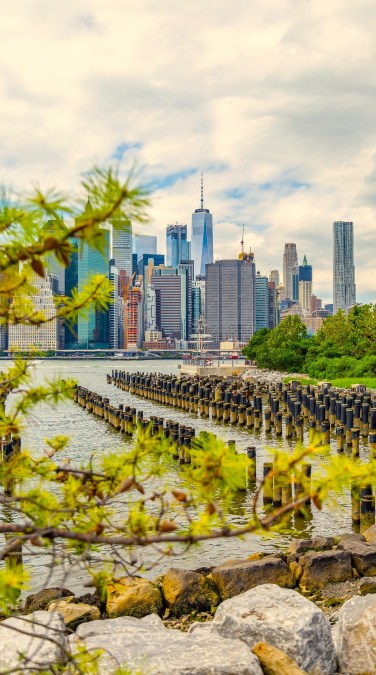
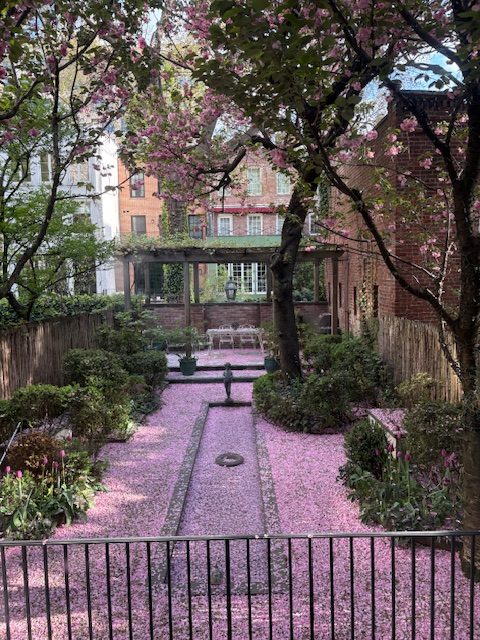
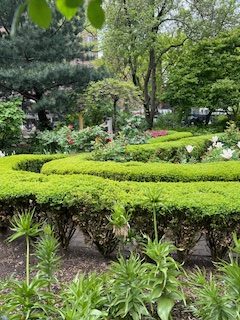
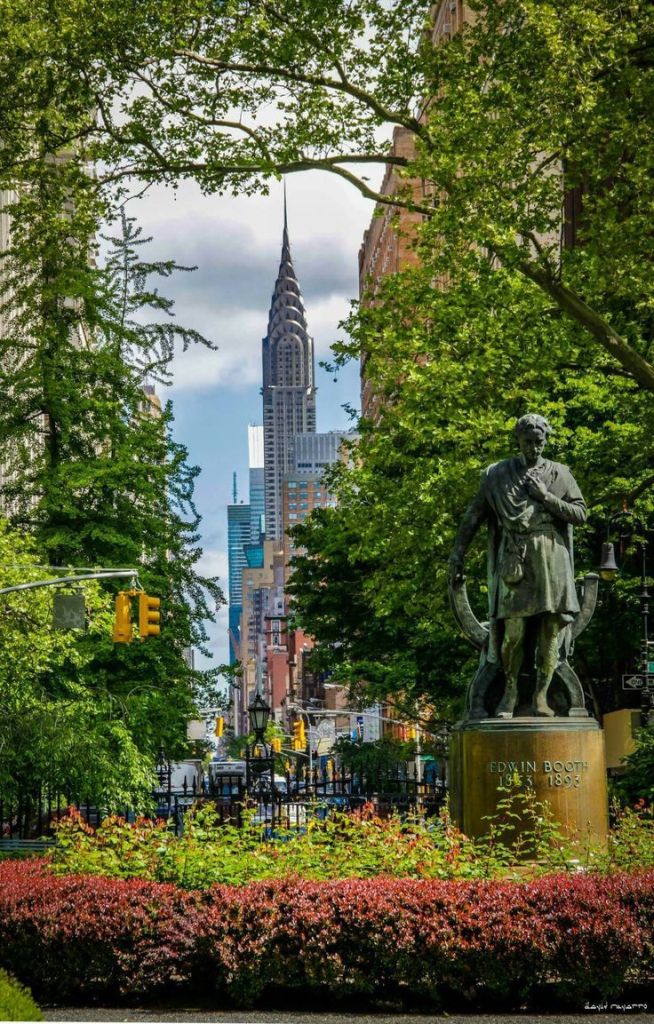
Here’s the thing – NYC is beautiful. It may not be your type of beauty, your cup of tea – but it has beauty. I say this because I know too many in rural America who regularly trash NYC and NYCers, and – quite frankly – I’m sick of it. FFS, it’s one of the greatest cities in the world, filled with wonderful people, and opportunities, and food, and sights and museums and yes, beauty. NYC is full of beauty. I was recently there, and these pics are from the trip, and a few others I have taken in the past. Whatever the season, NYC is beautiful. Is everything, every aspect gorgeous? No. Same as everywhere else. Poverty isn’t pretty, urban, rural or suburban. Neither is homelessness. Or litter. Don’t get me started.
It’s funny but I just realized I don’t have pics of NYC in winter. Maybe because I don’t ever take my hands out of my pockets? Very likely! Parks and gorgeous greenery is everywhere in NYC, if you would just get off the red bus and go for a walk, y’all.
I <3 NYC.
P.S. I doubled up on blog posts yesterday and I wish I could say “Omigarsh, I have no idea how that happened!!” – but. I do know, and it’s all due to my unwillingness to go into the other room and get my reading glasses. LOL.
For those who are unfamiliar or uninitiated re: the term Himpathy, it originated in Kate Manne’s excellent book, Down Girl, and is described by Manne as “the excessive sympathy shown toward male perpetrators of sexual violence.” She develops the concept in the context of her analysis of the People vs. Turner – you may remember who Turner is, or what he was; he was a ‘promising swimmer’ at Stanford U., who raped an unconscious woman and was caught in the act, yet in large part due to himpathy, Turner was given a slap on the wrist.
Chanel Miller, the unconscious woman Turner beat and raped, wrote an anonymous victim impact statement at the time that went viral and remains 1000% worth reading, as well as account of the attack, trial, and consequences, and so much more in Know My Name: A Memoir. In case you were busy/oblivious in the late twenty-teens, however, here’s a link to the basics at wiki: (https://en.wikipedia.org/wiki/People_v._Turner).
Here’s the thing – Himpathy, in my experience – extends far beyond sexual assault and sexual violence. We forgive men and feel bad – himpathetic – for them when they fuck up, excusing their behavior time and again. THINK ORANGE MENACE. FFS, if a woman did one tenth of the shit he’s pulled in this lifetime, she’d be in jail; it is telling indeed that Ghislaine Maxwell is the only Epstein perp in jail. Yet expanding the scope of Himpathy out, think every time a man missteps or fails to step up to the plate re: family or relationship responsibilities, yet is excused because ‘he tries’ or ‘work’, which the vast majority of women also have and do. Gack!
So, yes, let’s stop making excuses for bad behavior, and hold men accountable, and because we can multi-task, let’s stop blaming women for the actions of men, acknowledging that Himpathy is baked into the cake we’re all eating, part of our institutions, beliefs, religion, and entertainment. It is especially baked in when it comes to the law/s and the legal system, which is and was, are and were written, are enforced (or not), structured and staffed primarily, still, by men for and to the benefit of men.
Case in point, I’ve recently watched three films that all revolve around white men – played by good looking, popular, film stars – each of which were chock full Himpathy Narratives reinforcing the annoying AF idea that these men ought never to be held accountable. How did they do that? By producing and filming scripts that provide these white dudes with numerous outs and Himpathetic back stories.
All three movies were entertaining, but I also found myself bubbling with irritation and disbelief as each story line unwound in a manner that was wholly ridiculous, letting the men off the hook in each instance in a way that is completely in line with our desperate need to show these wealthy, good looking white men our himpathy, our fealty, our loyalty, our love – even within fictional narratives that could have been so much better, more complex and believable.
But we don’t do that anymore (or very often) do we?
The films? Caught Stealing, featuring Austin Butler, Crime 101 starring Chris Hemsworth, and Outcome featuring Keanu Reeves, who, in the film, written by co-star Jonah Hill (in another himpathy laden role), has the improbable name of Reef Hawk, a former child star and heroin addict. While his character might possibly be based in part on Charlie Sheen, the film is wholly without the refreshing honesty of, say, Sheen’s recent Netflix documentary, which is shot with a lot less himpathy for the doc’s main, and very troubled as well as lucky to be alive, subject. In my opinion, if Charlie were a Black man, absent the himpathy forever extended to Sheen, he’d’ve been dead ages ago, or incarcerated.
In Caught Stealing Butler plays a disappointed baseballer, whose best friend was killed in the same accident that ended Butler’s (we are to understand) destined for greatness major league career. This is the himpathy set-up, folks. Now he’s a sad, sexy AF barkeep in the East Village dating a nurse (oh, don’t we love that!!) played by Zoe Kravitz. Spoiler alert! Due to his inability to simply answer questions without engaging in male posturing early on in the film, Nurse Kravitz is the 1st of many to die of the many, many folks who, connected to wonder boy, are to perish in the film.
But of course our hero doesn’t die! And, to make him even more appealing, he has a great relationship with his mom, played by Laura Dern. She survives and even benefits from his reign of terror in and around Manhattan and – Queens? – could be Brooklyn but looked and felt like Queens, as the body count increases around him. Bullets, as in so many films, cannot touch our hero, but oh gosh do they swiftly sink into baddies!
Despite all this, he too ends up better off, living at the movie’s end in Tulum, Mexico with a boatload of drug money on hand to smooth his transition. Hey, who cares?! He’s so damned cute and – c’mon, he does the right thing, sharing the cash with his struggling single mom (we think, she’s on screen for so few moments, who knows?). Awwwwwwe.
Wait, could he not have sent some of the $$$ to the family of his bestie, the kid who died in the car crash as a result of his dangerously reckless driving? Of course not! Hey. Was it a fun watch? Sure, sorta. Did I laugh out loud at points? Yes, yes I did. Still, it was galling.
Crime 101. Also entertaining, and also implausible and crafted in such a way as to let handsome white male star – Hemsworth – off the damned hook for his actions. Himpathy narrative: he was raised in poverty, in foster care and knows LA like the back of his hand because he is native to those mean streets! Yes, he robs jewelry stores, but – remember this – he never hurts anyone, he’s just in pain, the poor hottie, compulsively covering his tracks, owning multiple hot cars, yet – sob! – unable to have a relationship… that is, until one day when a woman rear ends him in her bosses car.
Meet cute, 2026: our himpathetic/irresistible hero and his carefully controlled life – rear-ended!!
And about those robberies? It’s just money, after all; let’s not dwell on the trauma of having a gun held to your head when you – the person being robbed – are clearly not nice. These not nice folks were mainly played by dark men with accents, Arab or Jewish seeming characters, because they’re fair game, I guess, the male equivalent of a woman who ‘asks for it.’
Good cop appears, also a white male for whom the filmmakers additionally create and build himpathy by having his wife dump him after admitting she cheated on him multiple times. This is revealed in the 2nd scene in which she appears; in her first – and only other scene – the filmmaker cuts off her head by the manner in which he frames the shot. Like all those movie posters featuring female torsos, because Hollywood loves decapitating women, sending a message that women are at their best when headless. And what a waste of talent as the teeny, tiny 50% headless part is played by the incomparably brilliant Jennifer Jason Leigh.
The vast majority of films are still written, shot, produced and funded by white men, for 13-25 year old white male consumption. Okay, let’s be fair, they’re made for 13 – 35 years old white male consumption and the consumption of men over 50 who think they can still date 25 year-old women. Feh.
Good cop protects good thief because bad thief (played by Barry Keoghan) hurts people!! Good cop also protects good thief because he realizes suddenly (despite being a veteran officer of over 25+ years) that his colleagues are weak, corrupt, and selfish, as if that were a lightbulb news flash. JHFC. Anyway, what matters is that hunky, handsome, white male good thief deserves a 2nd chance; thus, thanks to good cop, good thief gets off scot free, and bad thief dies. Good thief also finds love, and guess what?!! Good cop might have found love, too, with woman injured by sexism/ageism but not, we think, racism even though she’s Black in America but when you’re as gorgeous as Halle Berry…sigh. It’s all so pat, I was entertained and nauseous all at once. Gack.
Outcome. Keanu Reeves is adorable, and pretty much impossible to dislike. I could not love him more, truly. And, in the film he is a recovered heroin addict who has kept his two closest friends despite years of bad behavior, which of corse we never, ever see. It’s a comedy! His mom is played by Susan Lucci and she’s a bad mom but not the worst Hollywood mom by far, lighten up (it’s a comedy!!); we also never see any of his antics while high on heroin, which you might think would’ve been caught during the internet age – with the mild exception of the film’s McGuffin – because he’s been that careful about his various extracurricular activities.
There is one scene with a former girlfriend – omg, a woman with a monologue?!!! shouldn’t we be grateful?!! (insert eye-roll here) – who he apologizes to for his past misdeeds, but she is played as a nondescript suburban mother complete with an outfit and hair color I struggle to recall, they were indeed that bland. These, peeps, are choices made by filmmaker, whether conscious or not, to reduce women, elevating the white man in question: no wonder he dumped her!!! Can you blame him??!! Never.
He was a child star, compulsive and driven. But we don’t see that, either? There are interesting moments (when he confronts, mildly, the person who is attempting to blackmail him) but all in all, another bland guy who really, at bottom, is just a darned good guy, a himpatheitc human/movie star who went through so, so, so much – except we don’t know and are never shown what ‘much’ that was. But anyway, don’t we all love him?!!
Jonah Hill – who wrote and directed – also gives himself a himpathy subplot I won’t go into here. Martin Scorcese, doing a small role, also gets a himpathy subplot. Make. It. Stop. These are the films that get made, and make money. Well, at least the 15 year-olds boys are happy.
*a submission to a local/regional arts magazine I have been published in regularly, to my joy and satisfaction! will this get in? only the shadow knows…thanks for being here, and for reading & following along…
As a kid, I always wanted a garden. We lived on a former dairy and cauliflower farm; we had an apple orchard, and a couple of pear trees planted decades previously by my grandparents. My dad showed me where the best blackberry patches were located all over the farm, and our apples were harvested for cider for years – but why didn’t we use a little bit of all this land for a garden? It seemed wasteful and even sinful to not grow something, anything, to make good use of all those acres. It still does.
My grandfather had completed and gifted my parents an oil painting of our house that featured the old kitchen garden front and center, stretching out across a bank that blanketed the first ten feet or so of our front lawn, facing the sun; it showed cabbages, lettuce, carrot, radish and beet greens among other growing things. Why not do that now? Didn’t anyone else in this house want a garden? Don’t you love how grandma planted purple iris by the side entrance, leading out to the barn? We could do more flowers, too! At least? Crickets. My dad was willing to consider the idea, but he was also working seven days a week, most of the time, so – sure, but a garden, kid? That’s a lot of work, y’know?
I didn’t know. How was I supposed to know when I’d never done it? Or seen anyone do it? Miss Connell and Miss Klapper were both gardeners, and my parents enjoyed excess vegetables occasionally in summer thanks to their efforts, but I was a child. I didn’t go there to hang out and ask questions about soil science; I only saw them during quick pit stops with my mom, dropping off books or magazines. Their garden was also behind their house; should I have run back there to take a gander? Children, mother said many, many times, were much better seen than heard. There was no way I would dare pester those two ladies with questions about gardening!
Dan and Kay – whose garden we passed on the way into town – might’ve been open to showing me a few of the ropes, but they had two uncomfortably odd sons I avoided as much as I could given that their parents were friends of mine. The family occasionally dined at our house; their daughter was unfriendly and slightly odd, too, almost as bad as my older sister. No way I was asking to go there!
Both the internet and Google didn’t yet exist, and the only equivalent we had was a full set of green and white covered Encyclopedia’s Britannica – which I loved to leaf through but – gardening? Too broad a topic. Maybe if there had been a handful of those clear sheets showing veggie gardens like they showed the body in layers – skeleton, muscles, organs, skin etc. made topsoil, temperature, seeds, planting depths and growing times – that would’ve helped, but there was no such thing.
There weren’t any garden shows I knew of on the single TV channel we received, stuck out there in rural Siberia-land in the dark times known as ‘pre-cable’. I didn’t want to pester my dad, either, who was often exhausted when his working days were done. My mother was a house cat sort of person, a reader and an intellectual for whom digging in the dirt, like going outside for any reason beyond getting into her car, was not happening. I do remember her lusting after Mountain Laurel bushes, which she finally obtained from an acquaintance in Dunraven, where they grew in native abundance, on a rocky hill facing the reservoir. My dad dug them in for her. They did okay, not great.
My siblings were also house cats for the most part, but I spent hours and hours outside, and was never happier. Gardening would’ve given me more reasons, more time out in the fresh air, which to this day makes me feel like a million bucks. Yes, I was and remain a reader myself, but being outdoors on a day either cloudy or sunny when the air is perfectly cool and temperate? Walking in the woods, especially in spring or the fall? Heaven.
Still, didn’t everybody love planting seeds in dirt as children, as grade schoolers? I sure did. And was there anything cooler than watching little green things sprout up through brown dirt? Not really. Not in my view. That garden out front or back or sideways at my childhood home never happened, but in college and during the many years I lived in New York City, I always had masses of indoor plants, one of which is still with me; it turns 36 this year, the lovely thing. I also have the African violet I inherited from my mother, who inherited from her mother-in-law, my beloved grandmother, which has exploded after literal decades in a shrunken state, a Sleeping Beauty trance broken by ‘just-right’ sunlight.
My first home in the Catskills was too shady for growing success, although one azalea bought for the house was placed perfectly for the morning sun. That sun-deprived location was a bit of a ‘yearning to grow things’ mistake on my part, but I’d been house hunting for ages; regardless, that little kid wanting a garden remained strong in me. I tried, planting blueberry bushes and four hydrangeas given to me by a beloved friend whose mom and grandmother cultivated a noteworthy garden at their home in Rye, N.Y., but my poor babies were neither fruitful nor happy. I did keep them alive, which counts? The hydrangeas still bloom, even as I’ve moved on.
Finally, after far too long, I am back on a small chip off the old farm block, a better set of ground entirely, into which I can plant seeds; my current home faces south, a necessary better fit for growing green and lovely things. There are still challenges, the best patches – where morning sun comes through – require an angled style of plotting. Still, six blueberry bushes planted and blooming, including the two, so forlorn at the last house, safely transplanted; 7 garden beds also inexpertly and sloppily filled and seeded or planted annually to my satisfaction and joy.
Because I joined the party so late, I don’t know the ins and outs of gardening by a whole lot, but the pleasure I get watching the plants and seeds I have put in make their way toward the sunlight makes me giddy, a kid again, watching tiny tender sprouts emerge in little white paper cups on the windowsill of Mrs. Birdsall’s room.
In summer, most of my mornings are spent watering, after which I harvest peas and beans and lettuce and blueberries with uncomplicated, sweaty joy.
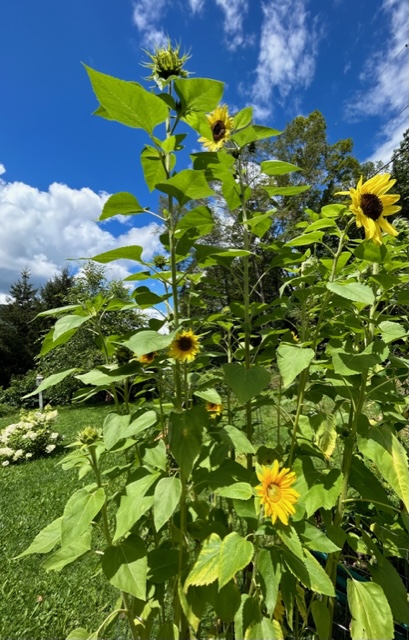
Like my sunflowers, which I grow to feed the birds I’m determined will thrive, my imperfect garden provides me with simple, profound pleasure. And yes, because I am human, there are moment of self-congratulatory giddiness, because wow, look at me, the farmer in the dell! It’s almost as good a feeling as when a toddler decides you, you right there, are a good human and theirs for the whole afternoon, holding your hand while spurning the attention of other adults.
Whenever I have an interest the first thing I usually do is buy a bunch of books on the subject. Yes, I have a couple of gardening books, but they’ve barely been cracked. I enjoy gardening in part because I am not good or expert at it; because it is sloppily and imperfectly done by me, myself, and I; because I am that ignorant while wholly motivated by love and possibility. A need to always know how it’s done, to excel at everything, to be smart and on top of it, is exhausting, a losing game. Let experience be my teacher, including failures galore. It has served me well so far, whatever unforced errors I make.
I’m also teaching myself how to build crosswords, but – in part thanks to my flailing gardening experiments – I’m not buying any books to help me along. Like growing beautiful things to adorn or eat, I’m just gonna see what comes up, and how I do. Hey, I never said I was Martha Stewart; I’m also no Will Shortz.
Gardening, like water-coloring or basic carpentry, does not have to be done solely by those who know exactly what they’re doing. I haven’t killed anything, even if my squash never seem to come out right; eventually, maybe, I’ll get a few that don’t need a hacksaw to cut them up, on a year when conditions are so perfect even my ignorance can’t make a hash of it.
Author May Sarton wrote, “Everything that slows us down and forces patience, everything that sets us back into the slow circles of nature, is a help. Gardening is an instrument of grace.” That seems about right, even when it’s imperfectly done.