Last night I watched the film Are You There, God? It’s Me, Margaret. I had never read the book; is it possible I’m the only woman in America – not in a conservative cult – to have missed it?! I’m not sure why we didn’t have a copy. It certainly wasn’t and isn’t even remotely scandalous compared to the suck and fuck novels lying all over the house, bodice rippers my mother was addicted to that I picked up and read at around the same age as the film’s main character Margaret, who is in 6th grade.
Set in 1970 in NYC and New Jersey – which, safe to say, stands in for most suburban towns in that era – it was laugh out loud funny, sweet, moving, and sad – and I’m not talking about the hair, clothes and interior decoration, although they made me laugh out loud and wanna weep, too. That BOAT of a station wagon. The plaid couches!!
It was sad, finally, because if my mother had shown one iota of the kindness toward me that two of the moms depicted in this film demonstrated toward their daughters when they got their first periods…well, she didn’t. She just couldn’t; it wasn’t in her nature to be kind to me, especially at big moments, and my getting my period (“I hope you know this doesn’t make you a woman!”) actually seemed to ratchet up the verbal and emotional abuse.
She had already been telling me for six years by that time that one day I would marry my father (when she was ‘gone’), that he loved me more than he loved her, and that I was manipulating him with humor, with charm, with my brains and pre-teen beauty.
It was a nightmare. How I hated her. How I depended on her, my mother, for so much. Later that day, my older sister suddenly appeared at my bedroom door (she avoided me like the plague, nick-naming me ‘Maggot’), shouting, “Here!”, throwing instruction pamphlets and period supplies at me (they landed on the floor), after which she equally abruptly turned and left.
The pamphlets included a short booklet telling me why Catholics should not marry outside the faith (I was twelve, FFS), especially not persons who were members of the Jewish religion, and a bunch of other rules for how to preserve that most previous gift from Christ: my virginity. How, exactly, Christ or his mythical sky daddy had given me my virginity was a mystery to me, as was a much larger personal challenge: knowing my precious virginity was already shot, a paternal first cousin having raped me four years prior, when I was eight. Oops!
Earlier that day, we were at one of a series of many family group parties at a farm belonging to a couple who were best friends with my mom and dad. All of the six or seven families who attended these parties had kids about the same age or pretty close, and there was a pool, bikes, a badminton set, and a buffet of mayonnaise-y salads, pickles and other sides to go with the hot dogs and burgers on the grill. It was late summer; school would soon be in session once more, and my life would get better again, as school got me out of the house, and away (mostly) from mother.
I wasn’t feeling good, a little faint, and – very unusually for me – I wasn’t interested in swimming. I was cold. At one point, sitting on a fieldstone step worn down by a century of use, I actually put my head between my knees, thinking, “Is this what fainting feels like? Am I dying?”, but I didn’t faint, or die. I got my period, which I discovered getting up to use the bathroom, splashing cold water on my face, which was pale and (I hoped!) interesting looking, with freckles long gone now splashed across my nose.
My mom’s best female friend could not have been nicer, or more kind. She gave me clean panties that were way too big and baggy, but would do, and a paper lunch bag she’d lined with plastic wrap to put my bloody ones in, kissing me on the forehand, hugging me close, assuring me that everything would be alright. Would it? Would it really? I owe this woman so much.
I was terrified to ask my mother how to best clean the stains out, waiting until we were home, and everyone had dispersed into their various corners in the old Victorian farmhouse. The TV was on, which meant my dad was safely ensconced in his recliner, a good thirty feet or more away. It had to be Sunday night football, as we only got one channel. I didn’t want him, or anyone to know, or overhear.
When I showed the bloody underwear to my mother, approaching her in the downstairs bathroom, she exploded. She’d physically attacked me once before for attempting to use her clothes washer, when yet again I’d made a mess of myself, probably playing outside in the rain, or in our unused barn. There was something about my existence that provoked her; I could have, probably should have just thrown the cheap cotton things away, but that made no sense either, as she hated buying me clothes; the recently purchased set of five pairs of underwear ‘for the new school year’ had to last.
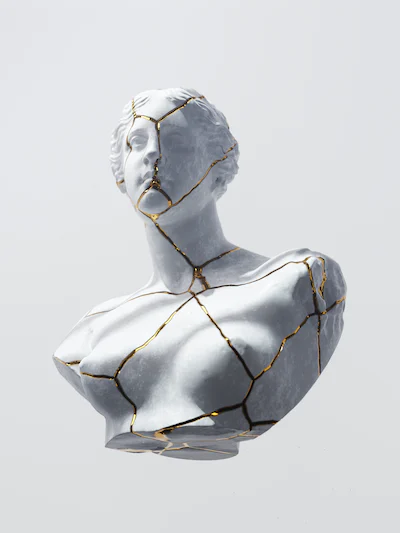
As happened so many times, I froze inside myself, observing her, observing myself in that narrow space, listening to her as if I were floating above the actual scene she was making, screaming at me – but not so her husband could hear – for being human, bloody, and alive in a world she dominated and tried to control with her energy and intellect, and with her crazy. It was not unlike the day my cousin led me into the woods and fields below the house, a long way from where my dad and uncle – his father – were doing a last walk-through check of the house and barn. Another moment caught in amber, as I floated up, up and away, above the trees, into the blue sky of another late summer day.
*from a group of essays – The Politics of Women’s Spirituality – which were collected and written by Charlene Spretnak, published by Anchor in 1982 (good gracious that’s getting to be a long time ago); the author’s wiki linked along with a brief description of the work below.I loved the quote, which is why it’s here – shall I buy this ‘ancient’ feminist classic and dig up this quote in its original form?! Mebbe. We’ll see. Happy Hump Day 😉
“The objective of patriarchy was and is to prevent women from achieving, or even supposing, our potential: that we are powerful in both mind and body and that the totality of those powers is a potent force. All of the myriad varieties of patriarchal oppression -co-opting and replacing the Goddess, imposing patrilineal descent and ownership of woman’s womb, restricting and mutilating woman’s body, denying woman education and legal rights, forbidding her control of her body, and portraying that body as a pornographic toy. All of these acts are motivated by one desperate drive: to prevent woman from experiencing her power.
The Description: This feminist classic (first published in 1982) presents a chorus of voices exploring their authentic spirituality. The essays are active rather than reactive, revolutionary rather than reformist, and express a broad political awareness. Rather than codifying a religion exclusively for women, the authors address a range of contemporary issues that are informed by spirituality, our attitude toward life on Earth.
Part One: Discovering a History of Power * What the Goddess Means to Women * Mythic Heras as Models of Strength and Wisdom
Part Two: Manifesting Personal Power * Consciousness/Energy/Action * Self-Images of Strength and Wholeness
Part Three: Transforming the Political * The Unity of Politics and Spirituality * Applications of Spirituality as a Political Force
Or is it just commercialism? Or convenience? Sometimes a carrot, said Freud, is just a carrot. I was wandering around Walgreens on my semi-annual drugstore stroll. This is a ritual I do in order to make sure I am well-stocked with band-aids, anti-biotic ointment, vitamins, supplemental or seasonal vitamins, antiseptic wipes, toothpaste, acetaminophen, ibuprofen…you get my drift. I also enjoy drugstores because of course I do. Doesn’t everyone?
Regardless, I perform this ritual not simply because I need stuff, but also because having grown up in a drugstore family, it took me at least two decades to realize that in fact my dad wasn’t there to fill my medicine cabinet anymore when it needed filling, largely because I was in NYC and he was in the Catskills. This also applied to my sock drawer, my supply of toilet paper, my paper and pen supplies, tampons – anything and everything he stocked at ye olde pharmacy or that my parental units had stocked as a matter of course because decent parenting required it.
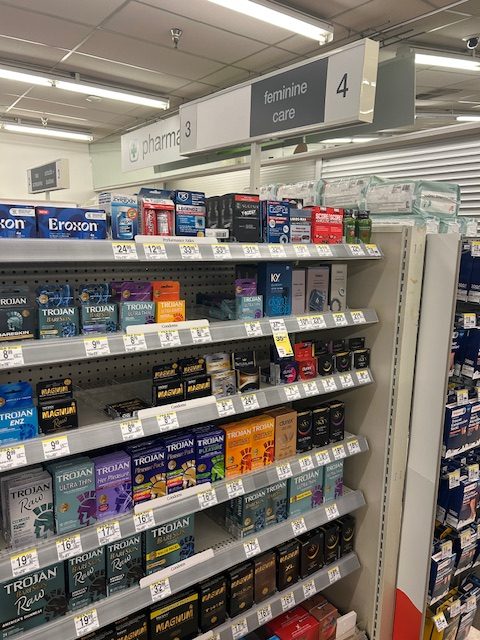
Buying bras and underwear for myself felt like adulting in those days; it was also a release, as my mother’s taste and mine could not have been more different. But I digress. The latest Walgreens I visited, where I was struggling to find the cushy inserts for my shoes that I like, had the ‘Feminine Care’ aisle clearly marked. Why I noticed the primary item stocked there was condoms, I don’t know – a high level of radar for irony? Or for that casual, institutional sexism I see in so many places, like changing tables in the women’s bathrooms but not the men’s, or the men’s room being both closer to access and twice the size of the women’s in so many buildings. Yeah, yeah – old buildings, but there is such a thing as renovation, updating, repurposing.
There is such a thing as taking care of female employees. Or smply making both lavatories unisex? If that freaks you out, maybe at least make the women’s bathroom the bigger one? It’s a thought!
But maybe it was simple commercialism: put the condoms there at the aisle’s end, and the tampons and pads in the middle of the long display avenue. In this way, women will purchase condoms, thinking oh yes, in order to keep from missing periods like the one I have now or am expecting this week/month (on average, women spend 30 years of our lives avoiding pregnancy), thereby upending my entire life, destiny, health, plans – you name it – I will pick up condoms because shit-for-brains never does. Or maybe even women will pick them up because we also enjoy sex?! Revolutionary idea!
Oh wait. That’s not it, or rather that’s not always it. Or more honestly, that’s rarely it. The truth is women take responsibility for preventing pregnancy much more often than men. How do I know this? Because I am a woman. Also, this: https://pmc.ncbi.nlm.nih.gov/articles/PMC6115298/
I actually thought about asking the druggist or manager about this display on the feminine care aisle, ‘Um, why are these placed here’ – yet you can’t argue that preventing pregnancy or the spread of STDs isn’t ‘caring for women and girls’, can you? Although I have argued that pregnancy is the most common STD women are attempting to avoid – an argument that never fails to upset persons more delicate than my rough and tumble self.
I said nothing, filled my little basket, paid, and left. But I took this photo because in time, this will change, right? Or maybe it won’t matter, as certainly among all the sexist stupid patronizing idiotic and downright harmful things going on in the world right now – who cares about minor stuff like this, which is really just a symptom of larger ills. Sigh.
*the kind of re-framing we need All Over the Damned Place, from the first man to minor in women’s studies at U. Mass Amherst, Dr. Jackson Katz!
We talk about how many women were raped last year, not about how many men raped women. We talk about how many girls in a school district were harassed last year, not about how many boys harassed girls. We talk about how many teenaged girls got pregnant in the state of Vermont last year, rather than how many men and teenaged boys got girls pregnant. So you can see how the use of this passive voice has a political effect. It shifts the focus off men and boys and onto girls and women. Even the term violence against women is problematic. It’s a passive construction. There’s no active agent in the sentence. It’s a bad thing that happens to women. It’s a bad thing that happens to women, but when you look at that term violence against women, nobody is doing it to them. It just happens. Men aren’t even a part of it! – Jackson Katz, PhD. from his TED Talk, Violence Against Women: It’s a men’s Issue
*a poem from Patricia Smith, and the New Yorker. I am closer to 70 than I am to 60, and it sure does feel like it – not always, but often and often. Gratitude for the present, for good health, and for whatever time I have left…more about Smith below.
Well, first, it seems immeasurably unjust that no one clues you to this bombshell—you will lose your pubic hair! No one brought up this grave development, the swift début of silver slowly turning soulless gray, then just an anarchy of wire, ’til one by one your glistening strands betray you, disengage and drift. Behold and lo, you’re bald in undreamt ways. My perfumed kink and curl, dense lace embellishing the door to everything, no longer shines its light for episodic visitors. I own a home not quite abandoned, simply stripped, the fireplace still ablaze within its walls.
I’m shamed by how much satisfaction I experience when I scan random crowds and whisper Everyone I see will die. The difference now is that I’m well aware that I’m included. If I shut my eyes to sleep, to hush this drowsy body down because the world is swirling, when I wake I’m just a little farther underground. And, yes, I’m terrified, and so are you, admit it. Someone said you die and just relive the life you’ve lost, again, again, again, with all its woe and wounds. That’s hell. I think I’d rather ceaselessly relive that godforsaken hour before I die.
I mourn the many poems that I failed to write, and then those poems that I failed— the poems I assumed would shove a life back into life, unlatch a cage or turn a thousand thirsty bullets back around, revive a fallen daddy, shrink a war, unreeling lines I thought could heal a thing, slam shut a thing, reverse a thing, or teach an Annie Pearl to love her reckless child. I grieve the lawless verses that fought back and silenced me because I lacked the spine required to know the tale they told was mine. I trusted myself blind. I really thought the words would grow to gospel in my hands.
And back to death again. It hovers, smirks, and rides that vile McRib right to my mouth and down. It’s eying me. Who’ll greet me at the gates? A God? No God? I’ve seen the hope— resuscitated Woofs and Fluffys, kin now tumorless and gleeful, those who raised you younger than they ever were all hauling ass through Heaven toward you. My daddy, with his glinting golden mouth, and Brady Bear my Berner, Ron the mutt, and, yes, my mother, maybe with a heart that works. This Hallmark paradise does what a blindfold does—you crave a light that isn’t there until it is. It’s not.
But what about the rampant blaze that scars that other place? Incendiary claws that fight to pull you down? Most poets swear they’ve been to Hell, prefer the place because there’s no gap left for silence, there’s no time to muse, regret, revise, or wonder what you’ve done or haven’t, just the bellowing of flames that shift your skin. The baying of Beelzebub begins and keeps beginning. But I suspect this too is trickery— a candy dangled, daring poets near. We don’t mind fire if there’s a tale attached. But what of me, whose greatest fear is dirt and silence? What if now is what there is?
For what must be the thousandth time, I watch the shudder-hipped industrious machine that is Beyoncé’s body and it’s like I’m on another planet. When you’re 70, it’s best to file that under “Kiss my old decrepit ass” and go about your biz. So what’s life like? Let’s see. I move, a sound comes out—a yowl, a groan, a pained unwinding hiss. Or, if it’s just my knee again, a scream that freaks the birds outside. My neck is prone to locking, and my eyes can only work behind a nerdy chunk of thick prescription glass. And, oops, it’s time to wind this sonnet down, but there is soooo
much left to gripe about, so let’s proceed. I stare at my reflection, and I see my melody is waning—no surprise, but only blues take root and hold. I spot inside myself the girl who never was less than a dance, who loved her daddy like a god. I wallow in my history because there’s just so goddamned much of it. And then I wonder if I’ve done enough. Or anything. I ponder that until I have to sit and catch my breath. Oh, hallelujah all this old. It’s what I’ve done. I write, I love, I break apart. I wrote. I loved. I broke apart.