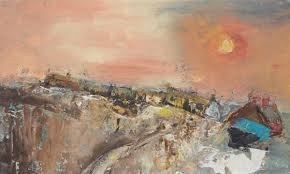
Joan of Arc. Joan Collins. Joan Jett. Joan Baez, Joans Bennett and Fontaine but nope, no recollection of a ‘Joan Eardley’. Who dat? An artist, a painter. A gifted and talented human gone much too soon, one whose work can be found in prominent galleries in her native – and beloved – Scotland.
Why are certain artists remembered and others forgotten? Gender certainly plays a role, timing too. The art world is a nightmare, I have always thought, which elevates ‘enfants terribles’ – the badly behaved, sensational or shocking – over many other equally or more talented others whose art is also alive with power and unique, bold or moving uses of color.
Men have traditionally been the gatekeepers, so yes, more males get ahead and are made much of and remembered, while women artists like Joan Eardley – who also died young at age 42 (bad luck and timing, that) – are often forgot.
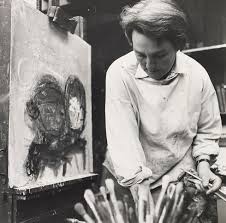
Here she is at work:
Let’s remember Eardley, elevating and celebrating her artistic gifts and work as wholly deserving of note and notice. As does her death, which was in part due to her doctor (one can only presume a male) ignoring her symptoms; that led to what was undiagnosed and untreated breast cancer spreading to her brain. Women and their symptoms – their… OUR knowledge of our own bodies continues to be a life-threatening challenge to this day. Sigh.
Eardley’s wiki page is linked below. If Hollywood seeks artsy bio-pic material (her father was a victim of shell-shock in the First World War, among many other notable points of interest), Eardley’s short, eventful life has my vote.
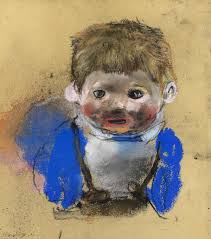
I love her work, and her use of color. The variety of her subjects is also compelling, admirable, humbling. It also reminds me that maybe, just maybe, I need to return to Scotland.
“Crying does not indicate that you are weak. Since birth, it has always been a sign that you are alive.” – Charlotte Bronte, Jane Eyre
Since when was crying seen as weak? Who decided? What made someone(s) make that dangerous bullshit up? Suppressing tears, sadness, despair, actually harms and even kills people, as does suppressing fear, anger, desire and need – with caveats, of course. I have needed a good cry all week, for reasons known and unknown. It builds up, you see, the sadness, making a weight on my chest, creating pressure behind my eyes. This is due to – oh, the time of year, maybe, the state of the world, the loss of friends and loved ones, the pain of being human.
“Keep me away from the wisdom which does not cry, the philosophy which does not laugh and the greatness which does not bow before children.” – Khalil Gibran
When I was eleven or twelve, my older sister decided to conduct an experiment with her three younger siblings; what prompted this, I cannot say. She would, she announced, track how many times we cried, and for what reason, determining who was the biggest cry-baby of the lot of us, going off and blatting for no good reason. As she was fourteen or fifteen at the time, I believe she felt she had surpassed all emotional outbursts, and, given her position of superiority and authority – amply demonstrated by her on an almost daily basis and supported by a doting mother, she was eager to show us – prove to us – what a bunch of wet blankets we collectively were.
“I have siblings. And there are certain things I know that I can push their buttons. And they know they have certain things where they can push mine.” – Catherine Zeta-Jones
I think too there was a thought she expressed, which was that by doing this we might pull ourselves together, and stop being such a drag on her older and wiser self. It was a long time ago, but over the next month or so, she took notes. Did I mention we only got one channel? And the internet didn’t exist yet? And we lived at the end of a long dirt road with a depressive, angry mother – the same one who doted on my older sister? There were no neighbors nearby to play with, and the road was all down hill, meaning walking back up hill if we thought of going for a bike ride. In other words, maybe she was simply creating entertainment for herself, like those awful people in Squid Game.
“…but these backwaters of existence sometimes breed, in their sluggish depths, strange acuities of emotion.” – Edith Wharton
So my brother won. Or, rather, he lost, coming in first as the person among the three youngest of our sibling group who cried the most for the least good reason, at least – according to our older sister. My baby sister came in second worst, and I ‘won’ in the category of least tears for the best reason. I barely cried at all, said the Queen of Sheba. Not sure what all that meant to me then, although given my older sister found me bottomlessly irritating (her nickname for me was Maggot), I suppose it was gratifying? Mostly, as was so often true then and now, it seemed to me as if my brother was allowed to have and express the full range of emotion sans any check or any real criticism.
“There is a sacredness in tears. They are not the mark of weakness, but of power. They speak more eloquently than ten thousand tongues. They are messengers of overwhelming grief… and unspeakable love.” – Washington Irving
Tonight I will seek out a good tear-jerker, to relieve the pressure I feel on my heart and in my head. Or, I’ll watch Derry Girls again, relieving myself by way of crying tears of laughter.
Menopause – the cessation of menstrual periods preceded by peri-menopause and accompanied by a whole host of symptoms in some, not all, women – is little talked about or understood by the larger public and populace. This ignorance persists despite 50% of humanity one point or another experiencing menopause, although public awareness and conversations around menopause (or, women aging in general) are happening, throwing a little more needed light on the subject.
Manopause, however, is even less understood, and talked about, which is a crying shame, as it should be when the other 50% of the population – men – must endure pain and suffering in the relative darkness of public ignorance, and indifference. Ignorance is not bliss, peeps. It just ain’t.
Manopause – for the vast number of uninitiated – is the delicate time between 40-60 when men begin to lose their hair (if they haven’t already) as well as – crucially – their ‘wood’; in plainer terms, after many years of familiar responsiveness, the little Johnson in their pocket no longer automatically and swiftly obeys a signal from the reptilian man-brain. It is, in other words, that sad, wounding time when men confront aging, can no longer automatically get an erection, and therefore very often lose their fucking minds in the process.
Male testyria during manopause takes many forms and has several differing yet very often common symptoms as well as generally consistent markers. These symptoms and markers may appear in clusters, or as individual indicators of the condition.
Among them are: buying into on-line conspiracy theories; excessive viewing of Fox News and a concomitant rage at various so-called ‘culture war’ issues; being divorced by or divorcing a spouse of many years; dating and even marrying ever-younger women, including women one’s daughters and even, in some acute cases, granddaughters’ ages; excessive gun purchases, including even in some cases the construction of a bunker; purchasing sports cars and/or boats in an attempt to rev up the wounded self-image; pumping iron to excess; the purchase and use of penis pumps or, most alarmingly, the implantation of a penis extension; susceptibility to on-line supplements offering renewed ‘wood’ and ‘flow’; hair implants or transplants; joining or creating militaristic style survivalism groups.
The list, sadly, is endless, and may include indulgence in niche hobbies no one of either gender in their right mind would pursue.
On a more serious note, suicide and acts of egregious violence are outcomes also associated with manopause; suicides, especially, are on the rise among men over a certain, delicate age. Manopause has been noted in men as young as 30, and as old as practically neck deep in the grave. Currently there are very few cures or non-surgical applications (lobotomy has been recommended in acute cases) for this potentially chronic and life-threatening disease.
Perhaps worse, however, than the very real symptoms and ills of manopause is the public ignorance of its existence. We cannot fix or address what we do not identify, name, or acknowledge. Cures will not and cannot be researched or funded if we continue to deny men’s testyria and vulnerability when traveling the long, often lonely road of manopause.
Manopause is real. If you know someone who you believe to be suffering from or through menopause (symptoms can last up to 20 years or more) without the help of medical assistance, either mental or physical, know that a. you are not alone, and b. in reading this you are becoming part of the solution, and c. once manopause has been identified in a person, and as a condition across a wide-swath of our fellow humans – can hormone therapies, alternative cures, different surgical strategies and more, including talk therapy, be far behind?
…BY THE WAY, y’all – because I learned something today while writing and prepping this piece: menopause, is also known as the climacteric – which nobody ever told me, and personally, I love this alternate name!!!
*a poem from Fanny Howe – who I had never heard of, or remembered hearing of because – oh, who knows!But, lemme tell you, she had one helluva’n interesting life; she was born in Buffalo, N.Y. in 1940, and died in July of this year. Her daughter is the novelist, Danzy Senna, who happens to be married to another novelist, Percival Everett (his book, James, still delights me in memory, so subversive and hilarious!). But, back to Howe. I love the poem above – simple, pure, true. For more on Howe read on, or check out her wiki page: https://en.wikipedia.org/wiki/Fanny_Howe
Fanny Howe was the author of over twenty books of poetry and prose; she was the recipient of the 2002 Lenore Marshall Poetry Prize for Selected Poems (2000), and won awards from the National Endowment for theArts, the National Poetry Foundation, the California Council for the Arts and the Village Voice, as well as fellowships from the Bunting Institute and the MacArthur Colony. Howe also guest lectured and taught creative writing at Tufts University, Emerson College, Columbia University, Yale University and MIT. She was a Professor Emerita of Writing and Literature at the UC San Diego.
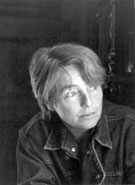
I am adding this photo of Howe because like the poem above – it feels and reads – to me – as pure and true. It is from 2003.
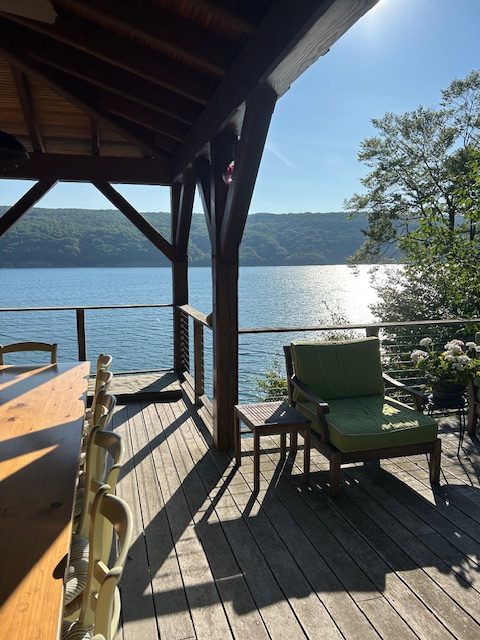
Summer is daily coming closer to a close. Night falls faster, minute by minute. I am not a fan of summer heat, or bugs – but summer is when I spend quality time and lots of it with my besties, making it a great season, the best, when the sky – even on rainy days – sings, and when my heart sings, too. Yes, there’s texting, phoning, zooming, and email but oh, sitting on a dock, on the beach, around a table filled with people I love and have known for-like-ever ~ cuddling on the couch, talking about the best books we’ve recently read, or TV we’ve watched, catching up and reminiscing, laughing, laughing, laughing – beautiful. Of course the birds sing. Of course the sky is filled with music.