“We are in the hands of men whose power and wealth have separated them from the reality of daily life and from the imagination. We are right to be afraid.” – Grace Paley
Sometimes, I am actually glad my father didn’t live to see the current state of the nation and especially of the presidency. He couldn’t stand George Bush, who he considered a privileged little shit, unworthy of the office to which he so easily ascended. If he knew who occupied the highest office in the land now, and did so in 2017 – he’d be dumbfounded. As am I, on alternate days. On the other days, I rage, and do whatever I can to fight the good fight against those who think they are entitled to shit on others, especially women and the poor.All that said, if you don’t know Paley’s work,you might check it out, or at least emulate in whatever way you can her anti-war/greed/racism etc. etc. activism!
Grace Paley, who died in 2007, was a writer, poet, and activist. I have read her poetry and her short stories, and while they are very much of the 20th century, they speak to our time now as all good and great writing does, being both wise and timeless.
From her wiki page: “In an interview given in the year of her death, in May 2007, Paley spoke of the dreams she had for her grandchildren, stating the desire for “a world without militarism and racism and greed—and where women don’t have to fight for their place in the world.”
*All to say that activism has been going on for a millennium, and a need for activism is never ending. And, sometimes, as with the second of Paley’s poems below, it’s also important to take break from activism, writing, pushing, and shoving, taking time out to make (and eat) pie.
Walking in the Woods
That’s when I saw the old maple a couple of its thick arms cracked one arm reclining half rotted into earthblack with the delicious hospitality of rot to the littlest creatures
the tree not really dyingliving less widelygreen head high above the other leaf-crowded treesa terrible stretch to sun just to stay alivebut if you’ve liked lifeyou do it
The Poet’s Occasional Alternative
I was going to write a poem I made a pie insteadit took about the same amount of time of course the pie was a final drafta poem would have some distance to godays and weeks and much crumpled paper
the pie already had a talking tumbling audience among small trucks and a fire engine on the kitchen floor
everybody will like this pie it will have apples and cranberries dried apricots in itmany friends will saywhy in the world did you make only one
this does not happen with poems
because of unreportable sadnesses I decided to settle this morning for a re- sponsive eatershipI do not want to wait a weeka yeara generation for the right consumer to come along
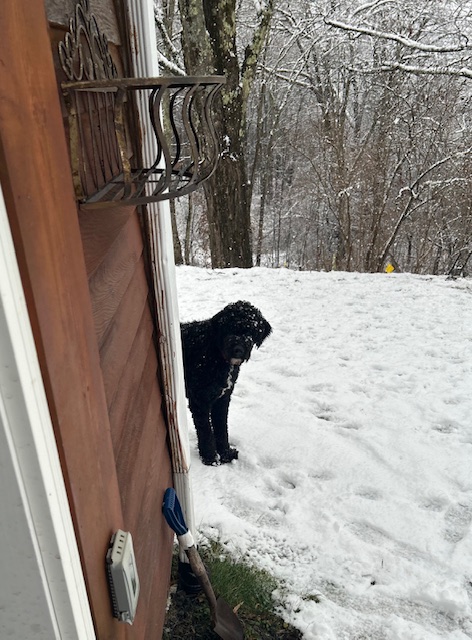
Diego loves the snow, and cold – he’s outside most of the day, these days, lying in it, including in the shade. It makes me shiver just writing that, but – being out in the cold is what he was bred to do and be, guarding sheep or whatever in the Pyrenees mountains. He eats snow for hydration; his bowl of water in the house, kept nice and fresh whether he drinks from it or not, totally neglected. He keeps the squirrels away from my bird feeder, and watches the valley. There are no leaves on the trees, and so the sounds of the rural county route float more easily our way, his way, alerting him to activity that needs his attention. and supervision. He’s a delight, and as he approaches three, the best boy, much calmer, no longer a puppy, really, although he does still love to play.
This is not the best shot of him in snow, but it’s falling here, and he’s out in it, a pig in sh*t, as they say. He wants me to come out and chase him a bit. And I will, just not now. Let’s allow the temps to get above 10 degrees, shall we?
“I shut my eyes and all the world drops dead; I lift my lids and all is born again. (I think I made you up inside my head.)
The stars go waltzing out in blue and red, and arbitrary blackness gallops in: I shut my eyes and all the world drops dead.
I dreamed that you bewitched me into bed and sung me moon-struck, kissed me quite
insane. (I think I made you up inside my head.)
God topples from the sky, hell’s fires fade: Exit seraphim and Satan’s men: I shut my eyes and all the world drops dead.
I fancied you’d return the way you said, but I grow old and I forget your name. (I think I made you up inside my head.)
I should have loved a thunderbird instead; At least when spring comes they roar back again. I shut my eyes and all the world drops dead. (I think I made you up inside my head.)”
In 2023, or perhaps the year before (I just did a search and there was soooo much advertising and far too many non-related articles offered I quit trying), the New Yorker had a long form article on gas stoves in the UK during the first half plus of the 20th century, which played a part in many suicides – including in 1963 that of Sylvia Plath. The article spoke of the domestic despair of those years before the NIH was fully established, along with other social supports, as well as how, with a simple fix – the gas automatically shutting off after 2 minutes? 1? – many lives were saved, particularly the lives of women, who were overwhelmingly committing suicide by simply turning the gas stove on, and leaving it on without lighting a fire…A similar, tragic consequence is happening in America, when families have unsecured guns readily available to their children in the modern age. We can fix this, the questions are: do we have the will to make essential changes in law and practice, and how many more children have to die in order for us to grow the will to do better?
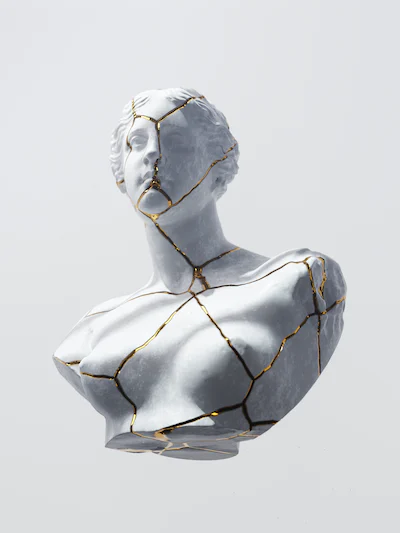
Imagine the world with more of Sylvia Plath’s genius in it…had she lived.We must imagine and work toward a better world. One of the aspects of this history, that examined in the article, was just how long – years and years and years – it took male leaders to notice the hard data on suicide, how and where they were happening (gas stoves, in the home, mostly women) before further acknowledging that suicides were and are most often acts of impulse later regretted and, having acknowledged that reality, doing something about it. A simple fix that saved many, many lives. We can do and we must be better.
I’ve been thinking about the Bechdel Test as I often do during or after consuming media, and recently I thought of it as I started the Apple TV series Shrinking, featuring Harrison Ford (adorbs), Jason Segal (meh) and the amazing Jessica Williams. There are three main female roles in the show, with three or four men (if you count the supporting character of Brian), so okay to good representation for women with regards to the series. But. There are other aspects to representation, ya’ll, and (spoiler alert) when yet another mother – Jason’s wife Tia – is dead as the series begins in order to make dad both available and vulnerable, automatically sympathetic to an audience while setting a series up, it gets my feminist goat, y’know?
There is a long history of this obnoxious, sexist, convenient/dead female plot line in Hollywood, both in TV and film: My Three Sons. Bonanza, The Courtship of Eddie’s Father. Family Affair (yes, both parents were dead but…were there no aunts or married couples on either side of the family equation?!!) or Three Men and a Baby. Sleepless in Seattle. Legends of the Fall. Or, for variety’s sake, we see the mom – briefly – but then, pow, she’s dead and revenge must be got because real men kill lady killers (I suspect there’s a whole set of these starring Charles Bronson, but I didn’t see them…) as in Road Warrior, and Gladiator.
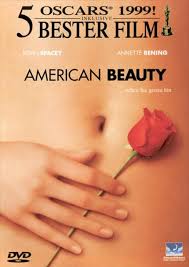
Meh. Worse yet are films that have few speaking or named parts for women at all. Sigh. It has also been pointed out by others that Hollywood loooooves posters and advertising that show only the female torso, decapitating ‘hot’ women from the collarbone down because that’s the only part that matters when selling a film, and who cares about how women are represented in print, on TV, on film? FEH. Once you see it, once you notice it, the lack of speaking roles for women, you can’t not see it in future, so be warned when reading the following on the Bechdel Test and how it came to be, with all due respect to Alison Bechdel, Virginia Woolf, and women everywhere who have been pointing this out for far too long, to little or no effect, dammit.
Are things getting better? Not really. But, we live in hope. From Wiki – a much shortened trio of highlights:
“The Bechdel test also known as the Bechdel-Wallace test, is a measure of the representation of women in film and other fiction. The test asks whether a work features at least two female characters who have a conversation about something other than a man. Some versions of the test also require that those two female characters have names.
A work of fiction passing or failing the test does not necessarily indicate the overall representation of women in the work. Instead, the test is used as an indicator for the active presence (or lack thereof) of women in fiction, and to call attention to gender inequality in fiction.
The test is named after the American cartoonist Alison Bechdel, in whose 1985 comic strip Dykes to Watch Out For the test first appeared. Bechdel credited the idea to her friend Liz Wallace and the writings of Virginia Woolf. Originally meant as “a little lesbian joke in an alternative feminist newspaper”, according to Bechdel, the test became more widely discussed in the 2000s, as a number of variants and tests inspired by it emerged.”
“In film, a study of gender portrayals in 855 of the most financially successful U.S. films from 1950 to 2006 showed that there were, on average, two male characters for each female character, a ratio that remained stable over time. Women were twice as likely as men to be involved in sexual activity, and this only continued to increase over time.”
“The “reverse Bechdel test” asks whether a work features men who talk to men about something other than a woman. A 2022 study that analyzed 341 popular films of the last 40 years showed that almost all (95%) passed the reverse Bechdel test, speaking to a much stronger representation of men than women.”
The plum you’re going to eat next summer doesn’t exist yet; its potential lives inside a tree you’ll never see in an orchard you’ll never see, will be touched by a certain number of water droplets before it reaches you, by certain angles of light, by a finite amount of bugs and dust motes and hands you’ll never know. The plum you are going to eat next summer will gather sugar, gather mass, will harden at its center so it can soften toward your mouth. The plum you’re going to eat next summer doesn’t know you exist. The plum you are going to eat next summer is growing just for you.


 black with the delicious