*From the Services and Heritage Archeology Association : investigating the past, informing the future – info about their mission, work and how to get involved can be found here https://www.wdhuk.com
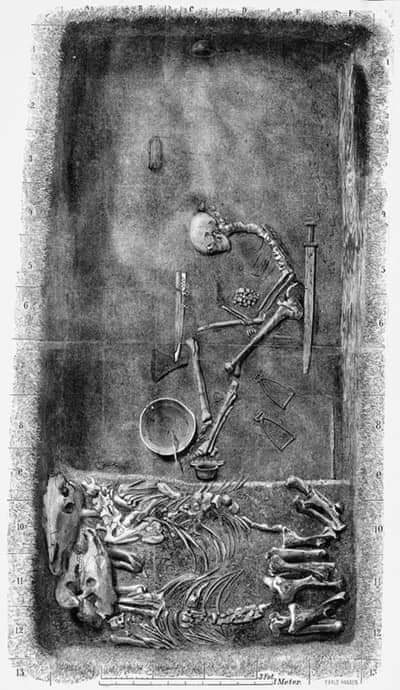
The Birka female Viking warrior was a woman buried with the accoutrements of an elite professional Viking warrior in a 10th century chamber-grave in Birka, Sweden.
Thought to be a male warrior since the grave’s excavation in 1889, the remains have been proved to be female by both osteological analysis and a DNA study in 2017.
The study concludes the artifacts buried with the woman are evidence she was a high-ranking professional warrior.
*not a surprise to many women, especially this one, (heeheehee) a fan of TVs Vikings, Long Live Lagertha, a character created prior to the re-identification described above, because truth follows fiction, sometimes, y’all.
Wm. Shakespeare, Merchant of Venice, Act IV, Scene I
*I once hoped to play the role of Portia, whose famous monologue is shared below. It’s a great role, and went to another actress, but I learned this speech and much of the rest of the play because I loved the language – and her intellect revealed though the language the character is given – so much. I’ve been contemplating doing a class? A talk? About Shakespeare, including this and other pieces – many lesser known – in the presentation. We’ll see.
The quality of mercy is not strained; It droppeth as the gentle rain from heaven Upon the place beneath. It is twice blest; It blesseth him that gives and him that takes: ‘Tis mightiest in the mightiest; it becomes The throned monarch better than his crown: His sceptre shows the force of temporal power, The attribute to awe and majesty, Wherein doth sit the dread and fear of kings; But mercy is above this sceptred sway; It is enthronèd in the hearts of kings, It is an attribute to God himself; And earthly power doth then show likest God’s When mercy seasons justice. Therefore, Jew, Though justice be thy plea, consider this, That, in the course of justice, none of us Should see salvation: we do pray for mercy; And that same prayer doth teach us all to render The deeds of mercy. I have spoke thus much To mitigate the justice of thy plea; Which if thou follow, this strict court of Venice Must needs give sentence ‘gainst the merchant there.
In 2005 I became the coach of the local high school tennis team, which was a spring sport as well as being the only co-ed athletic team. I had zero coaching experience, but loved tennis, loved kids, needed something to do while my parental units circled the drain (harsh, but true), and it’s always great to be outdoors doing fun shit. Tennis is definitely fun shit. I generally recommend learning tennis, as well as joining a tennis club or group play, to those who are partner-less and wish to be partnered; there is something about tennis that is not only fun, but inherently sexy. Hook ups of all sorts are common. Very. Just sayin’.
After the first spring season I coached (6-4 win-loss record), I was required by state law to take a coaches training course that included my having to re-certify in CPR, as well as learning how to apply a tourniquet, wrap an ankle or knee, basic coaching techniques (there was a workbook), and general safety training (allergies to bees, bullying, reporting evidence of abuse, etc.). The course, which I believe was twenty hours long, was done via distance learning, two and a half hours a pop, taught by a coach and athletic director located over an hour away in Otsego county. He video conferenced us into his classroom from another small town, Laurens, N.Y., and in this way all participants would be spared driving from throughout the wide rural region. His name was Pat (Pasquale) Grasso, and he was a local upstate legend; Laurens Central named their new gym after Coach Grasso. Pasquale had been teaching and coaching there since the mid-fifties, before I was born.
He seemed okay, whatever, just get me through the course, except oh no, Pat ‘The Legend’ Grasso was another of those old white guys who could not tolerate a changed and changing world. How do I know this? Well, on a regular basis, he shared with the class his opinion that girls’ sports were a waste of time and resources, and that girls’ sports weren’t, in his view, worth watching, ever, on any level, high school to college or professional. In fact, he said, he hated watching them. This from the athletic director of a rural K-12 school, a man who also sat on the board of regional and state level sports’ organizations. As the only woman in the room of coach-trainees, including in all of the other on-line classrooms, I took exception to these sexist statements (none of my male ‘compadres’ said a word) and, as a result, he referred to me as ‘feisty’ and as ‘one of those feminist types’. He was, in other words, a Neanderthal, a sexist dinosaur. And, while he was entitled to his regressive, idiotic opinion, because he was an athletic director who served on various boards, my larger concern was that his ignorant mind-set helped create, enforce, and contribute to regional and state-wide policy-making, which was not okay. Not. Okay.
Along with being a dangerous, ignorant Neanderthal, Pat Grasso was also a widow; his wife, I commented sotto voce to a friend in the class, got an early release, the lucky gal. Just my luck, however, lonely widower Pasquale took a shine to yours truly, although his method of showing it was to double down on his sexist commentary, and to maneuver several classes being held in person, in Laurens, where I made sure to travel to with that same friend, another coach from my school, because even if the old guy was subtle, it was clear Mr. Widower was sniffing where his ignorant fucking misogynistic nose didn’t belong.
The workbooks, where we kept notes and extra info gathered throughout the course length, were delivered to Coach Grasso near the end of the training for his review, after which we would again meet in Laurens for the return of same, along with certificates proclaiming course completion. Oh goodie. Another trip to the middle of fucking nowhere, but I wanted the certificate – previously always mailed to student-coaches – as I had earned it. I also wanted to get my workbook back as it had information in it I had gathered and wanted for future reference, including a couple of training ideas. Y’know, my workbook from a course paid for by my school, my work, my notes, mine?
Anyhoo, at the last training session, in Laurens, the legendary Pat Grasso handed out all of the workbooks except – oops! – he must’ve left mine at his house, darn it, but I could pick it up there after we were done, at approximately nine p.m., it’s only five minutes away! Are you fucking kidding me? That’s not even subtle. No. No thanks. I’d driven to the final session alone, as my fellow coach friend was dining out with his wife afterwards, so I was on my own if I was going to brave the old man’s house to get my workbook. No. You can send it on to me later, via the BOCES van, which had delivered it, along with all the others, to him in the first place (BOCES is a cooperative program of shared services and resources in NYS schools). He laughed. He laughed at my refusal to play along, I guess, I assume. It really pissed me off, all of it, and I almost changed my mind; I did, sitting there during the wrap-up, fantasize about going to his home, only to punch the old fucker in the nuts, but – no. I never got the workbook back, although I requested its return several times. Generations of female students coached, programs created or not, and run, managed, funded or not and to what level by the direction or recommendation of this guy? FEH.
All to say that – in 2005, not long ago, this kind of attitude was making policy, was enforcing sexist standards, was in the room where decisions were being made. Pat Grasso was the Athletic Director at Laurens C. S. right up to his death at eighty-two, in 2016, clinging to his little fiefdom to the last gasp, supported by a community and institution that – my opinion – looked the other way on his regressive bullshit because that’s what we do, we give these Neanderthals credit, grace, generosity, money, position, power – because they made the systems we all live within, and we think we owe them something. We don’t.
The real difficulty, the actual challenge we face is how to transform these institutions and boards and mind-sets to reflect the changing world Pat Grasso was kicking and screaming against. The real task at hand is to reform from within, as blowing shit up sounds fun, but usually ain’t – and, with time and more than anything representation, representation of, by, and for women, women in positions of power in all settings and rooms where decisions are being made, change is happening; we are taking steps toward parity, equity, decency, and justice, and – girls and women are leading the way. Yay.
My final overall record as a tennis coach? 43 – 7. Damn good, eh? You bet it is. Great kids. Loved almost every minute of it (bus rides over country roads, nauseating and bad for an aging back…and a few parental units I could’ve done without…but – I had a fabulous time).
*an essay about matriarchies in literature – from LitHub, 2022 written by G.R. Macallister. and, if you haven’t read Matrix (not the films and in no way related to them, as excellent and fun as those are!) by Lauren Groff, it’s durned good, and centers on a female led society in Medieval times.
Fiction is always a work of imagination, but speculative fiction—science fiction and fantasy—is the genre where we can truly let our imaginations run wild. Fire-breathing dragons hoarding treasure, torching hillsides, sowing chaos? Sure. Giant robot soldiers piloted by teenagers? You bet. Post-apocalyptic societies scratching out a new existence after global disaster? Too many to count.
So why don’t we see more science fiction and fantasy novels set in worlds run by women?
It’s not that we can’t imagine it, obviously. Authors have. In the past few years alone, epic fantasy novels like Samantha Shannon’s The Priory of the Orange Tree and Rebecca Roanhorse’s Black Sun have incorporated matriarchies into their vast world-building. Naomi Alderman’s 2016 novel The Power drew a fictional blueprint for how a matriarchal society might come to be.
If you follow the matriarchal thread, it winds back to much older antecedents, through Nicola Griffith’s 2002 SF debut Ammonite to Sheri S. Tepper’s 1988 post-apocalyptic novel The Gate to Women’s Country all the way to “The Yellow Wallpaper” author Charlotte Perkins Gilman’s utopian Herland, published in 1915. It’s not too hard to locate dozens of novels set in women-run worlds or societies, even if you don’t include self-published works, which are so numerous and imaginative that if you find yourself saying, “There are no books about X,” you’re virtually guaranteed to be wrong.
But that’s dozens of novels out of thousands, hundreds of thousands, in the genre. Obviously we can imagine matriarchy, and we can write about it. So why is the number of these books so comparatively small?
The easiest reason—or excuse, depending your perspective—is that in nearly all of recorded history, men have held power. Kings run kingdoms, which are still called kingdoms even when run by queens. So any author basing their fantasy world on a well-documented real-world one, from medieval Europe to Mughal India, can point to that precedent.
But look at the flip side: recorded history is not the same as actual history. Was Minoan Crete a matriarchy? Were Paleolithic hunter-gatherer communities egalitarian? There isn’t enough evidence to prove either. The vestiges that ancient societies left behind were almost exclusively dug up by male archaeologists and interpreted by male historians. If you’re going to trust recorded history, be mindful of who created the record. In any case, history is a jumping-off point for fantasy, not a guardrail, unless your version of recorded history includes dragons, elves, and ghosts.
These are choices for individual authors to make. The power to publish, however, is not entirely in the hands of authors, which leads to a second theory about the lack of matriarchies in fiction. Maybe those books are being written but not published. While the majority of books in general are bought and read by women, figures vary by genre, and speculative fiction has the reputation of having a larger male readership than many other genres. You could draw the conclusion that editors are selecting books for their perceived appeal to male readers, and if so, that these men want to read about, well, men.
But numbers to back up this supposed male/female divide (for readers who even identify in one of those two ways) are hard to come by. And even if it were true of adult fantasy, what about YA fantasy? This is a category more clearly dominated by female authors and primarily consumed by female readers, often featuring girls as main characters. Every author who sets a YA fantasy story in a patriarchal world makes a choice to do so. And it’s not necessarily a bad choice!
As writers, we’re advised to crank up the conflict, pressure, and stakes as high as we can. The protagonist of a story like Namina Forna’s The Gilded Ones or Xiran Jay Zhao’s Iron Widow isn’t just fighting for her rights, she’s fighting for her life, and she’s fighting an entire society—oppressive, rigid, patriarchal—purpose-built to contain and deny her. The more obstacles in her way, the more impressive her eventual triumph. In this case, fighting an extreme form of patriarchy makes for a better story.
This would also account for why, when matriarchies do occur in speculative fiction, they tend toward extreme interpretations. Authors want to make a splash. It’s a bigger, bolder statement when the matriarchy is either a utopia—“Everything’s fine now that the women are in charge!”—or dystopia—“The women are in charge and now everything’s worse than ever!” It’s extremely rare for a society run by women to function simply as background.
The setting of Lauren Beukes’s 2020 novel Afterland (released in some markets as Motherland) is a near-future world transformed by a pandemic that killed 99 out of 100 men, but it spends almost no page space addressing the new world’s power structure. It’s a cat-and-mouse chase tale with a mom and her son on the run, even if that son is disguised as a girl to protect his identity.
Given how infrequently worlds run by women show up in fiction, it’s interesting how many of those worlds have devastated or eliminated the male population with some kind of planetwide disaster. At surface level, these books seem to imply that women can only run things if men are taken out of the equation. In addition to Beukes’s Afterland and the long-awaited televised adaptation of Y: The Last Man, the past three years have seen a half-dozen similar scenarios presented in fiction.
Last year alone brought us Simone De Munoz’s Manflu and Christina Sweeney-Baird’s The End of Men, as well as Star Eater by Kerstin Hall, which puts a science fiction spin on the scenario with a planet run by cannibal nuns. Then there’s Gretchen Felker-Martin’s recent horror release, Manhunt, which dramatically shifts the premise by focusing on trans characters in the aftermath of a testosterone-targeting virus, and Sandra Newman’s upcoming The Men, in which everyone with a Y chromosome disappears, blending the now-familiar gender plague element with shades of Tom Perotta’s The Leftovers.
So what gives? Why does this sliver of a subgenre seem to dominate? I have a theory, and it ties in with the rarity of matriarchy in the genre as a whole. Patriarchy—or, to be generous, egalitarianism—requires no defense in fiction. For the reasons I outlined above (i.e. recorded history), a fantasy world built on male power will be assumed to be valid because that’s the kind of world we live in now. It’s familiar. But an author choosing a matriarchal world is always going to be questioned, asked for justification.
In other words, matriarchy is a choice; patriarchy is an assumption. But questioning the unquestioned is precisely what makes speculative fiction so powerful. There’s plenty of room in this genre for different approaches to matriarchy, even some that don’t require eliminating the competition.
Some reasons for avoiding matriarchal settings are solid; some are sketchy. But here’s what I hope: I hope no writer out there is avoiding setting their story in a matriarchal society because they think it’s already been done. Even in the handful of novels named above, no two matriarchies are the same. The matriarchal societies depicted in these books range from utterly brutal to remarkably idyllic, and the characters in these stories face many of the same obstacles to their happiness as characters do in any other book. My novel Scorpica is set in a matriarchal world of five queendoms, peopled by women who are heroes and healers, victims and villains, senators and warriors, shepherds and priests. Are their lives better because women are in charge? No, and the question would never even occur to most of them.
When I read fantasy novels as a kid, selecting from the options at in my small town’s small library, it was a given that in those books, men would play every role of consequence. There are more options available to today’s readers, young and otherwise. But could those options expand even further, to embrace a variety of matriarchies, showing an array of ways women can wield power? Without question.
Though publishing is notorious for “we already have one of those” thinking, if today’s readers can propel two novels about Agatha Christie’s 1926 disappearance onto the New York Times bestseller list in two consecutive years, they can surely handle reading more than one book about matriarchy in a lifetime.
*I wrote this in 2007 (I think), and am a long-time supporter of organized labor, having belonged for many years to the actors’ unions as well as the Dramatists’ Guild. Collective bargaining is collective power, and collective power creates change, opportunity, stability, and growth. Scranton Joe agrees, More Americans now feel positively about Unions than in any period for forty-plus years, basically since the %#&*$#@ Reagan Administration.
“There’s class warfare, all right, but it’s my class, the rich class, that’s making war, and we’re winning.” – Warren Buffett
Here are the ‘overpaid’ professions that the Republican Party would like to Union bust by crushing collective bargaining as well as the right to strike:
Nurses
Cops
Firefighters
Teachers
Sanitation workers
Social Service Workers
Government secretaries, assistants and clerks
Bus drivers
I am sure I’m missing some but as I make this list here is one thing I know for a fact to be true: I don’t want to perform any of the above necessary jobs and furthermore, not one of the above is what I would call, unlike far too many CEOs, overpaid. No question, when I read that a superintendant of schools on Long Island is making six figures (Syosset pays its super something like $336k) I feel a little bit queasy but then, Syosset school taxes are paid for via property tax, and if my own are anything to go by, they’re not bad all things considered. And anyway, if the good folks of Syosset aren’t having a cow about it, who’m I to complain? Nobody likes paying taxes, period but the Republican Party’s full-throttle drive to keep raising taxes off the table – and even almost worse, the Democrats going along with it – while our state and federal budgets are broke or near broke, is ridiculous, stupid and even dangerous as we continue to borrow money against our children’s future from the Chinese among others. We can, somehow, afford to continue two wars as well as building a wall on the border we share with Mexico (one that I personally find so deeply offensive to everything I love about the American Story, I feel queasier thinking about it than I do when reading about the salary mentioned above), we can also somehow continue to give our elected representatives regularly scheduled raises, fabulous pensions and the best healthcare in existence (okay maybe Bill & Melinda Gates have slightly better healthcare…) and we can, despite the above, feel no demonstrable pain about cutting education, health coverage for the poor along with transportation and infrastructure projects that our nation is begging for if we are to continue to have any vision around global competitiveness……..
Let me be clear: Big Business doesn’t care – big business has already moved overseas to places where unions don’t exist, places like China and India and Indonesia; places where the idea of workers rights is as foreign a concept as pensions, healthcare and that quaint concept, middle class standards of living………And shall we note that the overwhelming (something like 60%) number of workers these unions currently under fire represent are women….and lest we forget unions made the following possible in the US of A: the 5 day work week, the 8 hour day and child labor laws among other good and needful things. And unions, with their commitment to worker’s rights, put regulations on the books that made the workplaces of America safe, creating conditions that made the middle class possible. And by the way, the vanishing middle class is not those who make over $150-250k or more per year but rather those who somehow miraculously manage to raise their families on salaries that hover around 30-70k per year… and unless you’ve done that (N.B.: 100 members of our current congress are millionaires), shut the hell up about the ‘entitled’ union members who need to be taught a lesson. Deep breath and thank you Warren Buffett for your good sense and the Coffee Party Movement for the Buffett quote…….