*in my twenties and thirties I spent a great deal of time studying Native American culture, which I had also taken a college course in during my middle school years, the kind of one-off experience that – as a child – had a lasting effect on me. I still own the book we used every Saturday for several months in that class, with my childish scrawl of a signature inside it. I remember having to give up bowling to take the course, and how cold the classroom was; we wore our coats the entire time. The truth is my ancestors are entirely European, and at one point, even with this childhood connection, I felt like I was being inauthentic, and studied Celtic religions and traditions as a way of getting ‘it’ right, ‘it’ being the adoption of an more authentic, native to me, way of being. Still working on it, and still convinced Native Cultures all over the world have a lot to teach all the rest of us…if we’re willing to listen, as well as to also sit in silence.
“We Indians know about silence. We are not afraid of it. In fact, for us, silence is more powerful than words. Our elders were trained in the ways of silence, and they handed over this knowledge to us. Observe, listen, and then act, they would tell us. That was the manner of living.
With you, it is just the opposite. You learn by talking. You reward the children that talk the most at school. In your parties, you all try to talk at the same time. In your work, you are always having meetings in which everybody interrupts everybody and all talk five, ten or a hundred times. And you call that ‘solving a problem’. When you are in a room and there is silence, you get nervous. You must fill the space with sounds. So you talk compulsorily, even before you know what you are going to say.
White people love to discuss. They don’t even allow the other person to finish a sentence. They always interrupt. For us Indians, this looks like bad manners or even stupidity. If you start talking, I’m not going to interrupt you. I will listen. Maybe I’ll stop listening if I don’t like what you are saying, but I won’t interrupt you.
When you finish speaking, I’ll make up my mind about what you said, but I will not tell you I don’t agree unless it is important. Otherwise, I’ll just keep quiet and I’ll go away. You have told me all I need to know. There is no more to be said. But this is not enough for the majority of white people.
People should regard their words as seeds. They should sow them, and then allow them to grow in silence. Our elders taught us that the earth is always talking to us, but we should keep silent in order to hear her.
Not that being single needs defending, but – it’s a way into the subject, which is choosing to be and remain single. Nora Ephron said the following, which is both funny and brilliant: “The desire to get married – which, I regret to say, I believe is basic and primal in women – is followed almost immediately by an equally basic and primal urge, which is to be single again.” This might be called post-alter regret, which I’ve never had, never having been married, And, of course, so much of what can be identified as ‘basic and primal’ is also, seen through a more modern lens than that worn by Ephron, maybe not so primal and basic after all, but rather taught to girls as early as – well, birth. “Hey, Girls,” the message was when I was growing up, “You must marry, You should marry, marry, have babies, and then – well, once you’ve done that – good luck!!” Because what was not spoken aloud was “then, girls, once you’re married with children, you’re on your own”. And, while the message might be less intense nowadays than it was when I was a kid, being left by this culture on our own as women, with children or not, is still around big time (Paid family leave, anyone? Universal healthcare with pre-natal and post-natal care included, prioritized, required! Women friendly research and diagnoses? Access to reproductive healthcare!?).
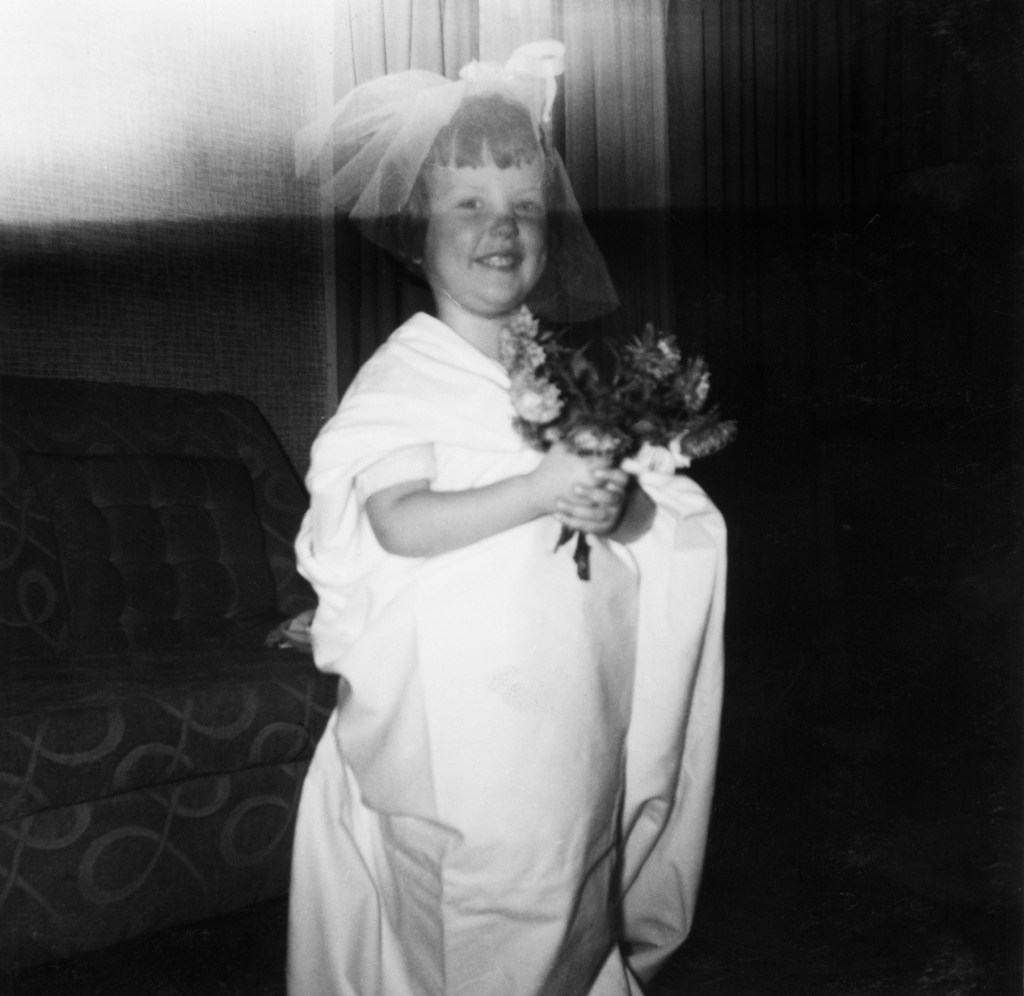
One of my niece’s, at her first communion, was told by her God-mother that she looked like a bride, and that this was practice for her wedding. SHE WAS EIGHT, and, hilariously/sadly, the God-momma was single, in her forties, and had, clearly, bought into the lie that she was of lesser value because ‘unmarried in her forties’. FEH. I know this because I was there, and immediately, like the good fairies in Sleeping Beauty, I said, “you know, there are a lot of other options for your future, darling one, other than marriage!!” “I know”, she replied. Smart cookie.
Fast forward thirty-years, that niece is married, with two kids, and – she’s a successful, busy surgeon.
Staying single is a choice, is something that happens, is the result of history, family, bad relationships, missed opportunities to marry and divorce several times over (heehee) and a temperamental idee fixe. For me, independence is my idee fixe, my primary value, my core. I do not want anyone, anyone making my choices for me, especially with a supposed legal right to do so. Husband, my ass, I’ll husband you, MoFo – husband meaning to conserve, to be the head of a household. So no, not legally, personally or otherwise, do I want anyone else to insert themselves into my life with what – I have experienced this – they, men, believe is the be-all and end-all of determinations. Mother may know best in sit-coms and myth, but men think they know everything, and that is not only not true, it’s annoying AF.
And as for playing the same of “of course you know best, honey”, then going my own way – not possible.
Everyone gets to decide for themselves what will work, and – the pressure of the culture to date, to marry, to be in partnership, is both real and immense. I see it in the thirty-somethings I know, lovely, wonderful, fun, smart young women who are complete unto themselves but who are being judged constantly, because they’re not partnered, with a timer ticking because BABIES, and fertility and all that jazz. Also annoying AF. Let the people, the individual persons, decide. There are so many ways to define and create family. For me, it has always, always been my friends. And my fur babies. 😉 (but true)
Many pursuits, people, relationships, etc. make life worth living. Marriage isn’t even in my top 100 list. Maybe it’s on yours, and if so, well, go for it, then. But leave me alone, dahlinks, please!! Divorce, as I like to say, is expensive, and homicide is verrrry tricky. Neither one appeals to me, nor does surrendering my life to an idea of marriage as the be all and end all, never was, never will be or could be. That concept – marriage as the win, the goal, the ultimate race won – for me, is nothing short of idiotic. Marriage and babies and all the rest can enhance lives, and they can be a total drag and every other marker in-between; what suits one women, or man, is not for everyone.
Claire who? Claire Fagin? Never heard of her. She died at ninety-seven in January of this year, and is worthy of note for many reasons, including the fact that she moved nursing education forward by leaps and bounds during her long and storied career in the nursing profession, and in academia. Fagin is also largely credited with changing the ways in which children – and their families – are treated in the healthcare system. Fagin believed that isolating children was a negative factor, and that allowing mothers to remain in hospital with their kids would increase positive outcomes. These days, allowing one or both parents to stay with small children makes complete sense, but at the time it was ground-breaking, garnering Fagin national attention.
Born in New York City in 1926, Fagin received her B.S. from Wagner College School of Nursing in Staten Island, an M.A. from Teacher’s College at Columbia U., and her Ph.D. from NYU. Her dissertation, published in 1966, was entitled “The Effects of Maternal Attendance during Hospitalization on the Behavior of Young Children”. She served as the director of the graduate program in Psychiatric Mental Health Nursing at New York University in the late sixties, after which Fagin served as chair and professor of the department of nursing at CUNY’s Herbert Lehman College from 1969 to 1977, during which time she developed a new baccalaureate nursing program that prepared nurses for primary care practice.
In 1977 she assumed the position as dean of the School of Nursing at U. Penn, a position she held until 1991. Among her many accomplishments is her appointment as director of the Health Professions Institute of Lehman College and the Montefiore Hospital and Medical Center, president of the American Orthopsychiatric Association, member of the Institute of Medicine, advisor for the World Health Organization, and as the first female board member of Provident Mutual Life Insurance Company. Under her leadership as dean at the U. of Penn, the School of Nursing became a well-known and respected institution, visible both domestically and internationally.
Fagin was the editor of several acclaimed books on psychiatric and pediatric nursing, including Family Centered Nursing in Community Psychiatry: Treatment in the Home and Nursing in Child Psychiatry. When Fagin retired as dean, she became dean emerita of the University Of Pennsylvania School Of Nursing, while continuing to teach and to be active with many professional organizations. She was president of the National League of Nursing, served as committee member of the American Ortho-psychiatric Association, served on an advisory panel on nursing of the World Health Organization, as well as a serving in a leadership position at the Provident Mutual Insurance Company. Fagin was also a member of the Institute of Medicine, and member of the editorial board of the American Journal of Orthopsychiatry. From 1993-1994, Fagin was the interim president of the University of Pennsylvania.
A quote from Fagin, who also advocated for patients to get their needs met, saying the best patients are also the worst (the noisy ones): knowledge will bring you the opportunity to make a difference. Amen. Rest in Power, Claire Fagin. And, I don’t know this for a fact, but I suspect the reason Fagin isn’t commonly known or referred to as Dr. Fagin is because she remained throughout her life a nurse, first and foremost, not a Doctor and yes, PhDs are doctors. 😉
There were five of us, or was it six? Six, until one of the ‘gang’ moved away at the end of our eighth grade year. The name, ‘Rock 99’, was bestowed upon us in middle-school by an underclasswoman; it was not meant as a compliment. We, she’d said, thought we were as cool as the popular at the time rock station out of New York City, Rock 99. Of course, what she didn’t know was that I, for one, had never heard Rock 99. Living out on the farm in New Kingston, where TV and radio reception was extremely limited, if I was lucky, and the wind was in the right direction, I could get a Binghamton station on Sunday nights, maybe, that played oldies from the fifties and sixties. But, most of the time, we only got WGY from Schenectady, which did matter, even if the music they played wasn’t cool: WGY announced school closings for snow. WGY played music my mom and dad liked, from their era, the forties, or elevator style music from the fifties. WGY announced the daily death tolls from Vietnam.
We – Rock 99 – were a loose gang, I suppose, of friendly, but not always too close or friendly girls; there would be pairs of intense friendships that developed within our numbers but we shared almost every class for four years in middle school. Most of us had known one another, however, since kindergarten or before, with one exception, a girl whose family had moved to town prior to our entering sixth grade. As we began those in middle school, years that were made much longer by an ‘innovation’ I think they called tracking, breaking our class into three sections by reading and math scores; the groups were designated simply – and painfully, A, B and C, with the smarter kids in A, and etc. This, it was thought, would to help us move more quickly ahead, and help the teachers, too, increasing efficiency.
Maybe it helped the teachers, but it didn’t help us. We always knew who the smart kids were in our class of just under fifty souls, but we also liked each other, or at least I did, and I think – I like to believe – that most of us did, like one another. The new system, A, B, C, ended that, and the competition between the various members of Rock 99 turned what were normal peer friendships into something more like an uneasy truce of the Capulets and Montagues, without the knives or bloodshed.
We were ambitious, smart pre-teens, and we loved doing well in school. It was expected, by our teachers and families. We had crushes on boys in grades above us, and in our own, but were not yet entangled in romance to the point where it distracted us from homework. We didn’t have middle-school sports, and all other activities happened during the regular school day. Most of the ’99’ gang came from families whose parents owned or co-owned small businesses in our town; most of our mothers worked, or had an education beyond high school, which wasn’t common at that time, in our small, rural community.
As we began high school, our class was a hot mess of angry teenagers who overwhelmingly no longer liked, trusted, or wanted to work with or for one another. The ‘A’ kids were disliked as snobs, snobs who thought they were better than everyone else, and indeed the school administration, in creating their noxious system of A, B, and C had designated us as such, at least academically. Yet their rankings had also revealed what was plain to see if we had known to look, a truth we couldn’t acknowledge as children: that if one looked beneath the surface most of the kids in C group were from poor families, families who struggled. They struggled, too, in school as well as out of it. The B kids, well, they were so likable, unlike us As, not stuck up yet stuck in between. They mostly had parents who worked for A group dads, in jobs that paid by the hour. And the A kids, well, would anyone have felt comfortable pointing out that we generally lived in houses where each sibling had their own bedroom, and a modern mid-century kitchen, possibly even a pool? Not in my hearing.
The lines that the school had drawn had inadvertently revealed things we didn’t want to know, or see, as the children we were, but there they were. It was the subtext under everything, never spoken, always present. Haves, have-nots, and have enoughs.
The name Rock 99 stuck; it was used to caption a photo of four of the bunch our senior year. By then, our divided, chaotic class had settled into a kind of peace, but the hostility, the hate, the dislike – with a few exceptions – never really faded; those four years of categorizing us all did permanent, lasting damage. It damaged and pigeon holed us all, whichever group we’d been slotted into.
I believe it is as important – if not more so – to teach kids how to respect and love one another, to get along, to settle disputes peaceably and well, as it is to improve math and reading scores. Our connections and bonds to our peer group are essential in creating lives of meaning and depth. We need our friends, friends with memories that are – if not identical – similar to us. There are generational differences and commonalities that bind and matter, deeply.
We liked one another; I believe that. Not all of us, it wasn’t a Disney cartoon, but it was real. And then it was not. What they did to us didn’t help anyone academically, in my view; all it did was divide us, hurt us, make us fear one another, and that’s not cool at all.
*An essay from one of my favorite writers and thinkers, Rebecca Solnit, published in Harper’s Magazine in 2014 (a decade ago, what?!), and 100% worth reading, thus, I post it here, for you!
The story of Cassandra, the woman who told the truth but was not believed, is not nearly as embedded in our culture as that of the Boy Who Cried Wolf — that is, the boy who was believed the first few times he told the same lie. Perhaps it should be. The daughter of the king of Troy, Cassandra was cursed with the gift of accurate prophecies no one heeded; her people thought she was both crazy and a liar and, in some accounts, locked her up before Agamemnon turned her into a concubine who was casually slain along with him.
I have been thinking of Cassandra as we sail through the choppy waters of the gender wars, because credibility is such a foundational power in those wars and because women are so often accused of being categorically lacking in this department.
Not uncommonly, when a woman says something that impugns a man, particularly a powerful one (not a black one unless he’s just been nominated for the Supreme Court by a Republican president), or an institution, especially if it has to do with sex, the response will question not just the facts of her assertion but her capacity to speak and her right to do so. Generations of women have been told they are delusional, confused, manipulative, malicious, conspiratorial, congenitally dishonest, often all at once.
Part of what interests me is the impulse to dismiss and how often it slides into the very incoherence or hysteria of which women are routinely accused. It would be nice if, say, Rush Limbaugh, who called Sandra Fluke a “slut” and a “prostitute” for testifying to Democrats in Congress about the need to fund birth control and who apparently completely failed to comprehend how birth control works — Limbaugh the word-salad king, the factually challenged, the eternally riled — got called hysterical once in a while.
Rachel Carson was labeled thus for her landmark work on the dangers of pesticides, Silent Spring. Carson had put together a book whose research was meticulously footnoted and whose argument is now considered prophetic. But the chemical companies were not happy, and being female was, so to speak, her Achilles’ heel. On October 14, 1962, the Arizona Star reviewed her book with the headline “Silent Spring Makes Protest Too Hysterical.” The preceding month — in an article that assured readers that DDT was entirely harmless to humans — Time magazine had called Carson’s book “unfair, one-sided, and hysterically overemphatic.” “Many scientists sympathize with Miss Carson’s . . . mystical attachment to the balance of nature,” the review allowed. “But they fear that her emotional and inaccurate outburst . . . may do harm.” Carson was a scientist, incidentally.
Hysteria derives from the Greek word for “uterus,” and the extreme emotional state it denotes was once thought to be due to a wandering womb; men were by definition exempt from this diagnosis that now just means being incoherent, overwrought, and maybe confused. In the late nineteenth century, it was a commonly diagnosed condition. These women, whose agonies were put on display by Sigmund Freud’s teacher Jean-Martin Charcot, appear in some cases to have been suffering from abuse, the resultant trauma, and the inability to express its cause.
The young Freud had a succession of patients whose troubles seemed to spring from childhood sexual abuse. What they were saying was unspeakable, in a sense: even today the severest traumas in war and domestic life so violate social mores and the victim’s psyche that they are excruciating to articulate. Sexual assault, like torture, is an attack on a victim’s right to bodily integrity, to self-determination and -expression. It’s annihilatory, silencing.
To tell a story and have it and the teller recognized and respected is still one of the best methods we have of overcoming trauma. Freud’s patients, amazingly, found their way to telling what they had suffered, and at first he heard them. In 1896, he wrote, “I therefore put forward the thesis that at the bottom of every case of hysteria there are one or more occurrences of premature sexual experience.” Then he repudiated his findings. If he believed his patients, he wrote, “in all cases, the father, not excluding my own, had to be accused of being perverse.”
As the feminist psychiatrist Judith Herman puts it in her book Trauma and Recovery: “His correspondence makes clear that he was increasingly troubled by the radical social implications of his hypothesis. . . . Faced with this dilemma, Freud stopped listening to his female patients.” If they were telling the truth, he would have to challenge the whole edifice of patriarchal authority to support them. Later, she adds, “with a stubborn persistence that drove him into ever greater convolutions of theory, he insisted that women imagined and longed for the abusive sexual encounters of which they complained.” It was as though a handy alibi had been constructed for all transgressive authority, all male perpetrators of crimes against females. She wanted it. She imagined it. She doesn’t know what she is saying.
Silence, like Dante’s hell, has its concentric circles. First come the internal inhibitions, self-doubts, repressions, confusions, and shame that make it difficult to impossible to speak, along with the fear of being punished or ostracized for doing so. Susan Brison, now chair of the philosophy department at Dartmouth, was raped in 1990 by a man, a stranger, who called her a whore and told her to shut up before choking her repeatedly, bashing her head with a stone, and leaving her for dead. Afterward she found various problems in talking about the experience: “It was one thing to have decided to speak and write about my rape, but another to find the voice with which to do it. Even after my fractured trachea had healed, I frequently had trouble speaking. I was never entirely mute, but I often had bouts of what a friend labeled ‘fractured speech,’ during which I stuttered and stammered, unable to string together a simple sentence without the words scattering like a broken necklace.”
Surrounding this circle are the forces who attempt to silence someone who speaks up anyway, whether by humiliating or bullying or outright violence, including violence unto death. Finally, in the outermost ring, when the story has been told and the speaker has not been silenced directly, tale and teller are discredited. Given the hostility of this zone, you could call the brief era when Freud listened to his patients with an open mind a false dawn. For it’s particularly when women speak up about sexual crimes that their right and capacity to speak come under attack. It seems almost reflexive at this point, and there is certainly a very clear pattern, one that has a history.
That pattern was first comprehensively challenged in the 1980s. We have at this point heard way too much about the 1960s, but the revolutionary changes of the 1980s — in toppled regimes around the world and in the bedroom, the classroom, the workplace, and the streets, and even in political organizing (with the feminist-inspired rise of consensus and other anti- hierarchical, anti-authoritarian techniques) — are mostly neglected and forgotten. It was an explosive era. The feminism of that era is often dismissed as grimly anti-sex because it pointed out that sex is an arena of power and that power is liable to abuse and because it described the nature of some of that abuse.
Feminists didn’t just push for legislation but from the mid-1970s on defined and named whole categories of violation that had previously been unrecognized. In doing so, they announced that abuse of power was a serious problem, and that the authority of men, of bosses, husbands, fathers — and adults generally — was going to be questioned. They created a framework and support network for stories of incest and child abuse, as well as rape and domestic violence. Those stories became part of the narrative explosion in our time as so many of the formerly silent spoke up about their experiences.
On October 11, 1991, a law professor was called to testify before the Senate Judiciary Committee. The occasion was the confirmation hearing for Clarence Thomas, nominated to the Supreme Court by George H. W. Bush; the speaker was Anita Hill. When asked in a private interview and then, after that interview was leaked to the press, in Senate hearings, she recounted a list of incidents in which Thomas, then her boss, made her listen to him talk about pornography he’d watched and his sexual fantasies. He also pressured her to date him. When she declined, she said, “he would not accept my explanation as being valid,” as though no were not itself valid.
Though she was criticized for doing nothing about his conduct at the time, it’s worth remembering that feminists had only recently articulated the concept and coined the term sexual harassment, and that only in 1986, after the incidents she described had taken place, had the Supreme Court recognized such behavior in the workplace as a violation of the law. When she did speak up about it in 1991 she was attacked, extravagantly and furiously. Her interrogators were all men, the Republicans in particular jocular and incredulous and jeering. Senator Arlen Specter asked one witness, who on the basis of a couple of fleeting encounters testified that Hill had sexual fantasies about him, “Do you think it a possibility that Professor Hill imagined or fantasized Judge Thomas saying the things she has charged him with?” It was the Freudian framework all over again: When she said something repellent happened, she was wishing it had, and maybe she couldn’t tell the difference.
The country was in an uproar and a sort of civil war, as many women understood exactly how ordinary harassment is and how many unpleasant consequences there can be for reporting it, and many men didn’t get it. In the short term, Hill was subjected to a humiliating ordeal, and Thomas won the appointment anyway. The loudest accusations came from conservative journalist David Brock, who published first an article and then a whole book smearing Hill. A decade later he repented from both his attacks on her and his alignment with the right, writing: “[D]oing everything I could to ruin Hill’s credibility, I took a scattershot approach, dumping virtually every derogatory — and often contradictory — allegation I had collected on Hill from the Thomas camp into the mix. . . . She was, in my words, ‘a little bit nutty and a little bit slutty.’ ”
In the long term, “I Believe You, Anita” became a feminist slogan, and Hill is often credited with launching a revolution in recognition of and response to workplace sexual harassment. A month after the hearings, Congress passed the Civil Rights Act of 1991, part of which allowed sexual-harassment victims to sue their employers for damages and backpay. Harassment claims skyrocketed as people were given a way to address workplace abuses. The 1992 election was nicknamed “The Year of the Woman,” and Carol Moseley Braun, still the only African-American woman ever elected to the Senate, won office along with more female senators and congresswomen than ever before.
Still, even now, when a woman says something uncomfortable about male misconduct, she is routinely portrayed as delusional, a malicious conspirator, a pathological liar, a whiner who doesn’t recognize it’s all in fun, or all of the above. The overkill of these responses recalls Freud’s deployment of the joke about the broken kettle. A man accused by his neighbor of having returned a borrowed kettle damaged replies that he had returned it undamaged, it was already damaged when he borrowed it, and he had never borrowed it anyway. When a woman accuses a man and he or his defenders protest that much, she becomes that broken kettle.